Editors’ Highlights are summaries of recent papers by AGU’s journal editors.
Source: Journal of Geophysical Research: Atmospheres
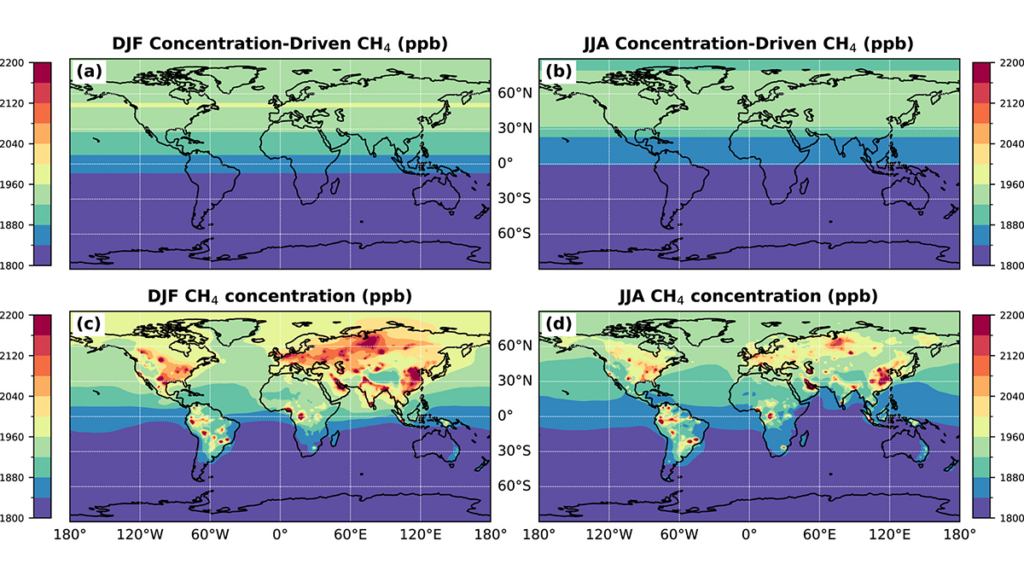
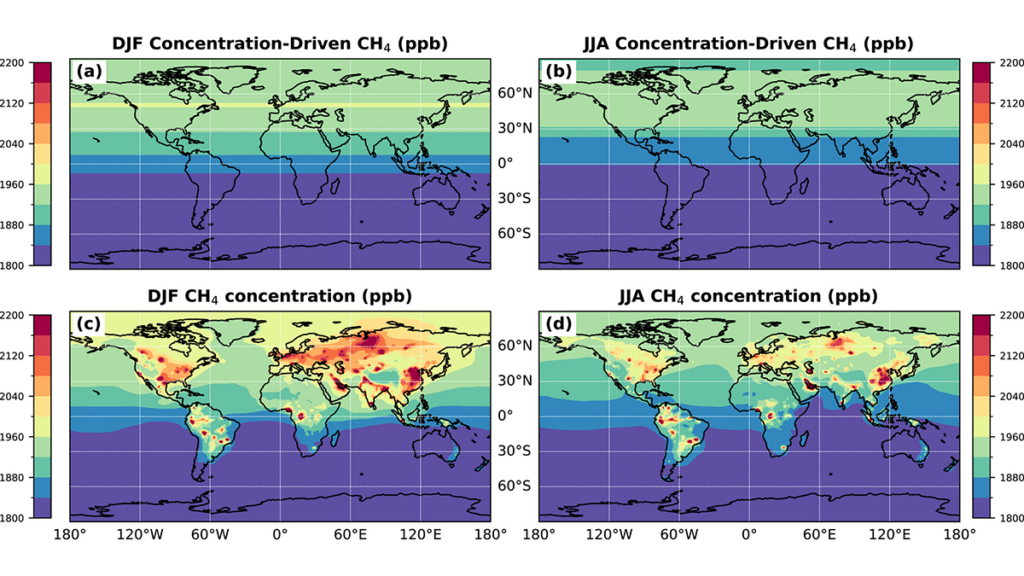
Methane is the second largest radiative forcing on climate after carbon dioxide with an atmospheric lifetime of about 9 years. The emissions of methane arise from a variety of sources, including wetlands, fires, agriculture, and industry. Most climate simulations set fixed concentrations of methane that vary by latitude (see top row of figure above), and do not explicitly account for variable emissions.
In contrast, Feng et al. [2026] perform novel simulations that: (1) account for emissions, chemistry, and transport leading to regional differences (bottom row of figure), and (2) track individual source regions to their global contributions. The authors find that emissions from Europe are initially up to 30% more effective at increasing surface concentrations than the global average. In other words, reducing a gram of methane in Europe is more effective at lowering global concentrations than a gram in North America or Asia. This is because Europe is situated at higher latitudes, and whose emissions tend to transport towards polar regions where atmospheric chemistry is slower and methane lives longer. Along with magnitude, the location of emissions also matters for understanding the global burden of methane.
Citation: Feng, C., Xu, Y., Mirrezaei, M. A., Buechler, R., & Gaubert, B. (2026). Distinct efficacy of regional methane emissions in affecting global and regional concentrations: An emission-driven CESM2 modeling study with methane tags. Journal of Geophysical Research: Atmospheres, 131, e2025JD045301. https://doi.org/10.1029/2025JD045301
—Brian McDonald, Associate Editor, Journal of Geophysical Research: Atmospheres
Text © 2026. The authors. CC BY-NC-ND 3.0
Except where otherwise noted, images are subject to copyright. Any reuse without express permission from the copyright owner is prohibited.