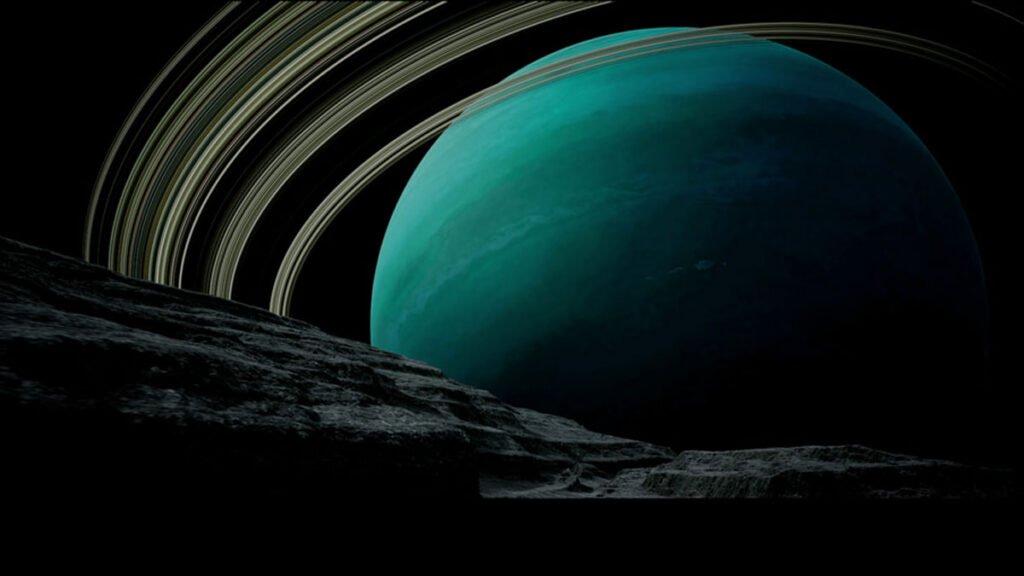
Source: Journal of Geophysical Research: Space Physics
Sending a spacecraft to the underexplored planet Uranus is at the top of many planetary scientists’ wish lists. But which spacecraft-mounted instruments would be the most useful for answering questions about the mysterious ice giant?
Several missions to other parts of the solar system have included an instrument that detects energetic neutral atoms (ENAs) zipping through space. An ENA is created when a fast-moving, positively charged ion collides with a neutral particle and “steals” an electron. The now-neutral atom maintains its high energy, and because it is no longer charged, it escapes any influence of a magnetic field and flies onward in a straight line—perhaps right into a spacecraft-mounted ENA detector.
By measuring the numbers, directions, and energies of ENAs produced in a magnetic system, scientists can create three-dimensional images that illuminate the structure and dynamics of that system. ENA imaging previously deepened understanding of the space environments surrounding Earth, Mars, Saturn, and the Sun and highlighted interaction mechanisms occurring at the edge of our solar system.
However, whether ENA imaging would be useful in future exploration of Uranus has been unclear. New simulations by Santos-Costa and André suggest that ENAs are, indeed, likely detectable at Uranus and that studying the ice giant with ENA imaging could return valuable insights into its complex magnetosphere.
The simulations incorporate realistic parameters drawn from what scientists already know about Uranus, such as its strangely offset magnetic field, clouds of neutral particles surrounding its icy moons and the planet itself, and the presence of protons trapped in the planet’s magnetic field. The researchers used the simulations to explore what scientists might have seen if an ENA detector similar to that mounted on the Saturn probe Cassini had been on board the spacecraft Voyager 2 during its brief flyby of Uranus in 1986.
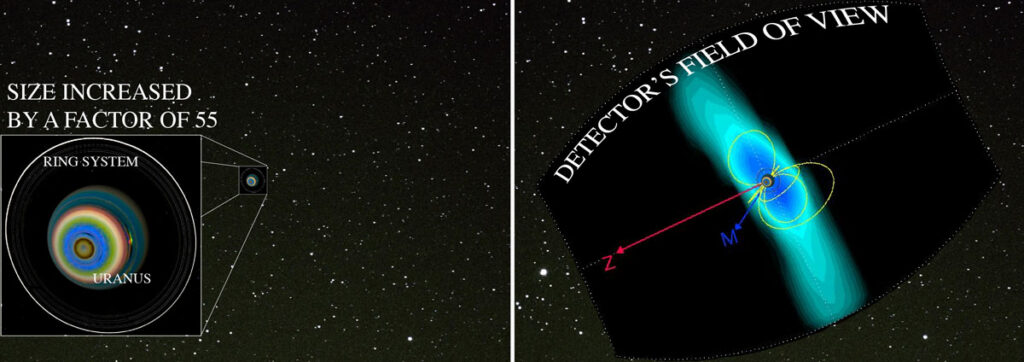
The results point to the strong probability that a “Voyager 2 ENA detector” would have observed ENAs created by collisions between protons and neutral particles that escape the atmosphere and populate a vast region of space—aiding understanding of Uranus’s magnetospheric system. Because the distribution of protons within Uranus’s magnetosphere is poorly understood, the researchers ran the simulations with a few different distribution scenarios. Even in their worst-case scenario, ENAs remained detectable.
ENAs could also result from collisions between protons and neutral particles surrounding Uranus’s moons, rather than the neutral environment originating from the planet itself, but the simulations did not conclusively show whether a Cassini-like detector might capture them.
The researchers conclude that their simulations make a compelling case for including ENA imaging in future exploration of Uranus. (Journal of Geophysical Research: Space Physics, https://doi.org/10.1029/2026JA035080, 2026)
—Sarah Stanley, Science Writer

Citation: Stanley, S. (2026), The speedy particles that could help us learn more about Uranus, Eos, 107, https://doi.org/10.1029/2026EO260196. Published on 18 June 2026.
Text © 2026. AGU. CC BY-NC-ND 3.0
Except where otherwise noted, images are subject to copyright. Any reuse without express permission from the copyright owner is prohibited.