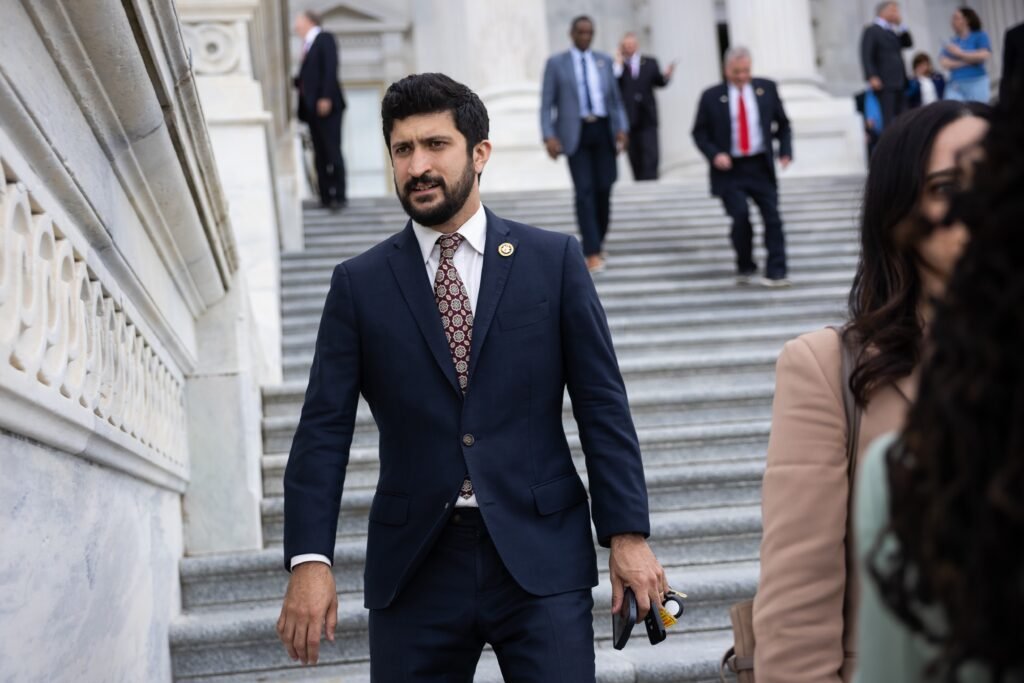
The chair of the Congressional Progressive Caucus says Democrats are “in the wilderness” when it comes to artificial intelligence — warning that members of his party are being cowed by special interests and must look beyond data centers for evidence of AI’s growing threats.
In an interview Friday, Texas Rep. Greg Casar laid out a proposal for Democrats to become “AI populists,” which he defined as “Democrats stand[ing] with working people who know in their gut that AI right now is just going to make a few billionaires into trillionaires while making millions of Americans poorer, less safe and less free.”
That means, for one thing, eschewing money from AI giants — something that might make some Democrats uncomfortable in a cycle that has been dominated by the rise of new pro-AI super PACs like Leading the Future, which just spent $8 million to defeat an industry critic in a New York City House primary.
“I know for a fact that there’s a lot of consultants telling their clients that you don’t want an AI super PAC to spend millions against you, so just don’t touch the issue at all,” Casar said. “We absolutely cannot let the AI money silence us.”
He wants to ban companies from using AI to set prices based on personal consumer data, establish guardrails for chatbots and require data centers to generate their own electricity. He’s also introducing legislation to tax tokens — the underlying unit of AI computing power — to slow down the industry’s growth.
“I think those sorts of proposals are what working people are looking for from Democrats,” he said. “They want to know that we have a plan to stop their lives from getting significantly worse through unregulated AI development.”
Casar’s platform is dramatically more extensive than that of House Democratic leaders, who are choosing to promote a more narrow AI message ahead of the midterms that centers on shielding people from the cost of data centers and preventing President Donald Trump’s administration from writing the AI rulebook for the entire country.
His message is also far more detailed than that of Minority Leader Hakeem Jeffries, who has said little publicly beyond wanting to protect the “American ratepayer” from the explosion of data centers.
“A new Stanford study finding that young workers in AI-exposed careers are already having trouble finding jobs; mass layoffs at Oracle, which is based in my district in Austin … as those impacts start to be felt more and more across the country, I think the uprising against data centers may wind up looking small compared to the uprising against all of the impacts of unregulated artificial intelligence,” Casar said.
He’s also growing impatient as the three-member commission that Jeffries convened to develop a consensus Democratic AI framework does not expect to introduce any legislation until the end of the year — once the House majority has likely already been settled.
“I don’t think that, on AI issues, we should be a party like where we are right now on cryptocurrency, where it’s just not really clear where the Democratic Party stands,” Casar said. “We cannot afford for the public to be confused about which of the parties is for them versus the AI companies.”
Casar is calling for an attention-grabbing approach. Last month, for instance, he staged a news conference in front of Oracle headquarters to condemn the company for AI-related layoffs. It’s similar to the high-profile tour of a Meta data construction site in Georgia convened by Rep. Alexandria Ocasio-Cortez (D-N.Y) back in May.
But he is not in full lockstep with Ocasio-Cortez and other progressive standard-bearers. For example, he wouldn’t endorse the 10-year moratorium on data center construction proposed by Ocasio-Cortez and Sen. Bernie Sanders (I-Vt.).
“I generally align with the point that we shouldn’t build data centers that are going to make our lives worse, and that we need to put the rules in place first while I look at the specifics of the bill,” said Casar.
Casar is not the only Democrat with a sense of urgency about AI. Rep. Lori Trahan (D-Mass.) teamed up with Rep. Jay Obernolte (R-Calif.) to develop a bipartisan proposal that lays out broad transparency and safety rules for tech companies and, controversially, would preempt state laws on AI development for three years.
The actual legislative text is still in the works as Trahan and Obernolte absorb feedback from their colleagues — much of which has been negative.
While Casar said he respects Trahan’s attempt to broker a deal, the framework falls short of creating the sort of “major federal safety protections” he’s demanding — on par with the Nuclear Regulatory Commission, an agency with a nearly-billion-dollar annual budget that conducts about 900 annual inspections.
Casar said those sort of safety measures would be a prerequisite for any bipartisan accord to allow the federal government to preempt state AI safety laws: “If we could get true AI safety legislation across the finish line, we should be willing to compromise and work together.”
In the absence of actual legislation to run on ahead of the midterms, Casar said Democrats need to fill in the blanks for voters by vowing an AI-regulatory blitz next Congress — even if it draws more pro-AI spending that endangers their party’s ability to counter Trump in a potential House Democratic majority.
“Of course, fighting back against Trump is important,” Casar said. “But I think when we look back at 15 or 20 years, the most important thing that happened in 2026 may be AI development, not whatever crazy thing Trump just did today. … We can’t let the threat that Trump poses overwhelm our ability to organize on AI.”