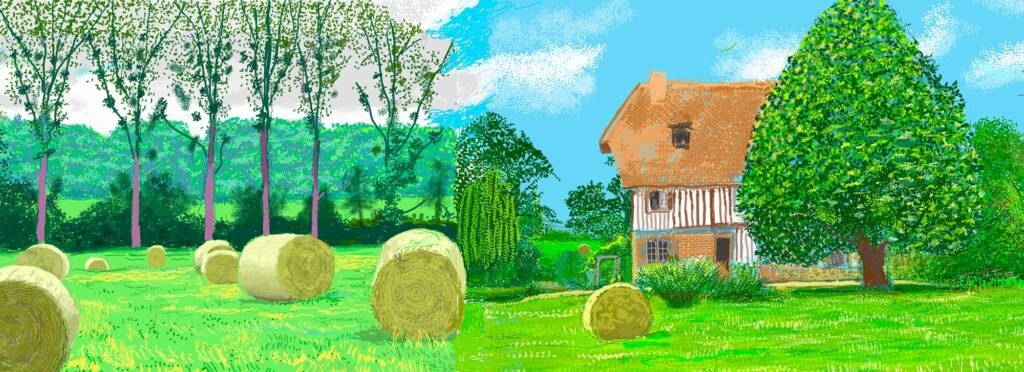
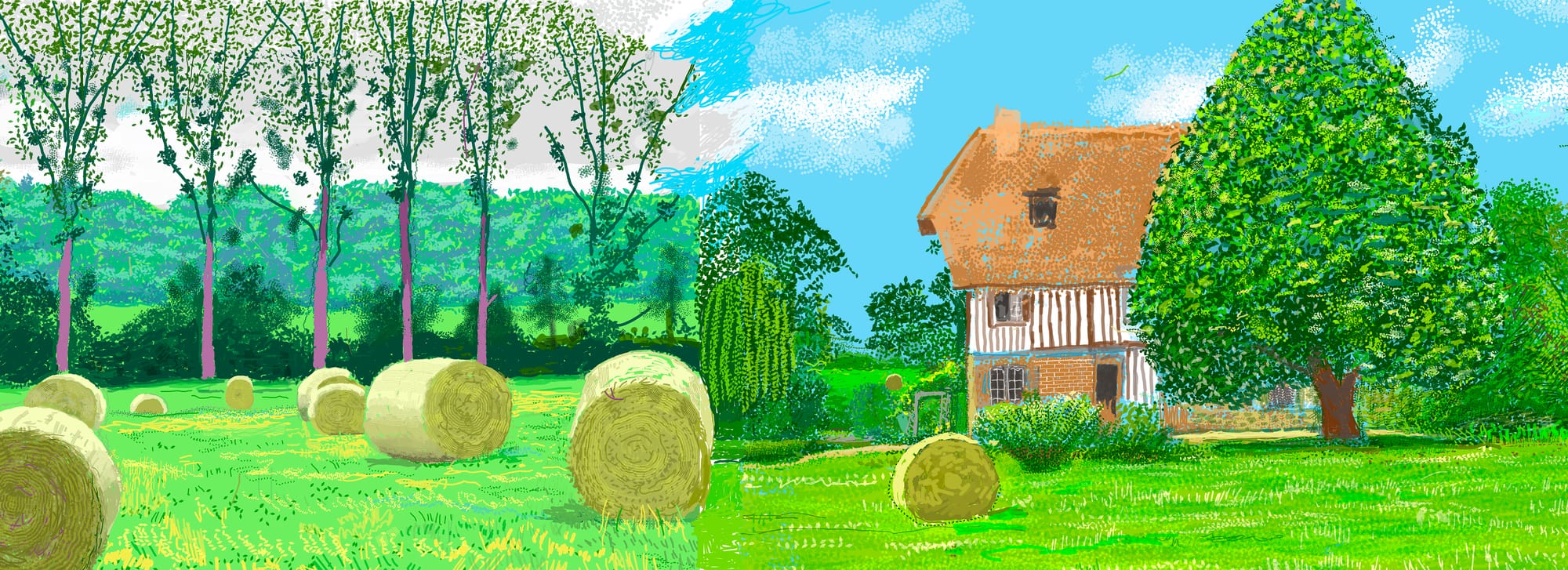
LONDON — The Bayeux Tapestry, an 11th-century, 230-foot (~70-meter) linen that illustrates the story of the Norman conquest, has just returned to England after nearly a millennium for a forthcoming exhibition at the British Museum. Was David Hockney taking the piss out of this event by presenting an even longer 295-foot (~90-meter) composite iPad “painting,” titled “A Year in Normandie” (2020–21), at Serpentine Galleries in March?
Hockney, who died last month at age 88, argued against the Bayeux Tapestry’s loan from the French government due to the risk to the object, a concern expressed by numerous historians and scholars. Yet his Serpentine show, entitled A Year in Normandie and Some Other Thoughts About Painting, cites Hockney’s “endless invention” through more than 100 printed iPad paintings digitally “stitched” together. Encircling the gallery interior, this work is meant to “encourage movement and close looking,” as the opening wall text states. Furthermore, the exhibition purports to highlight how Hockney’s work “fuses digital tools with ancient traditions,” inspired by 14th-century Chinese scroll paintings and, yes, the Bayeux Tapestry itself.
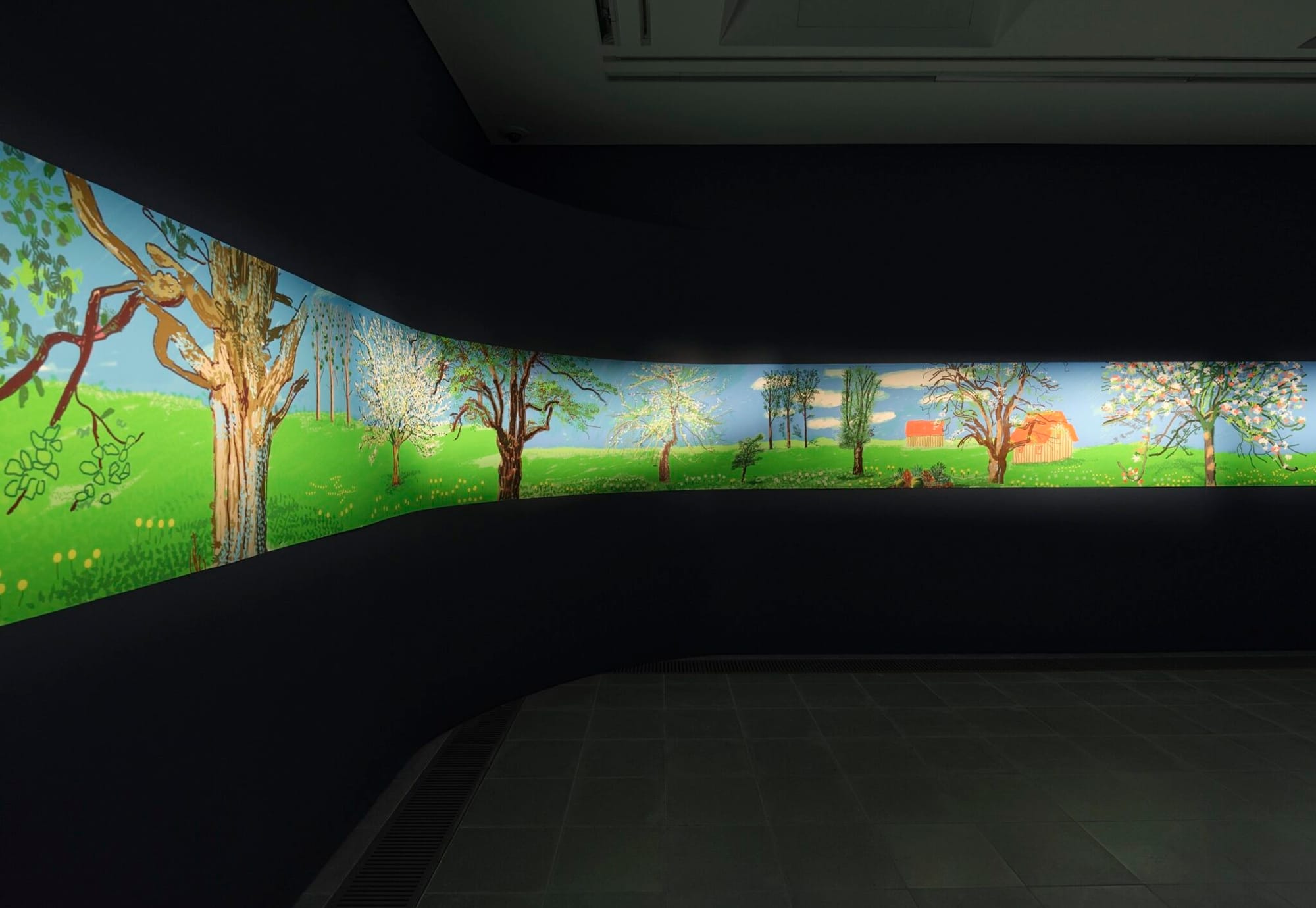
No amount of such curatorial reverse-engineering, or insistence that the iPad creations were made en plein air through the changing seasons, counters the sense that these digital doodles represent the very antithesis of the traditional methods and inspirations they are supposedly honoring. Certainly, iPads are a useful tool for artists to sketch and design preparatory work rapidly and mess-free. Using a stylus to magically sweep color onto a screen feels as satisfying as drawing on a banana with a ballpoint pen. Over the course of his decades-long career, Hockney consistently encouraged audiences to look closely at the world around us; tote bags and eyeglass cases in the gallery gift shop bear the artist’s rather domineering slogan, “look with both eyes.” This sentiment goes back to the basics of learning to make and appreciate art, which also includes mark-making: how to physically put implement to surface.
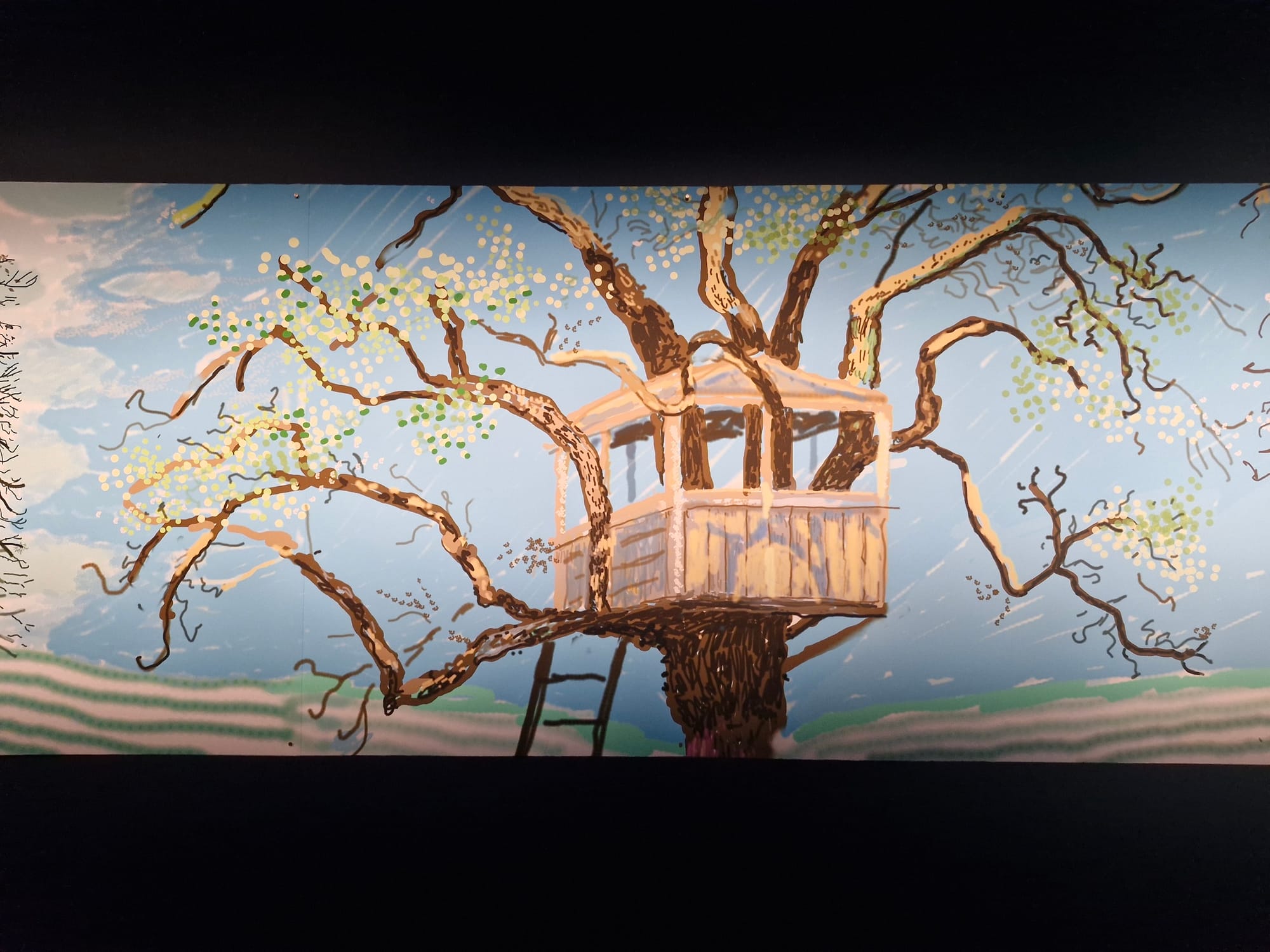
The iPad, however, is a fascistic form of mark-making. Tablet “painting” is dictated by software designed by a corporation. Its “marks” are strictly delineated, as is its palette. Whether by design or accident, the perspectival differences between Hockney’s stitched-together vistas are explained away by the wall text as “prompting viewers to shift their point of view,” but nonetheless remain visually flat. Flowers are reduced to unidentifiable, uniform yellow circles, though it must have been satisfying to tap out “blob, blob, blob” with each touch of the stylus. Here, Hockney’s naturally gifted draughtsmanship is hindered by his digital brush and palette.
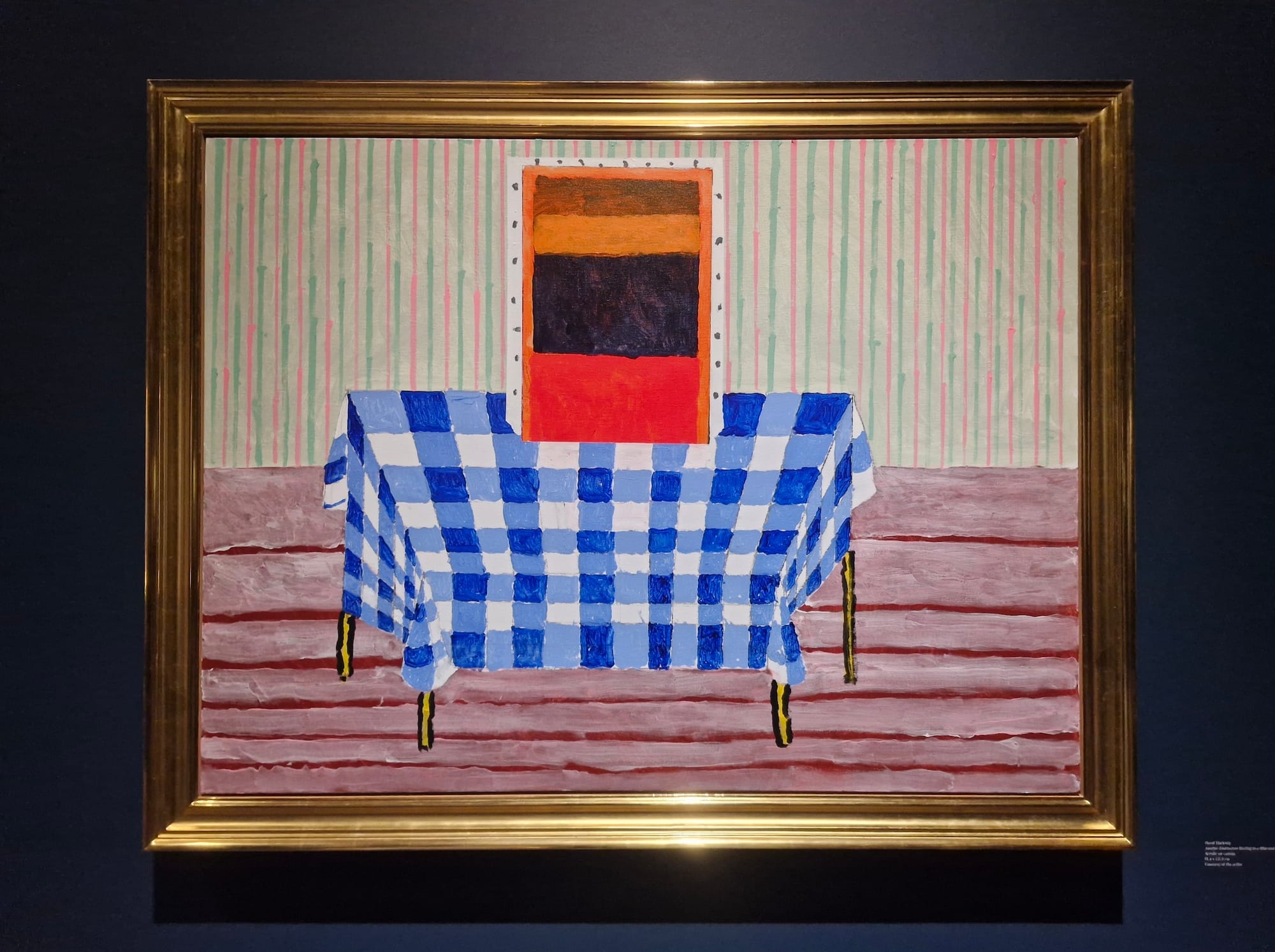
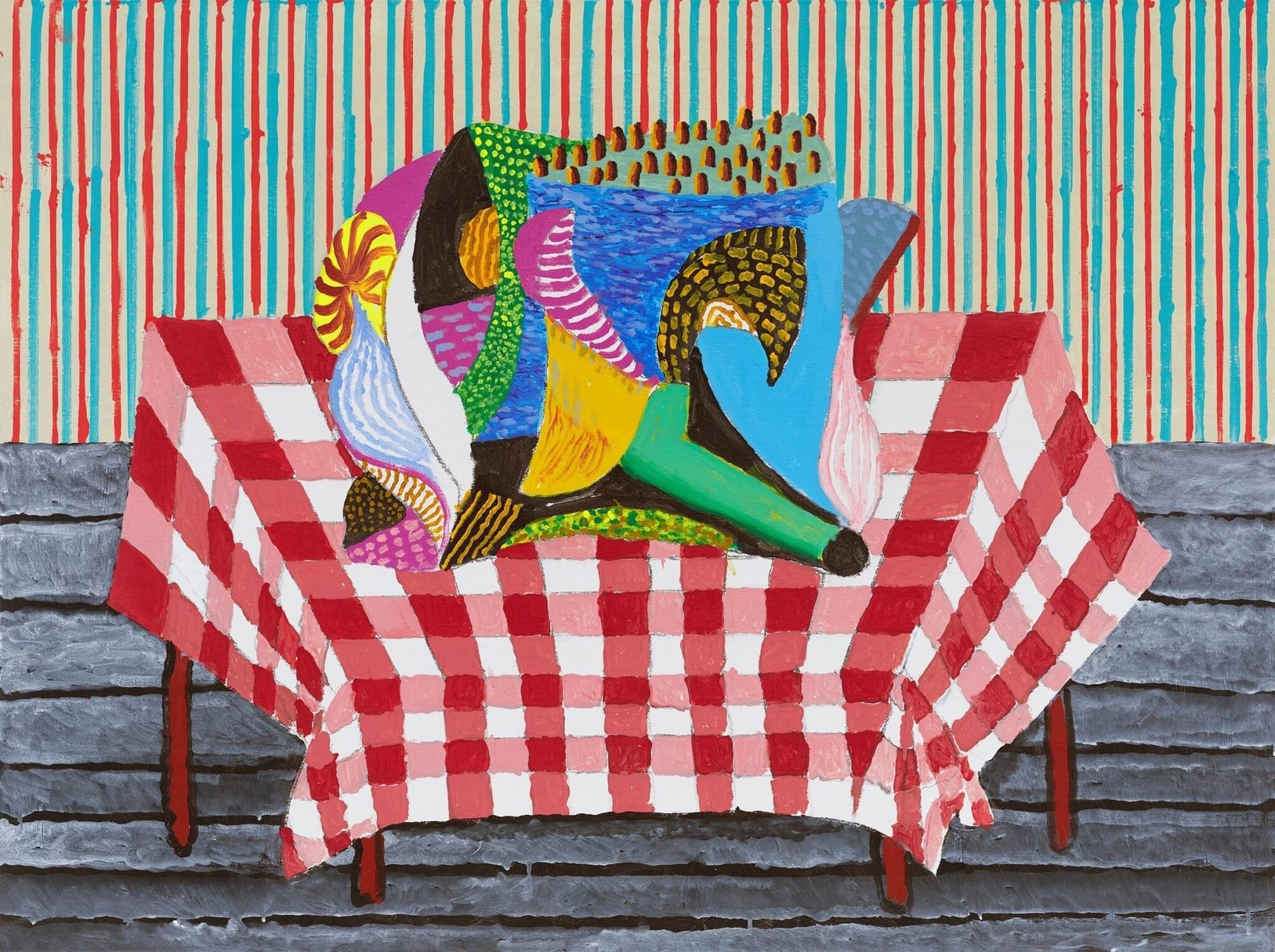
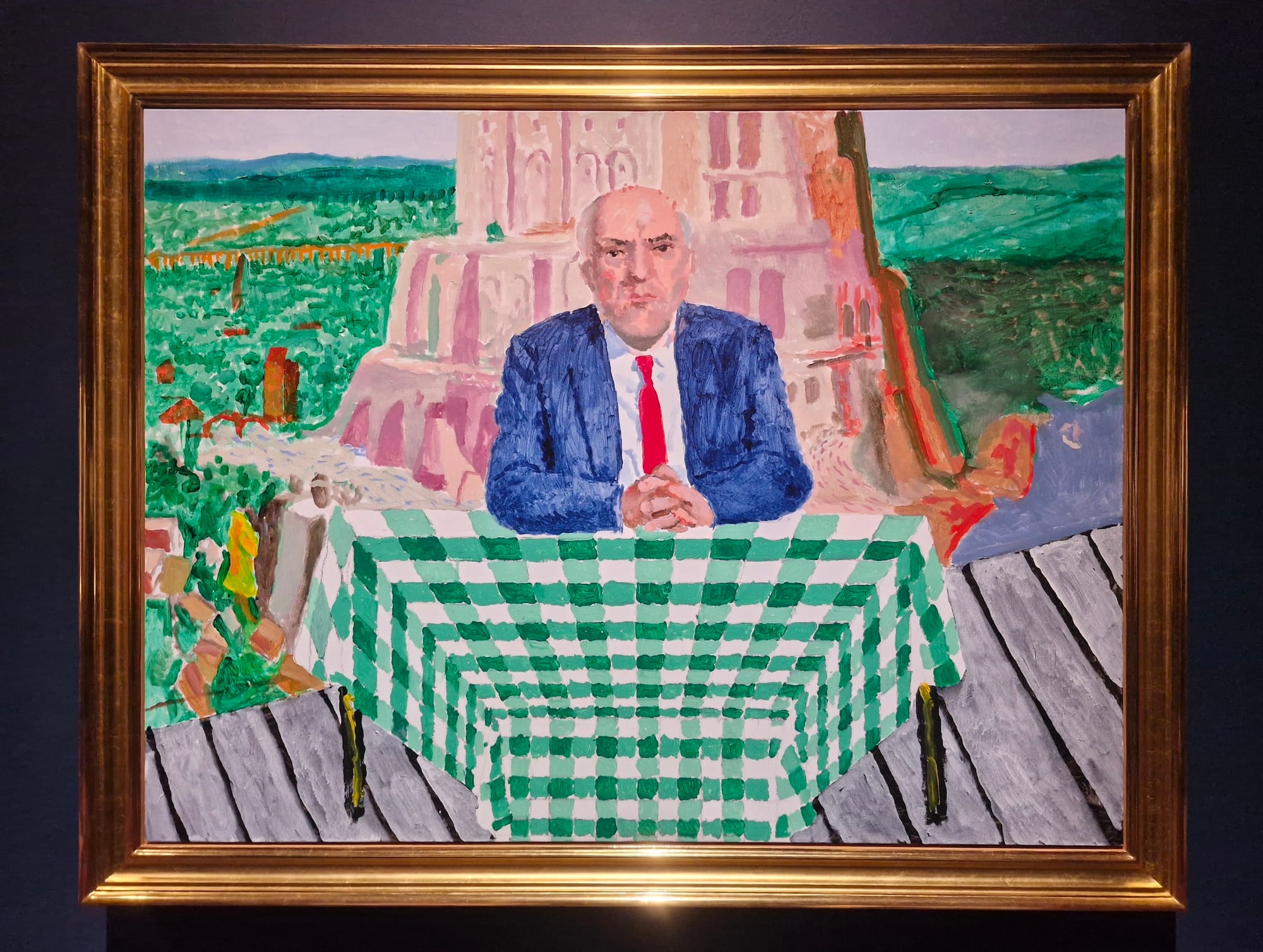
Having endured the changing seasons, we eventually reach an inner sanctum displaying a selection of physical paintings completed for the show in late 2025. Though done in acrylic, the immediacy of light bouncing off the paint’s plasticity sings in comparison to the inkjet-printed iPad piece, which requires an intense spotlight, low ambient light, and darkly colored walls to make any kind of emotional impact.
We get glimpses of the ample capability Hockney demonstrated in his career, brush in hand, and his searching sense for upending representational norms informed by both his own work and that of his peers. Each painting includes a gingham-laid table reversed perspectivally, a little like the constructs of British artist Patrick Hughes, presumably from scenes immediately in and around his Normandy house. Some have sitters, including family and friends. One inexplicably sits in front of a rendering of the Tower of Babel. Other gingham tables bear no sitter, but have atop their surface a reversed canvas, abstract compositions, and even an unmistakable version of an “Abstraktes Bild” by Gerhard Richter. In the latter, Hockney employs Richter’s paint-and-drag technique, something unseen in his previous work; it is these experiments in abstraction that demonstrate real inventiveness, certainly more than his iPad use.
Hockney passed away a couple of months after his digital Normandy version of the Bayeux Tapestry opened, prompting an outpouring of gratitude and respect for a glitteringly prolific and inventive artistic life. This review, however, considers the exhibition presented at its end; should we begrudge Hockney’s use of an iPad if it enabled him to continue creating so prodigiously in his twilight years? With a long-planned major Hockney retrospective set to open next year at Tate Britain, there has been a macabre sense of the art world latterly wringing as much from the man as possible. We can admire his outstanding contribution to art in the 20th century, but it does him a disservice to position the iPad as a portal to a brave new world of dazzling invention.
David Hockney: A Year in Normandie and Some Other Thoughts About Painting continues at Serpentine North Gallery (West Carriage Drive, Hyde Park, London, England) through August 23. The exhibition was organized by Hans Ulrich Obrist, Claude Adjil, and Liz Stumpf.