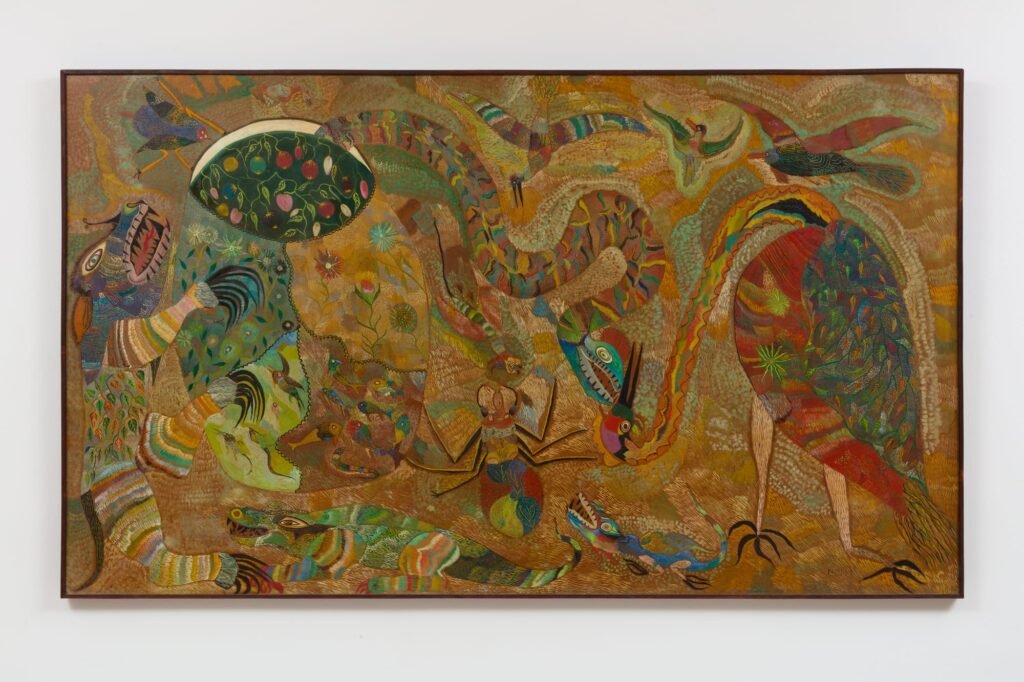
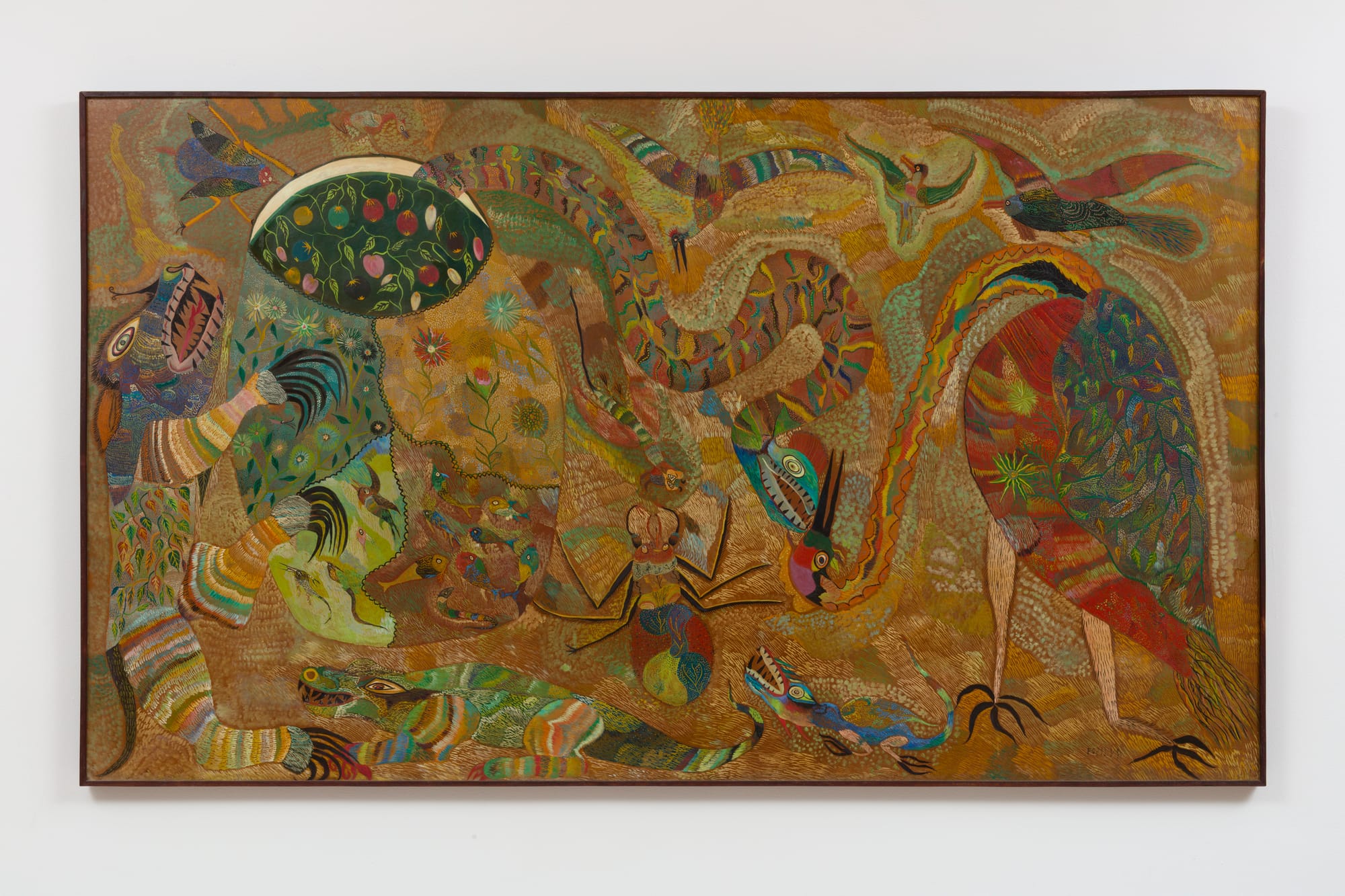
The rise and fall of Chico da Silva in the global art world is a cautionary tale. He was born in 1910 in the Amazon Rainforest, the son of an Indigenous Peruvian fisherman and a Brazilian woman from Ceará, along the Atlantic Ocean. After his father died from a snakebite, she brought her son to Fortaleza, the capital of the state of Ceará, settling in the impoverished neighborhood of Pirambu. In the 1940s, da Silva, who never learned to read or write, and whose parents’ names remain unknown, began to become locally known for drawing mystical, Amazon-inspired murals with black charcoal, chalk, and natural pigments on the exteriors of fishermen’s houses. This situation changed in 1943 when Jean-Pierre Chabloz, a Swiss critic and artist who had moved to Brazil because of World War II, went to Fortaleza on business and saw da Silva’s murals. Soon after, Chabloz began supplying da Silva with art materials, such as gouache, tempera, and canvas, effectively changing him into a European’s idea of an artist.
Here, the story follows a familiar but distressing path. Chabloz successfully introduced da Silva’s art to the rest of Brazil. Eventually, this led to da Silva receiving an honorable mention in the Brazilian pavilion presentation at the 1966 Venice Biennale. In these works, da Silva found a way to transfer his visionary world of spellbound animals, fantastic flora and fauna, magical line and pattern onto canvas and paper with gouache and tempera. However, instead of completing the transformation and becoming an artist (or “inspired genius”) in Western eyes, he remained true to his roots and started the Pirambu School, an informal artist workshop in the community that had sustained him. He taught neighbors how to paint in his style and signed the works as his own, infuriating Chabloz, who judged the work done in the workshop as “fake,” ending the art world’s interest in da Silva. Less than two decades later, he died destitute and forgotten.
Simon Watson, director of an eponymous New York gallery from 1979 to 1991, has been involved with Brazilian art since 1994, when he organized the sculptor Tunga’s first solo exhibition in the United States in association with Marc Pottier. He curated Riverlines: Chico da Silva, Joseca Yanomami, and Kuenan Mayu, Three Generations of Amazonian Indigenous Artists at David Nolan Gallery, which reintroduces as well as contextualizes da Silva’s art. By presenting da Silva with two Amazonian artists of different generations, the exhibition undermines the oppressive Western notion of the artist as an isolated genius. Indeed, Chabloz — who saw himself as da Silva’s savior — described him as a “sympathetic nomadic, gloriously primitive, divinely illiterate and, above all, a wonderful artist who, until then, lacked nothing but a favorable opportunity to reveal his extraordinary gifts.”
By juxtaposing da Silva’s work with artists from different tribes and histories who share a locale (the Amazon River), the exhibition aligns itself with Martinican writer Édouard Glissant, who once stated: “Decolonization will have done its real work when it goes beyond this limit” — the limit being the binary of universal vs. local, settled vs. nomadic, and civilized vs. primitive. Recognizing the flattening power of capitalism and the hierarchical orders and binaries rampant throughout Western thinking, Glissant countered its categorical judgments by emphasizing the local.
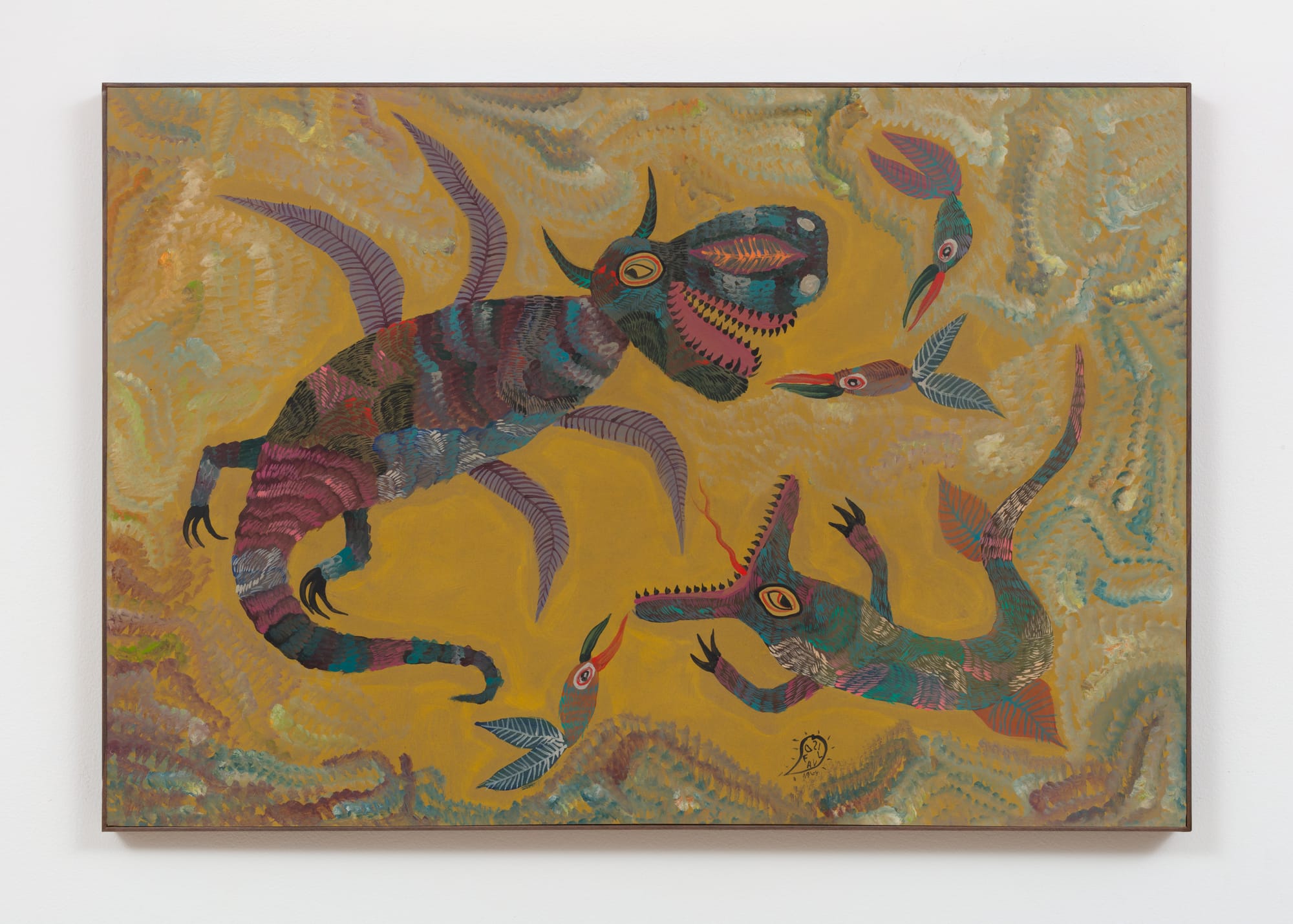
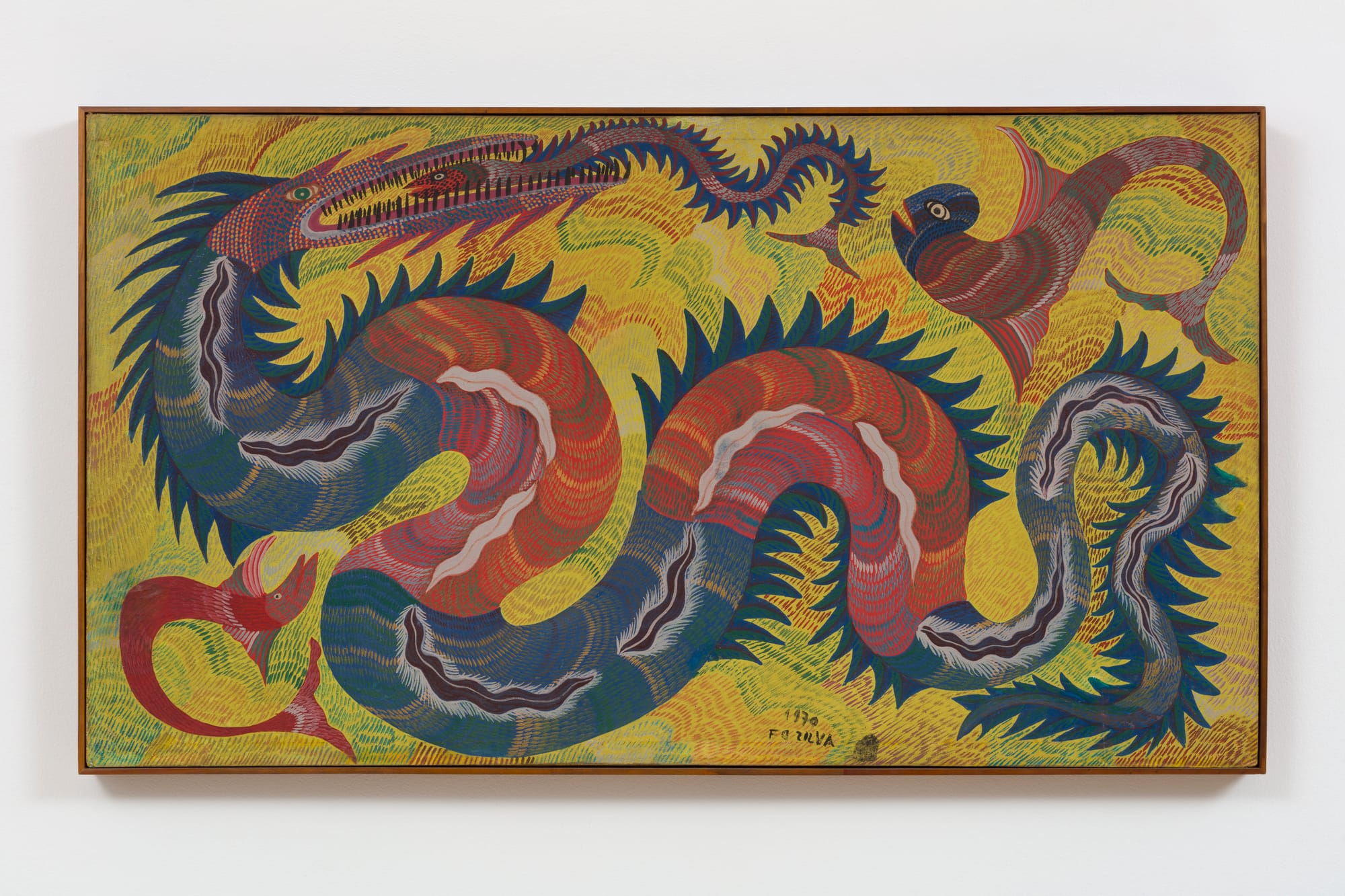
There are more than 50 works in the exhibition, almost evenly divided among the three artists. Each is given one of the three spaces that make up this Upper East Side gallery. Da Silva’s works, dated between 1964 and ’82 (he passed away in 1985), conjure a tumultuous world of fantastic animals living in rivers, mountains and trees.
One of the included works is “Serpente da serra luminosa” (Luminous Mountain Serpent) (c. 1966), which was first shown in the 1966 Venice Biennale. Da Silva’s animals have large, sharp fangs. Different patterns are used to define bodily areas such as the head, body, wings, talons, gills, and fins, while the eyes imbue the creatures with life, conveying both their identity and their ability to fit into the surrounding landscape. The colorful, turbulent world he evokes is populated by creatures fighting to survive.
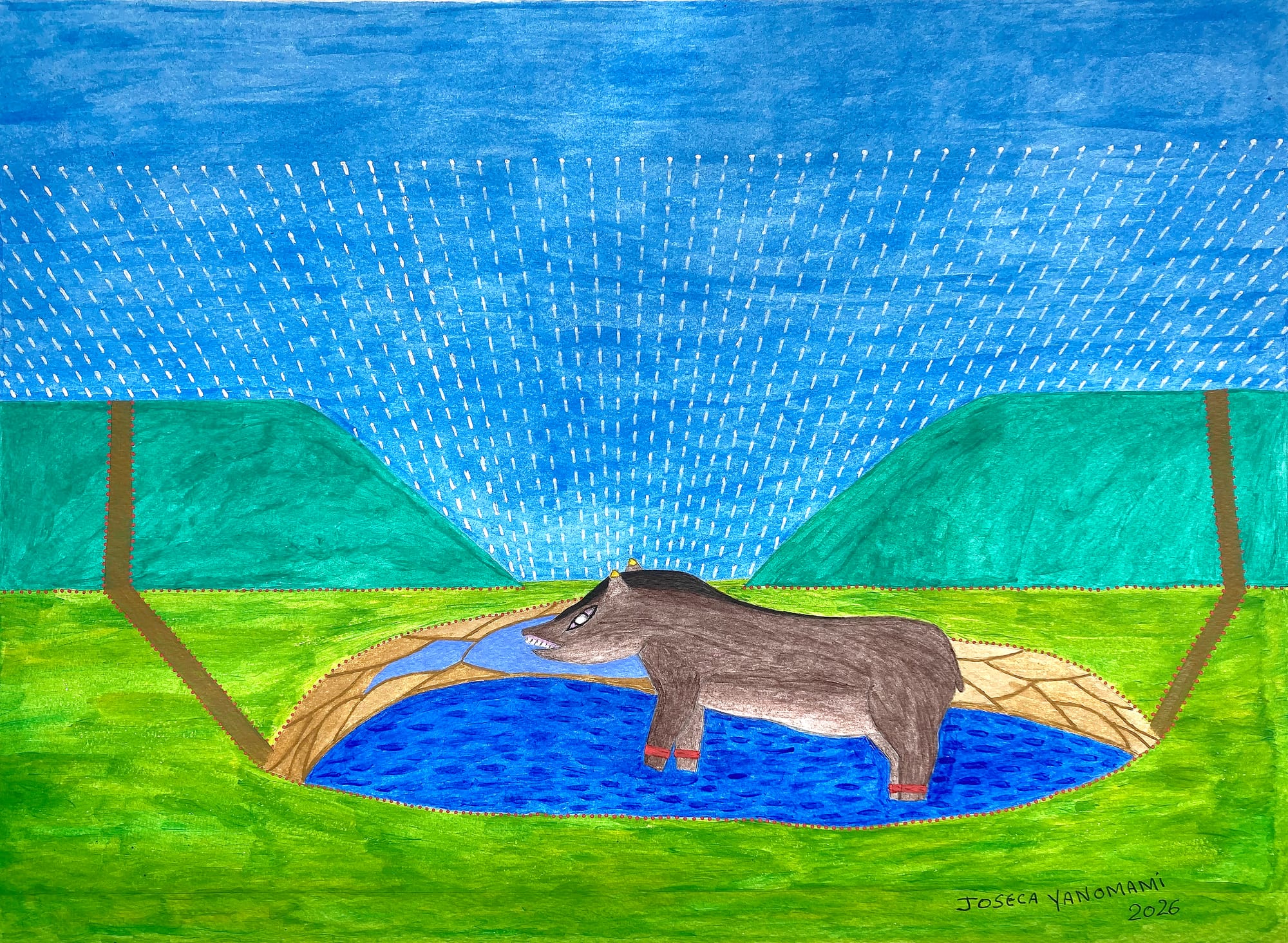
Working in graphite, colored pencil, ballpoint pen, and marker on paper and acrylic on canvas, Joseca Yanomami, born in 1971 to Yanomami shamans, depicts a world in which animals, objects, and people are animated by invisible spirits, endowing them with power. His mixture of representation and repeated lines, recognizable details and inexplicable forms, conveys an otherworldly place. “Xamariwë, The Spirit of the Tapir” (2026) shows the herbivorous mammal cooling off in an almond-shaped pond in a verdant field. Two emerald-green, flat-topped mountains with slanting sides face each other on the horizon about a third of the way up the painting. Two identical brown paths edged by red dots lead down from the mountaintop to the vertices of the almond. Short white lines rise in the space between the mountains and fan out in the blue sky without reaching the top. The world is radiant, peaceful, and mysterious. The tapir inhabits a symmetry that suggests a cosmic balance.
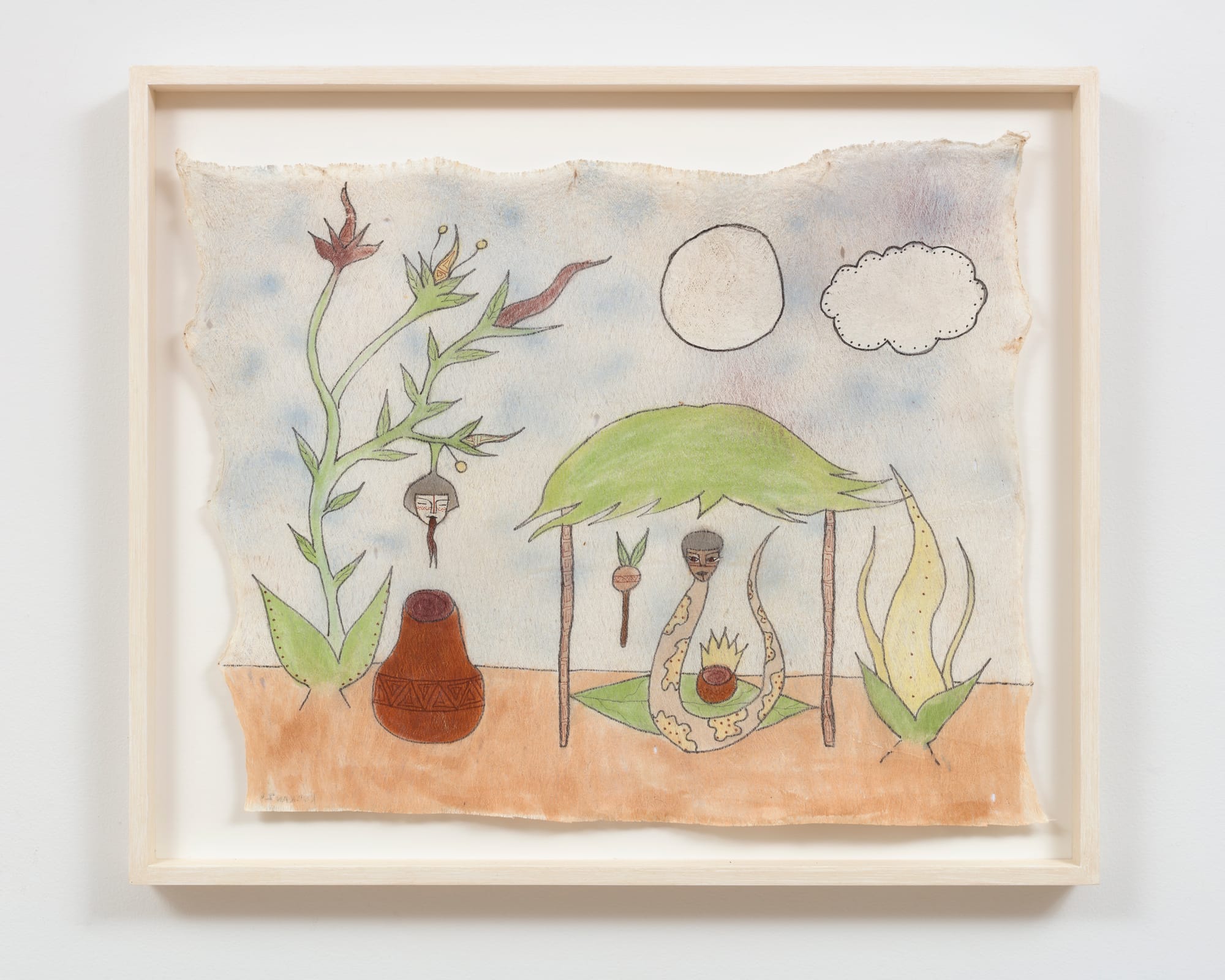
The youngest of these artists, Kuenan Mayu, who was born in 2003, holds her own in this exhibition. A member of the Magüta (Tikuna), Tariana, and Tukano peoples of the Amazon, she works with natural pigments, such as turmeric, white clay, cumate, brazilwood, and tururi bark, which is considered sacred. The animistic world she depicts is as complete and singular as those conjured by da Silva and Yanomami. Working in a palette of earth colors, Mayu depicts a porous world where humans and spirits intermingle. In “Antapé Pataün (Snake Home) — From the Enchantment Series (2026), a snake with a human head sits on a leaf under a leaf canopy. Behind him is a bowl with crown-like flames. To his left is a tree with a woman’s head hanging from a branch. Her long snake-like tongue connects her to the male snake, though we are not sure how. Beneath her stands a large earthenware pot incised with an abstract pattern circling its girth.
The world we see is not mine, and likely not yours, and it does not invite us into it. But in a world where the possibility of co-existence is under threat, there is so much we can learn from recognizing that not everything is ours — that the best thing we can do is to protect these gifts and their makers.
Riverlines: Chico da Silva, Joseca Yanomami, and Kuenan Mayu continues at David Nolan Gallery (24 East 81st Street 4th floor, Upper East Side, Manhattan) through July 31. The exhibition was curated by Simon Watson.