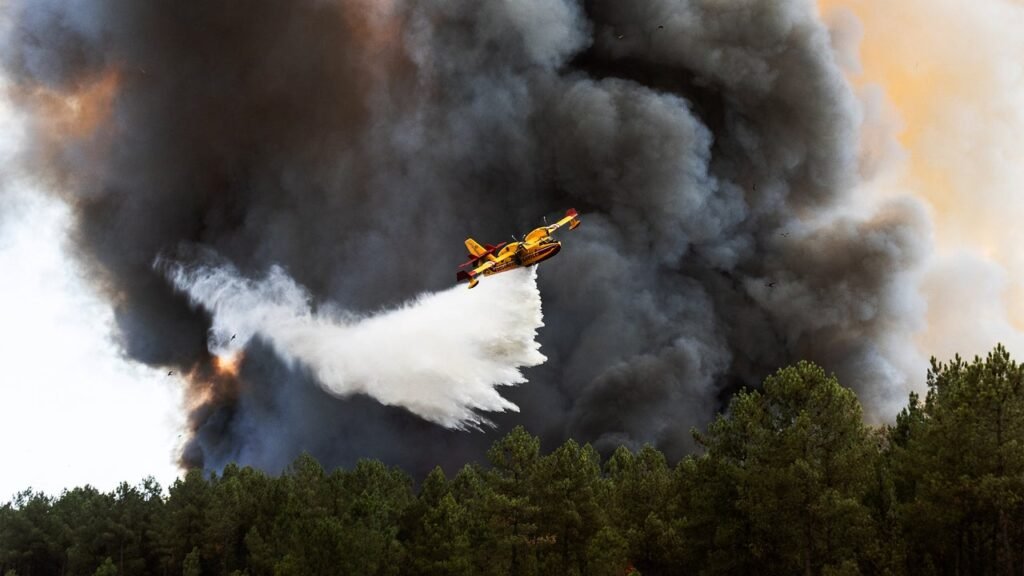
As record-breaking wildfires burned through France this week, they neared a hub of aerospace and defense industry sites, threatening plants that house rocket fuel and missiles.
This is far from the first time climate change has threatened defense infrastructure. In Greece, wildfires reached an ammunition depot in 2023, setting off a series of explosions. In the U.S., climate impacts including flooding, wildfire, drought, and extreme winds have already affected half of the military’s more than 3,500 sites worldwide. A naval shipyard in Norfolk, Virginia, experienced nine major floods over a 10-year span. California bases have been evacuated because of wildfires, and a missile-tracking site in the Pacific could become uninhabitable and unusable by 2035.
All of these examples illustrate the alarming way in which our warming planet can collide with the defense industry. Those risks make climate change a national security issue, experts say, and underscore the need for militaries and defense departments to prepare for a hotter, more volatile world.
CAL FIRE assisting Beale Air Force Base with a vegetation fire. 40 to 50 acres of vegetation near base housing. The fire is currently 20% contained. pic.twitter.com/O2COf1WPQr
— CAL FIRE Nevada-Yuba-Placer Unit (@CALFIRENEU) October 12, 2021
A double whammy of safety concerns
Wildfires threatening defense industry sites present a “double whammy” of safety concerns, says Sherri Goodman, secretary general of the International Military Council on Climate and Security, and former U.S. Deputy Undersecretary of Defense for Environmental Security during the Clinton administration.
“You have the fire threat that’s affecting the entire region, and now you’ve got the added peril of toxic and hazardous chemicals that are part of rocket propellant and other defense and missile activity in that region also at risk,” she says. Those sites have likely prepared for such a threat in their planning assumptions, creating firebreaks around facilities by removing flammable vegetation and forming evacuation plans.
Europe has seen multiple record-breaking heatwaves back to back, which helped fuel the fires. In southwest France alone, some 42,000 hectares have burned since early July, making it the region’s largest wildfire since World War II. Of Europe’s 15 largest fires in the past decade, three have occurred this month.
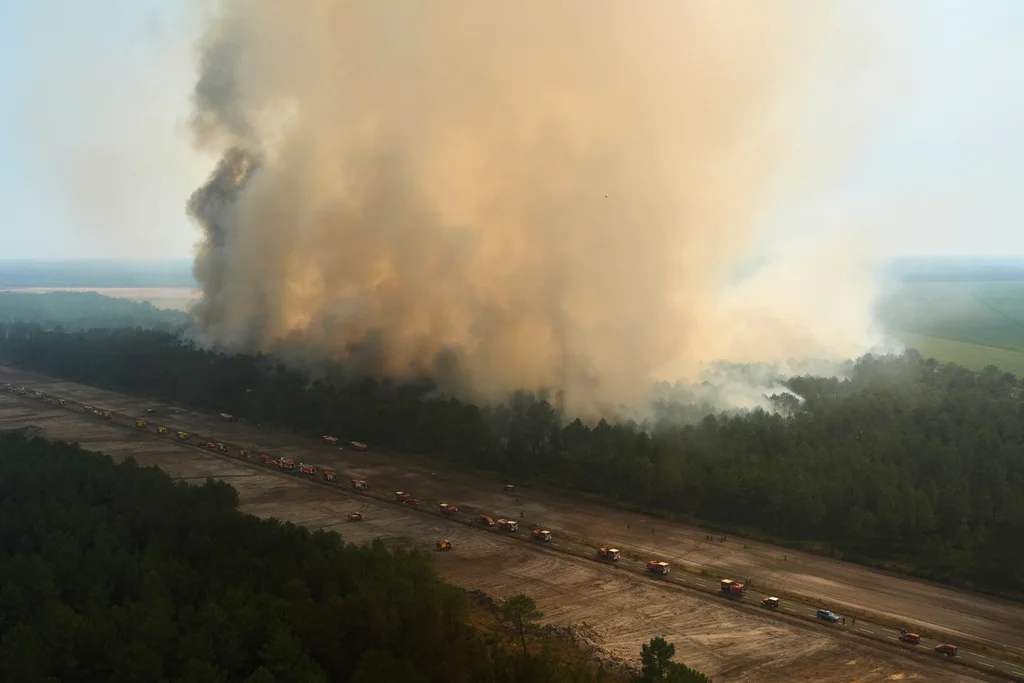
Existing safety plans may not account for such severe conditions. “Humans are always fighting the last fire,” Goodman says. “We’re not necessarily fighting or prepared to fight the bigger fire that’s now in front of us.”
Some military facilities have begun adapting, though those measures may not be sufficient for the conditions ahead. In the U.S., naval bases have had to raise their piers and reinforce infrastructure against flooding caused by sea level rise, while runways at Air Force bases remain vulnerable to rising waters.
Elsewhere, the pressures are different. In the Southwest, prolonged droughts mean military bases have to increasingly compete with local communities for water. Troops in the Pacific, meanwhile, face the threat of more intense hurricanes and typhoons, as well as the dangers of extreme heat.
The need to name climate change as a threat
These growing risks are shaping decisions about where defense infrastructure can safely remain, and where new facilities should be built. In the U.S., however, some of that planning relies on outdated data, says Erin Sikorsky, director of the Center for Climate and Security, a research institute focused on the security implications of climate change.
“They’re looking 10, 20 years ago at weather patterns, at the frequency of extreme weather events … and that’s what they’re making their building decisions on,” she says. “Whereas in a climate change world, you need to look to the future.”
The NATO alliance has recognized that need, she adds, but there are often still issues around implementation. Looking at future risks means considering what protections a facility has, who there is trained to respond to climate impacts, how munitions rated for a certain temperature are stored, and if there’s the ability to keep that temperature consistent.
This means militaries need to specifically name climate change as a threat. The Trump administration has rolled back such efforts, cutting climate research funding and adaptation plans. “The Defense Department is not in the business of climate change,” U.S. Secretary of Defense Pete Hegseth said in 2025.
“They’ve made [climate change] like a four-letter word. They want to hide from it,” says International Military Council on Climate and Security’s Goodman. “But you can’t hide from climate risk.”
There may be ongoing efforts in the Defense Department under different names, Sikorsky notes, like “extreme weather” or “resilience,” and some research, like on how extreme heat affects troops, seems to be continuing. “But certainly the political rhetoric has a chilling effect, and you’re not as focused on it,” Sikorsky adds. “Turning a blind eye doesn’t make you safer.”
Climate change as ‘threat multiplier’
Militaries are indeed considering the climate when it comes to their infrastructure—and beyond that, they’re finally recognizing climate change as a threat multiplier, a term Goodman used for the title of her 2024 book about how climate change is “the biggest security risk in global history.”
An extreme weather event like a wildfire also makes any cybersecurity threats or attacks on electrical grids more threatening. They’re also a chance for countries to disseminate disinformation (as Russia did, for example, after hurricanes Helene and Milton).
“Climate acts as an additional amplification of other threats we already face,” Goodman says, “from terrorism to strategic competition with China, Russia, or Iran, to prolonged humanitarian emergencies as a result of increasing food and water insecurity in drought- and heat-stressed parts of the world.”
In other words, investing in climate prevention and response benefits national security at large. “It’s not, either we deal with climate threats or we deal with threats from bad actors,” Sikorsky says. “It’s that by dealing with climate threats, we will be more prepared and more capable, and have more bandwidth to then deal with other threats.”
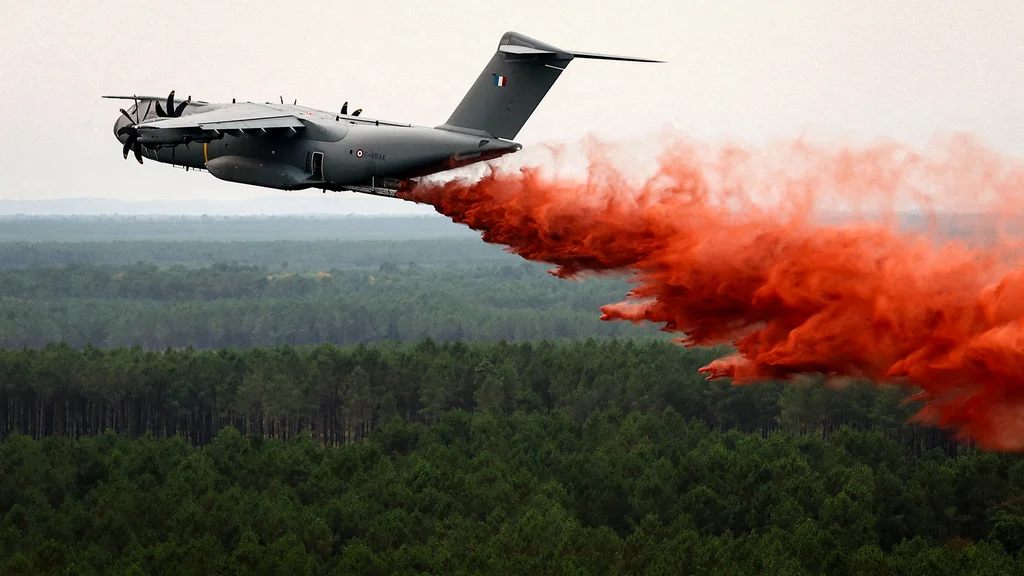
The defense industry could also help everyone, even civilians, prepare for and respond to climate change. France has fitted military planes with tanks for water or fire retardant to help fight wildfires. There’s a unit within the Spanish Armed Forces, for example, solely focused on disaster relief. The National Geospatial-Intelligence Agency, part of the U.S. Department of Defense, has shared satellite data to help communities track and respond to wildfires.
“To me, that is all security, but it’s not traditionally how we’ve thought about security in the U.S.,” Sikorsky says.
Previously, Sikorsky worked on counterterrorism efforts, and she makes a comparison between that and climate change to stress its security implications: “When you look at the number of people that have died from terrorist attacks in the past year globally, it pales in comparison to the number of people that died in Europe this summer due to the heat waves,” she says. Already, Europe has seen more than 10,000 excess deaths from heat this summer.
“Recalibrating our idea of what security threats are and where we spend our time and attention,” she says, “is really important in the face of these climate threats.”