The sky fades into a pink sunset as Lido Pimienta, the Grammy-nominated Colombian Canadian singer-songwriter, belts over the sweeping accompaniment of the Hamilton Philharmonic Orchestra. The air feels lighter now that the rain has stopped just in time for the annual Concert in the Garden. At the Royal Botanical Gardens (RBG) in Burlington, Ontario, about an hour west of Toronto, the musical is expansive, the gardens lush, and just beyond the audience, Ken Kelleher’s newly installed Anchorball: A Curious Art Journey is on view.
Photography courtesy of Royal Botanical Gardens
Alongside its responsibilities in horticulture, conservation, and research, RBG has increasingly embraced its role as an institution that brings people together through art, music, and shared public experiences. As Zahra Noorani, RBG director of business development, explains, these streams don’t always need to overlap—even though in this case, they do. “Sometimes they intersect, and sometimes they simply coexist,” she says.

Photography courtesy of Royal Botanical Gardens
Officially established in 1941, the garden traces its origins to conservation efforts in the western end of Lake Ontario in the late 1920s. Today, the organization encompasses more than 2,400 acres of nature sanctuaries and cultivated gardens, making it Canada’s largest botanical garden.

Photography courtesy of Royal Botanical Gardens
Looking ahead, leadership has become increasingly intentional about broadening the audience that “sees RBG as a place for them” through outdoor art, wellness programming, seasonal festivals, and thoughtfully curated cultural experiences—like Anchorball. The exhibition marks the first Canadian presentation by American artist Ken Kelleher, who has designed a series of storied and personalized characters as monumental sculptures created especially for the garden setting.

Photography courtesy of Royal Botanical Gardens
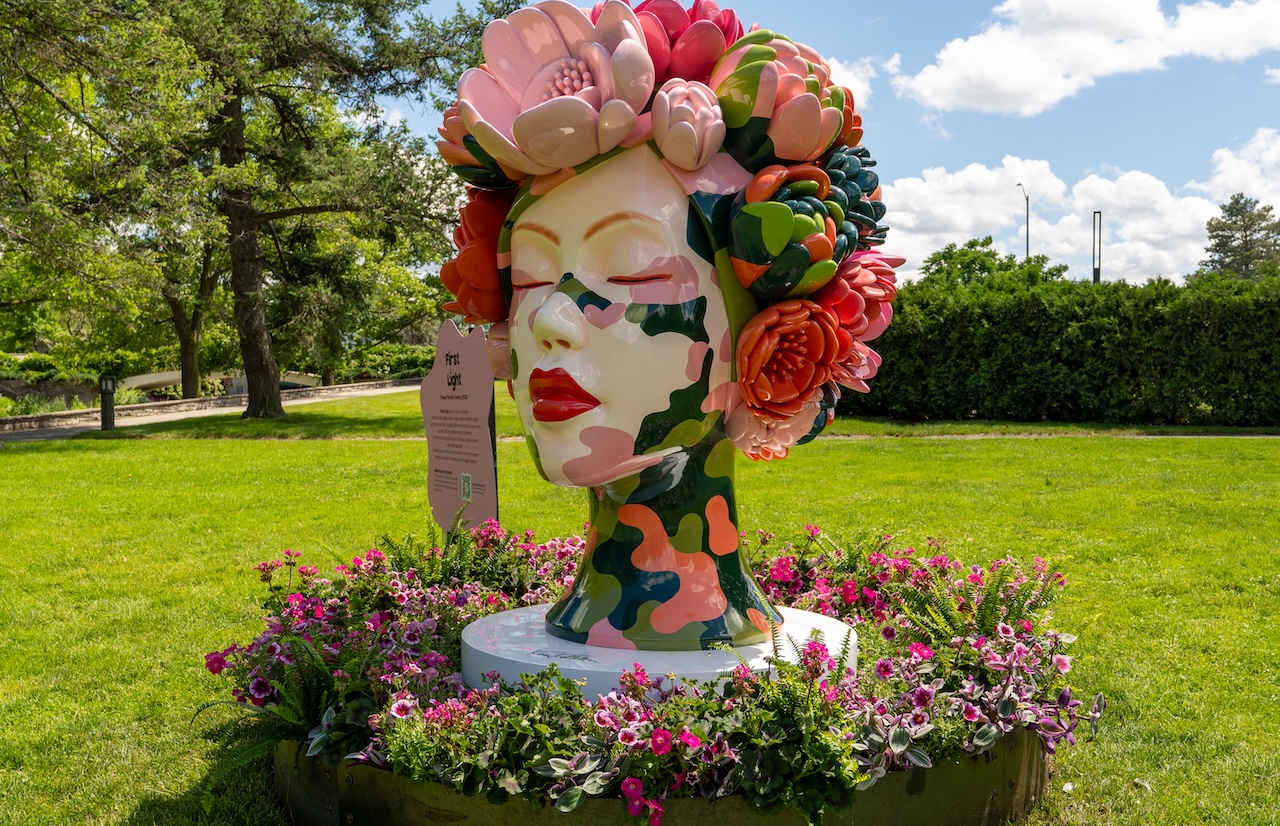
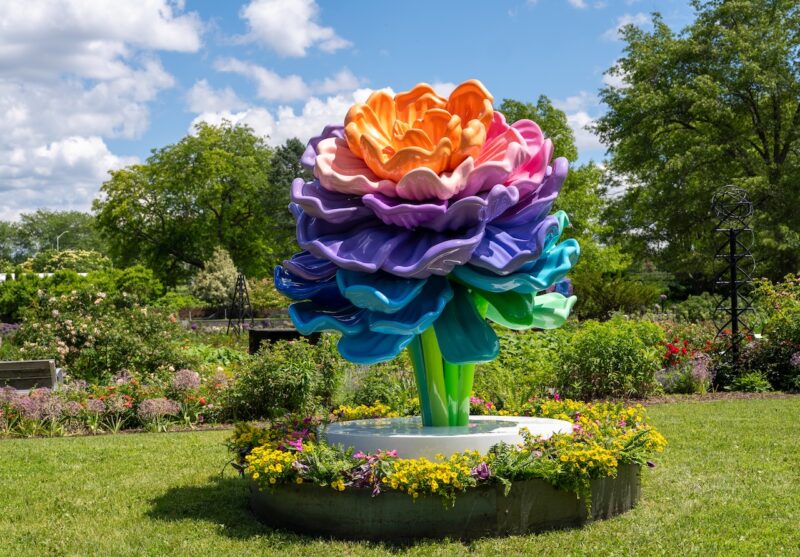
Curated by RBG’s cultural program development lead, Jeremy Freiburger, Anchorball comprises 18 monumental sculptures—some stretching 12 feet high—distributed throughout the gardens alongside an integrated augmented reality experience. The exhibition unfolds as a walking journey, encouraging visitors to navigate the site differently as sculpture, landscape, and digital media overlap.

Photography courtesy of Royal Botanical Gardens
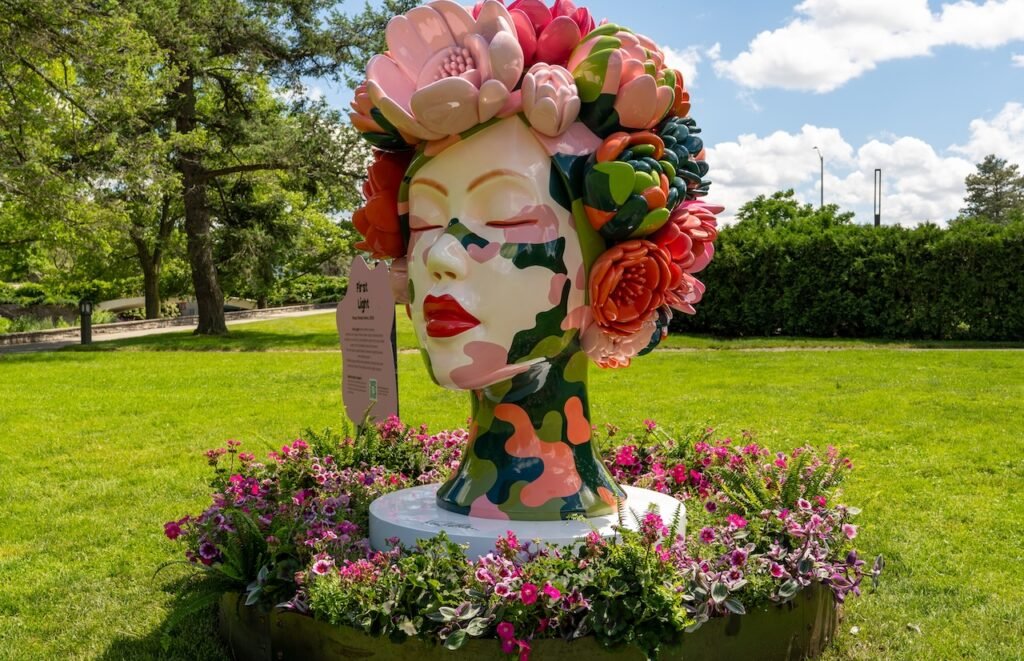
The gardens themselves informed many of Kelleher’s site-specific interventions. In the Sustainable Rose Garden, the sculptures emerge from carefully composed companion plantings, while elsewhere, brightly colored forms frame long vistas or appear unexpectedly between mature trees. The characters range from cartoonish, bunny-like creatures to serene women’s faces peeking through coiffures of flowers, as well as more minimalist individual blooms with curved, monolithic stems.

Photography courtesy of Royal Botanical Gardens
These characters were modeled digitally in 3D alongside the production of their fiberglass counterparts. The accompanying augmented reality layer introduces animated digital works that can only be activated on site, resulting in a dialogue between the physical landscape and virtual space. In this way, the exhibition encourages visitors to slow down, look more closely—and maybe even smell the roses.

Photography courtesy of Royal Botanical Gardens
For Noorani, the show has also become a test case for how the institution approaches ambitious cultural projects. “Anchorball has definitely stretched us, but in the best way,” she shares. “Bringing an exhibition like this to life meant learning how to work in new ways, building relationships with artists and creative partners, and finding ways for teams across the organization to bring their expertise together. Every project teaches us something, and this one has given us a lot of confidence in what we’re capable of taking on.”