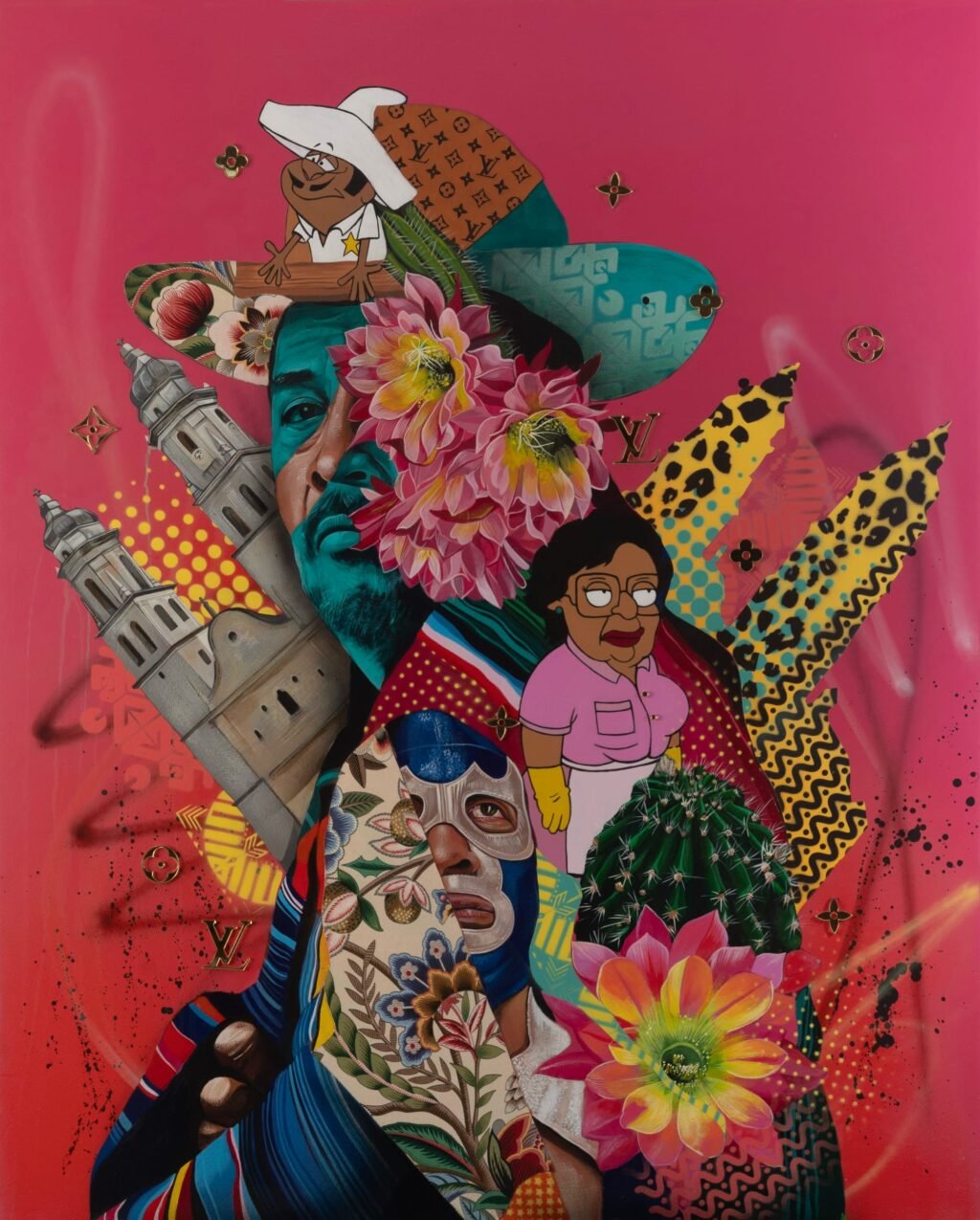

Animated characters, patterned textiles, logos from iconic fashion labels, graffiti, and more coalesce in the vibrant portraits of Victor Quiñonez. Born in Mexico, raised in East Dallas, and now based in Brooklyn, the artist, who works as Marka27, is interested in the ways activism and pop culture converge, and he infuses the visual language of contemporary street art with Indigenous imagery and Mexican mural traditions. Whether working on large-scale walls or more intimate canvases, Quiñonez taps into his own experiences of living between cultures and the arbitrary nature of national borders.
Portraits like “Luchando Por Mi Alma” superimpose the signature Louis Vuitton pattern, desert flora, a striped weaving, a masked Lucha Libre figure, and a stereotypical, low-wage character from the television show Family Guy atop a portrait of a man in a wide-brimmed hat. This pastiche is emblematic of what Quiñonez dubs his “neo Indigenous” style in which potent cultural symbols and a critical consideration of the social and political landscape converge.

In his solo exhibition Ni de Aquí, Ni de Allá, which translates to “not from here, not from there,” the artist presents several portraits alongside a collection of sculptures and immersive installations. Following its debut at Boston University in 2025, the exhibition traveled to the University of North Texas in Denton, where it was on view briefly before being shut down by the administration. Now at its third venue, Ni de Aquí, Ni de Allá will open at Institute of the Arts and Sciences in Santa Cruz this October.
The censored show is explicitly critical of the Trump administration’s immigration crackdown, with the artist’s I.C.E. Scream series confronting the mandate. This particular body of work includes a street vendor’s pushcart and sculptural paletas, one of which encases handcuffs in its translucent resin body with a faint image of a person in a cage imprinted on the oversized stick. Smaller acrylic iterations contain photographic portraits of street vendors embedded within. Etched onto the wooden sticks are a government logo paired with a mock agency called “U.S. Inhumane and Cruelty Enforcement.” By placing portraiture at the center of every work large and small, the artist directs our attentions to the very people most impacted by these actions, while emphasizing our shared humanity.
“At first glance, you’re like, ‘Oh, wow, that’s a popsicle.’ You want to approach it. It brings back nostalgia for everyone. It symbolizes something fun, innocent and childlike,” Quiñonez told The Los Angeles Times. “But then when you get closer, you see the writing on the popsicle sticks. … I wanted to show the two different sides of the world that we’re living in.”
In addition to his studio works, the artist has painted murals in cities across the U.S., which you can explore more of on his website and Instagram.


Do stories and artists like this matter to you? Become a Colossal Member today and support independent arts publishing for as little as $7 per month. The article Marka27 Superimposes Pop Culture, Graffiti, and Political Critique in Urgent Portraits appeared first on Colossal.