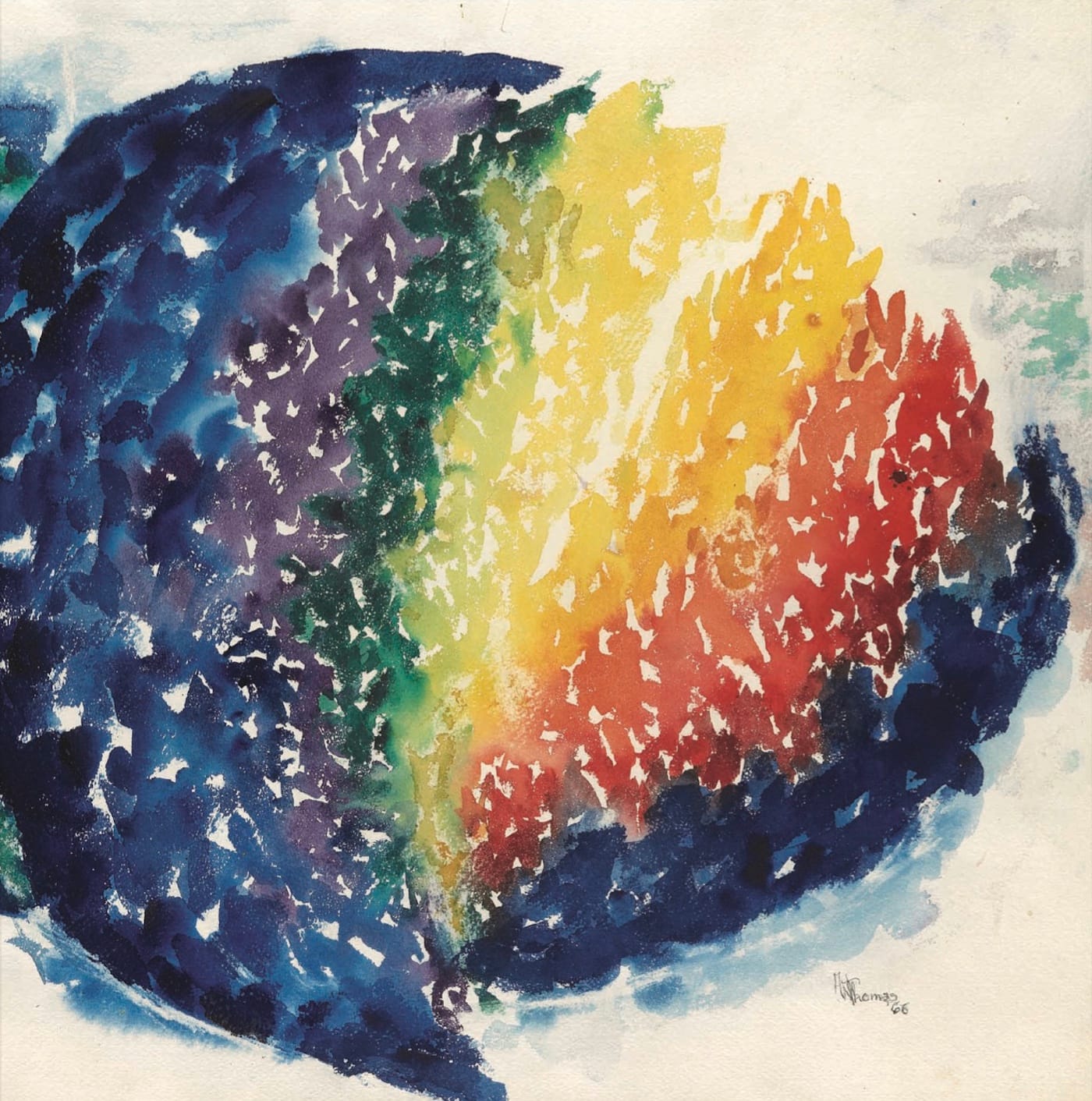
Editor’s Note: The following article is a chapter titled “Field” that has been excerpted from Primary: After and With Alma Thomas by Alexis Pauline Gumbs, published by Yale University Press on September 29 and available online and through independent booksellers. (Copyright © 2026 by Alexis Pauline Gumbs. Published by permission. All rights reserved.)
When Richard Powell, one of the most influential theorists of visual art in the Black diaspora, was a wide-eyed MFA student, or in his sardonic self-description decades later “a young clear-eyed critic striving for objectivity,” he wrote a review of Alma Thomas’s 1975 exhibition at Howard University. His celebration of Alma Thomas’s color paintings may also have been an early critique of other approaches to visual art. Powell the student, knowingly reviewing the work of the first graduate of the very department where he studied, knows that objectivity is impossible for himself or for any of us. He praises Thomas for her choice to “forgo the unreal objectiveness of details and detached photographic realism and dive into what we see and feel.” But he also notes that she moves away from what he calls the “mundanity” of impressionism. Instead she “cornrows and parboils it,” she “aerates the ground as only a native Georgian can and places growing colors in it the way one plants vegetables and fruit in a backyard.” The young Powell prefigures the way that Kellie Jones contextualizes Alma Thomas’s experimentalism years later: “Alma Thomas saw herself surrounded by creativity from an early age, from her mother’s use of color as an expert seamstress to her extended family’s planting and working of southern soil.” For both critics, Thomas’s roots in and continued connection to the very tangible arts of clothing and feeding people do not contradict but enable the experimental approach that Jones will call “Afro-Futuristic.”
When Powell describes Alma Thomas’s color fields as “cornrows” he brings to mind two linked references at once: fields of one of the North American continent’s most abundant plants, and a beloved and infamous African diasporic hairstyle. Never merely descriptive, Powell’s choice of words is also referential. In the first sense, cornrows, like other agricultural fields in the United States, share a colonized kinship with the African laborers forced to toil under captivity to generate the vast fields of monocultural crops that continue to define US food systems. In the second sense, cornrows, a time-intensive hairstyle of close braids and patterned open scalp, have been criminalized and forbidden under racist labor codes post-emancipation. But in his positive review, which asserts that there is liberation available to a viewer who chooses to engage Thomas’s paintings, he uplifts the brightness and nourishment in her “parboiled” but never overcooked images. Powell does not mean for the reference to cornrows to offer a mere lament for labor. We sense a reclamation in Thomas’s paintings and Powell’s love for them. Or let me forgo the pretense of objectivity. I feel a claim. I feel loved. Do you?
Cornrows constitute living archives of sisters and sisterliness. That archive includes my hands in my sister’s hair unbraiding it at the end of the summer, my own patience sitting between the legs of my sisterfriend Kara as she parts and flat-twists my hair before our college graduation. The cornrows gracing the heads of people around the world at this moment are mostly the artwork of a diasporic cohort of feminine workers who either offer their craft to people with whom they are in intimate sisterly proximity or with clients to whom they offer their services. Sometimes the line between sister/friend/stylist blurs. Sometimes in the shops staffed by African women and patronized by African-American and Afro-Caribbean people in cities in the United States, a strained and severed sisterhood across diasporic difference reveals or rejects a longing for tenderness among the tender-headed, tenderhearted, and tense. I would suggest that all of these braiders are modeling the work of sistering, the generative challenge of the closest simultaneous interfaces of similarity and difference.
John Maurice Thomas, Alma’s younger sister, who usually went by “Maurice” and lived in the same Washington, DC, house with Alma their whole adult lives, practiced parting, styling, threading work as an archivist and curator of her older sister’s work and legacy. Her institutional choices of where to place certain artifacts, and especially her penciled notes on the backs of pictures and event programs clarifying Alma’s presence and achievements, have the tight, gentle touch of a person accountable for preserving an intimate witness, a close deviation from her own life.
Alma Thomas, who lived inside the practice of sistering and lives today as a result of the archival and curatorial care of her younger sister, becomes related to and different from generations of braiders. Her bright brushstrokes and the spaces between them, Powell suggests with his cornrow reference, do not only beckon our minds, they open up our crowns.
When I first heard Malcolm Peacock’s voice, he was running. His words punctuated by the need for breath, ragged and reaching like the closest view of the spaces between Alma Thomas’s applications of color. In his recorded reflections while running, the reach for breath shapes the insights Peacock shares about life, love, racism, intimacy, and Hortense Spillers, among other topics. We feel the breath that disrupted and enabled each articulation at the same moment. When I actually talked to Malcolm on the phone, their voice was steadier. They were sitting still and explaining how these days they were walking from Brooklyn to Harlem every day, past Teachers College, where Alma Thomas studied puppetry, up to the Studio Museum’s transitional studio space, where they were applying their mother’s living room cornrow technique to the task of braiding together a redwood tree. Malcolm texted me a photograph of their studio floor covered with packets of hair extensions and noted that their marathon braiding sessions kept them up in Harlem in vigil with countless African hair-braiding establishments finishing one or two last clients late into the night.
As far as I know, Alma Thomas doesn’t have a painting of corn in particular or of the redwoods where Malcolm Peacock once ran a last-minute marathon while fearing for his Black life. But her paintings do evoke corn in their patterned multiplicity. We could think of her color paintings both as fields of corn in rows, and as each ear of corn, kernel after indented kernel, holding close and sweet. The heirloom Cherokee corn I help grow and harvest at Tierra Negra Farm near my home in Durham, North Carolina, does what Alma does. It places different colors in tight kerneled relationship to each other across a field of possibility. When we shuck the corn we are surprised by each ear because no pattern is the same. This one has purple, blue, magenta, maroon kernels alternating. This one has all purple and one white. Most of them look like an autumn rainbow, but never the same rainbow twice. The cornrows of an Alma Thomas painting both look like the infinitely diverse ears of native corn and hold the ethic of the Indigenous context of corn that is, again, sisterhood. Just as Alma Thomas’s paintings exceed the monotony of agribusiness conformity in their movement and flow, corn on this continent is meant to exist in mounds as part of the three sisters Indigenous planting system. As Potawatomi scientist and poet Robin Wall Kimmerer describes it, corn is the oldest sister sprouting up first out of the ground, followed by the second sister, the beans that climb the cornstalks encircling her. Then the sprawl of squash leaves and flowers sitting on the ground at their feet skirts them both, filling in almost all of the available space between mound after mound of earth, each about a square foot wide. Alma Thomas reveals herself as kin again not only through her grandmother Fannie Simmons, a South Carolinian woman of African, Indigenous, and European heritage, but also in practice, offering mark after mark in the tradition of the Indigenous farmers who create not merely furrowed linear rows of earth but constellations of mounds so the three dimensions of the intertwined plants can fill the space, feed the people, nourish the land, open the earth to the lessons of rain.
During a conversation I did not directly witness, my old friend Ashon Crawley, who makes paintings that are the remnants of his embodied sound work in the tradition of Black Pentecostal breathing, told my new friend, the world-building critical writer Sofia Samatar, that his paintings, records of what happens on the floor while he moves in the sound and spirit of transforming a homophobic tradition into a vessel of queer possibility, were not landscape paintings. And in the sense of the colonial optic of landscape painting as a form of domination and ownership over living space, of course they are not. But Sofia offered a corrective that Ashon included in one of the letters in his book The Lonely Letters about what landscape might be. And I think Sofia might know, since she writes books with maps in the beginning so we can find ourselves inside the worlds she has created and populated with her own reflective imagination. Sofia said Ashon’s paintings are landscapes in the sense that they invite the maroon questions, Can I shelter there? Can I get in there? Can I stay there for a while?
Sofia calls this “landscape from the inside” because it is about inhabiting a space. I would add that it is a vulnerable form of inhabitation; there is need and precarity there. Ashon explains that in his painting practice he is trying to get back into, to shelter within, the sound of the Black church, his community of aesthetic origin, a homophobic community that excluded him even while he, as a prolific church organist, was providing the context, the sound of that community’s being. Can I shelter there? Can I stay?
Was Alma Thomas a maroon? She was not housing insecure. She lived her adult life in a house her parents purchased that she and her sister inherited together. She was gainfully employed, an active and respected member of her church and community. If we think of Alma Thomas as a maroon, we have to imagine her marooned in time. What if the “achievement” of being first is simply the consistent pattern of arriving where no one expects you? Of enacting things no one has found a use or a name for until you insist? What if Alma Thomas, marveled at in the New York Times, the New Yorker, and the Washington Evening Star as an old new young artist after retiring from teaching, was marooned in age? Alma’s painting teacher says that in her arthritic last days she would cry out, “Oh if I only had a body!” When she went to the hospital to what would be her deathbed, she brought her paints with her. What if Alma Thomas was marooned in space too? Committed to uplifting her Washington, DC, community while longing for a Georgia she returned to most frequently in paintings? Marooned in the early dream of a world where her students could live with dignity? A world safe enough for her sister Fannie to have had the equal medical access that would have allowed her to live through childhood into adulthood? What if Alma Thomas’s paintings are imagined landscapes where the movement of the air and the movement of time creates a maroonage, a free place, where linear time loops back? Where a girl from the horse and buggy age can travel to the moon and Mars without leaving what and whom she loves behind? What if the vulnerable question of shelter is a question about whether she can access her dead baby sister’s heaven? Can that space hold her? Does it still hold their relationship?
Can I get in there? It could be a question about seeking to reach a sound, a feeling, a possible world beyond our undoing. Can I shelter there? It could be a question about what will hold, what will hold me? Can I stay? At least for a while? It could be a longing across impermanence. It could be my question each time I am faced with the full and open world of Thomas’s paintings. Can I get to the world that her work implies? Can it hold me? And what does that work have to say about the world I see when I reach, when I’m vulnerable, when I close my eyes and remember there is a landscape inside?
Thomas’s works, often inspired by her own garden and the gardens of others, or fields and seasons and the emergence of flowers and the changing of leaves and images of outer space, are all spatial and temporal. They are about time and space, but they do not fix a given space in time. They offer repetition and difference. They offer proximity and contrast. They offer the phenomena she witnesses, the freedom of presence. They cultivate possibility. They create a possible encounter between Alma Thomas and a viewer, this viewer, any viewer, between an image Alma Thomas blinked inside and a future in which dead Alma Thomas is a presence. They create a possible encounter between a living Alma Thomas and her sister Fannie who was already pure spirit and also therefore between modes of encounter. What is at stake in my encounter with this work?
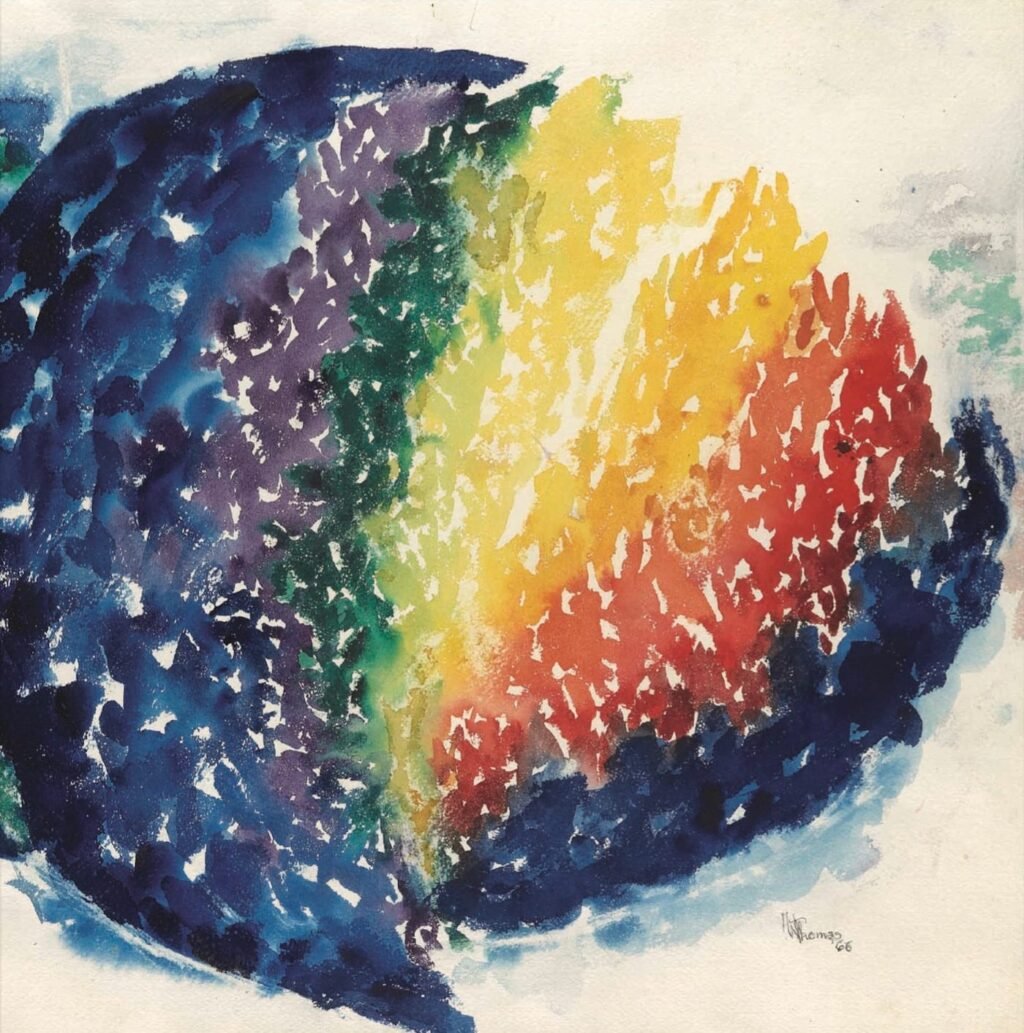
Consider Rick Powell’s description of Alma Thomas’s “Orange Glow” during his series of Mellon Lectures at the National Gallery in Thomas’s hometown of Washington, DC. It’s so beautiful, it’s like a spell. He names the “harmonious optics” of the primary, secondary, and tertiary color choices and then remarks on points where they “bust loose.” He riffs on the “radiant and vibrant connotations” of the title “Orange Glow” and how orange, a minority color in the painting, modifies the prioritized glow of Thomas’s intuitively placed colors, suggesting that the orange colors in the painting also “transform everything in their orbit.” He keeps going to the cosmic, understanding that the glow referenced in the title and enacted in the painting “not unlike sunlight, envelops nature and civilization and covered Thomas’s gritty inner-city neighborhood with brilliance and optimism.” He branches out to her other paintings of flowers and nurseries, her documentation of “planet earth’s chromatic responses to seasonal and atmospheric cycles.”
He quotes the Black British Guyanese artist Frank Bowling on color as line and applies Bowling’s observation that incorporating line between the colors introduces clashes “wherever the colors meet in a confused passion.” As a Caribbean immigrant to the United Kingdom, Bowling knows of what he speaks. Powell continues emphasizing again the “abstract cornrows and plait-like gestures,” the “light and energy generating ideal,” the passion, the confusion that happens when I see you in a different light.
I don’t think that I will ever describe Alma Thomas’s paintings better than Rick Powell already has. Not even a 1975 student Rick Powell. Certainly not a Mellon Distinguished Lecturer Rick Powell. Thankfully, I’m not trying to.
Alma Thomas and the artists I have named here (Powell included!) are all in the midst of transforming a deadly encounter, the genocidal colonial encounter, the earth-killing monocultural agricultural domination, the reproduction of property through landscape painting, the reification of art as property through art criticism. I think Powell’s approach here and elsewhere points us in this liberatory direction. My encounter with Alma Thomas’s work wants to do this too. But my mode is different.
Instead of describing the work and then describing it better, or more pointedly, instead of demonstrating mastery or conferring mastery upon the artist, I have to risk freedom. I have to confront sameness and difference. I have to confront what I mean when what I want to be the same is different and what I wish were different reproduces itself and stays the same. I have to be transformed by how I see myself and lose myself in you. I have to risk another form of knowing. I have to refuse to master. Goldenrod. Aster. I have to refuse to daughter. Dirt. Water. Rain barrel cistern. I have to become related alongside you. Woven with you. Unraveling too. I have to sister.
If I were to attempt to describe Alma Thomas’s 1973 painting “Jonquils” in the mode of art critical inquiry, I would try to find words for that exact yellow, is it goldenrod or should I not use another flower to describe a flower? Is it a gold yellow, a light yellow, a light-infused yellow? And then I would seek to tell you how the strokes of yellow meet, crash into each other, crowd each other, embrace each other in some places, overlap and darken each other in other places. And they could look like scattered grains of corn from some angles. But to me these brushstrokes mostly look like living beings moved by wind. And in the end, I am too awestruck by how she has infused the inert with movement again to say anything else, except maybe death, where is thy victory? Segregation, proffer your concession call? And so in the end, I am not at the end. I am moved, beyond my lifetime. I am opened into the sistering relation of crowding or embracing. I should know what you are thinking and I will never understand you. The decoloniality is: that this relation remains a question, not a relation of domination or reproduction but of accompaniment, or betrayal, solidarity, or judgment across something and something else. I wonder about you. I lean back and look again.
What does a sistering relation or the loss of it make possible? I continue in wonder and build a room to ponder the motivation of a genius who has created not only a work of art, but a transformation of what work even is or could be or could become in the face of death. And for whom? The question is can we stay here? And the answer is no. And the answer is yes. And this is the poem:
SISTER TECH
i am pounding out a field of gold
with a horsehair hammer
the interface i use to build
this, our cosmic computer
with a horsehair hammer
and the light of memory
our cosmic computer
creates a circuit between worlds
and the light of memory
and your unforgettable face
and a circuit between worlds
your hand to my hand
and your face behind my eyelids
and all the flowers
are your hands
too soon they freeze and die
and oh the flowers
become my faith
too soon
we pound the earth
break into gold