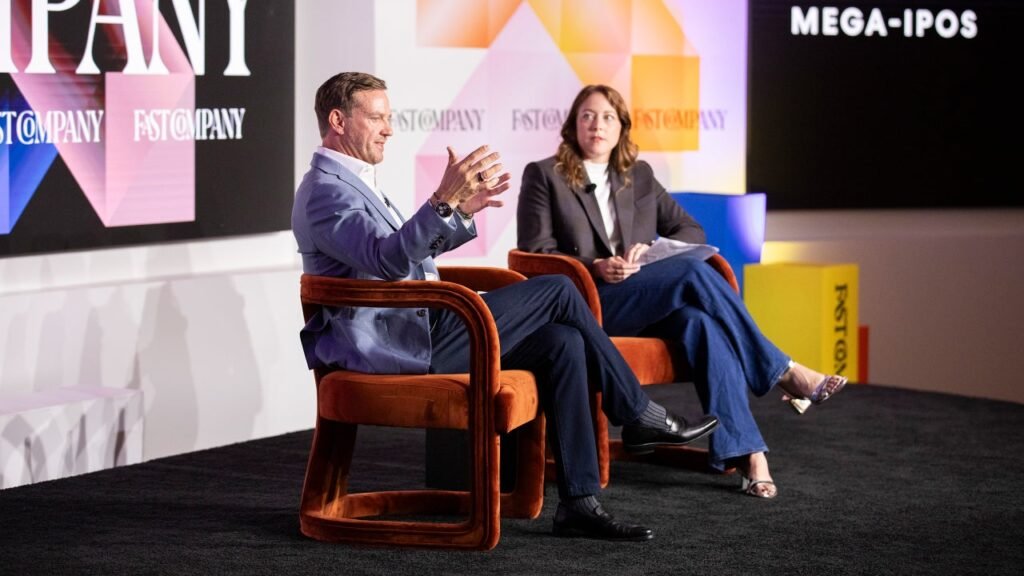
Nelson Griggs, Nasdaq’s president and head of its Capital Access Platforms Division, sat down with Fast Company senior writer Ainsley Harris during this year’s Innovation Festival to discuss how the new era of mega-IPOs could reshape industries, the public stock market, and the economy.
In June, SpaceX entered the stock market with a record-breaking initial public offering (IPO), just days after Anthropic, the company behind Claude, announced its proposed IPO, which could have a $2 trillion valuation, according to Bloomberg.
OpenAI, ChatGPT’s maker, has been right behind its rival, though as of this week, new concerns around AI’s safety risks have led the company to pump the brakes, Fortune reported. Meanwhile, Perplexity AI is eyeing an IPO in 2028.
A comeback for public listings?
The companies are entering the market as investors shift toward privately held assets. Greater access to private capital in recent years has resulted in fewer companies going public, according to Morgan Stanley, and the number of publicly listed companies, which peaked at roughly 8,000 in 1996, has dropped to about 4,000.
Now, there’s concern that these mega-IPOs could crowd out smaller companies that do wish to go public, especially after regulators recently enacted stricter rules for “micro-cap IPOs” following a series of alleged pump-and-dump schemes.
But Griggs said he wouldn’t look at public and private markets as an “either-or.”
There’s a massive appetite to invest in public markets, he said; “but you have this awesome private market that is growing at three times the pace of the public markets globally,” which is letting companies stay private longer.
That way, they can build durable businesses and be better positioned to go public later. SpaceX, for example, existed as a private company for 24 years before its stock listing in June.
AI buildout requires massive capital
Public markets could be improved, Griggs said, and “I think we just need to see private markets become a bit more liquid, and more transparent. And I think that’s happening, but at a slow pace.”
In terms of why major AI companies have decided that now is the time to pull the trigger on IPOs, Griggs said that “the AI buildout requires a massive amount of capital”—and public markets provide consistent, sustained liquidity.
At the same time, that massive capital investment has fed concerns that we’re watching the growth of an AI bubble that will burst if those companies’ profits don’t grow fast enough.
Goldman Sachs Research estimates that AI capital expenditure will account for 1.8% of the U.S. GDP and 0.9% of global GDP this year.
According to Griggs, the AI buildout is currently keeping the U.S. out of a recession, so while he appreciates some of the discussions around slowdowns of AI development and data centers, “if those things do not happen, the economy will start to shrink.”
“We need to get, hopefully, some smarter minds than myself figuring out how we continue to move that forward,” Griggs said.
“So you’re saying there’s danger if the music stops?” Harris asked.
“There’s definitely expectations that this is going to continue in the capital market,” he replied.