Editors’ Highlights are summaries of recent papers by AGU’s journal editors.
Source: AGU Advances
Plants and soils constantly exchange carbon dioxide (CO2) with the atmosphere. Extreme climate events such as droughts, heatwaves, floods, and wildfires can strongly disrupt this exchange. For example, the 2003 European summer drought released as much carbon as the continent’s ecosystems had stored over the previous four years.
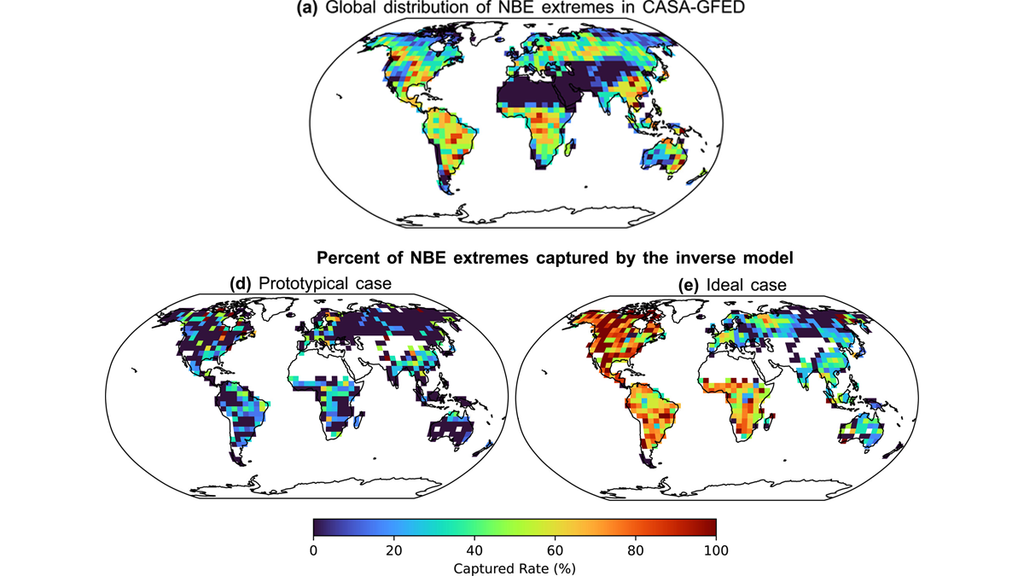
Lei et al. [2026] ask how well these extreme events can be detected from atmospheric CO2 observations. The authors prescribe a known “true” carbon flux, simulate what NASA’s Orbiting Carbon Observatory-2 (OCO-2) satellite and ground-based stations would observe, and then use an inverse model to determine how well the surface flux extremes can be recovered. They find that OCO-2 detects many more extremes than ground stations alone, but under realistic conditions it identifies only about 16% of the extreme locations, and about half even in an idealized, error-free case.
The inferred magnitudes of these events are also consistently underestimated. Detection is better for large and long-lasting events and for hot and dry extremes, while cold and wet events are more difficult to detect because clouds often limit satellite observations. These results highlight both the value and current limitations of satellite carbon monitoring, and the importance of future missions with wider coverage for understanding how climate extremes affect Earth’s carbon cycle.
Citation: Lei, R., Morgan, K. L., Huntzinger, D. N., & Miller, S. M. (2026). The detectability of extreme CO2 flux events using atmospheric observations. AGU Advances, 7, e2025AV002047. https://doi.org/10.1029/2025AV002047
—Xi Zhang, Editor, AGU Advances
Text © 2026. The authors. CC BY-NC-ND 3.0
Except where otherwise noted, images are subject to copyright. Any reuse without express permission from the copyright owner is prohibited.