A new paper (Xie et al. 2026) provides a detailed analysis of the landslides triggered by Typhoon Doksuri in northern China in 2023.

Between 29 July and 1 August 2023, the remnants of Typhoon Doksuri triggered large numbers of landslides in northern China, most notably in the Taihang Mountains in Beijing, Hebei and Shanxi. Shortly afterwards, I posted about this event, and more recently I linked to a short article (Xie et al. 2026) that provided the headlines about this event.
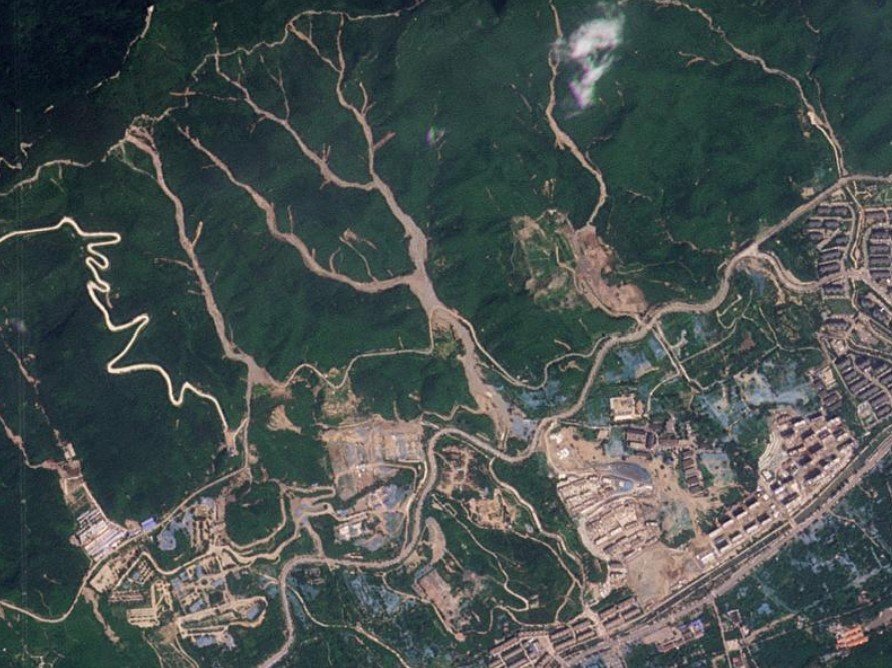
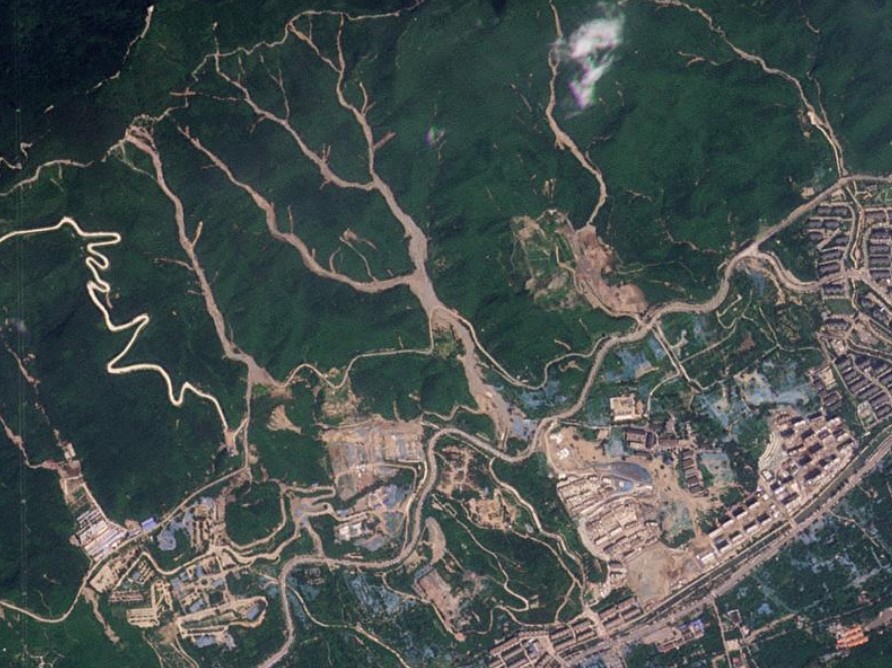
As a reminder, this is a Planet Labs image from after the landslides, which I used in my blog in January 2026, showing some of the landslides:-
A new paper (Xie et al. 2026) has been published in the journal Terrestrial, Atmospheric and Ocean Sciences that provides a detailed analysis of these landslides. It is a very good piece of work, and pleasingly it is both open access and published under a Creative Commons license.
In this latest study, the authors have analysed the rainfall pattern associated with Typhoon Doksuri. One of their sample site recorded a cumulative total of 581.3 mm, including 307.4 mm recorded in a single day.
This rainfall triggered a total of 104,555 landslides, all of which have nbeen mapped by Xie et al. (2026). These landslides occurred over a very large area (the authors mapped over 44,000 km2); interestingly, there are very distinct, isolated clusters across this area. This diagram, from the paper, shows this clustering effect across the counties most impacted by Typhoon Doksuri in northern China:-
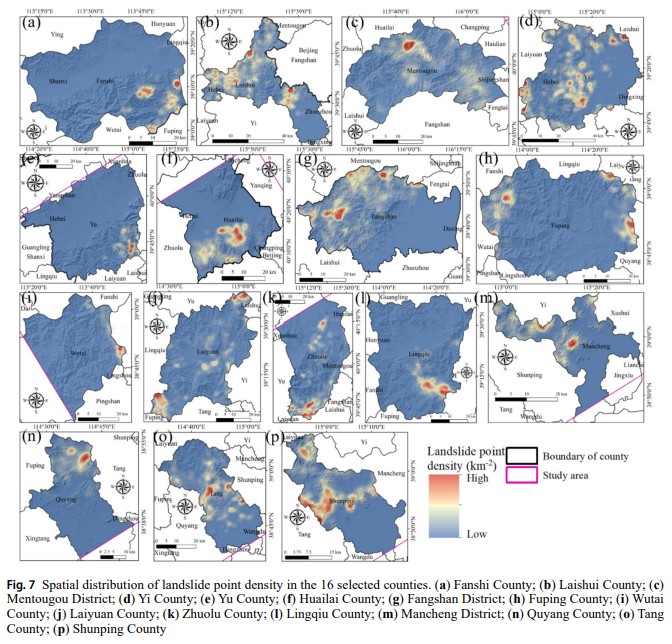
Xie et al. (2026) find that the distribution of landslides is closely related to the distribution of rainfall intensity and rainfall total for the passage of Tyohoon Doksuri. There was also a strong control associated with topography and, to a lesser degree, geology.
When tropical cyclones make landfall, patterns of extreme rainfall are highly variable, driven both by the typhoon dynamics but also by the interaction between the atmosphere and the landscape. This leads to cells of very intense rainfall. Steep slopes are very sensitive to very intense rainfall events, so where the topography permits, pockets of intense landslides are then generated. A very similar typhoon impacting the same area is likely to generate a different distribution of landslides.
For those in the area of such a cluster of landslides, the impacts can be extremely serious. Forecasting where these will occur is a very substantial challenge, but work such as that by Xie et al. (2026) helps greatly in this endeavour.
References and acknowledgement
Xie, C., Xu, C., Xu, X. et al. 2026 Detailed inventory of rainfall-induced landslides triggered by Typhoon Doksuri in July 2023 and county-scale spatial variability characteristics.
Terrestrial, Atmospheric and Oceanic Sciences. https://doi.org/10.1007/s44195-026-00149-6.
Xie, C., Huang, Y., Xu, C. et al. 2026. Over 100,000 landslides triggered by typhoon-induced rainfall in North China in July 2023. Landslides. https://doi.org/10.1007/s10346-026-02698-w.
Thanks as ever to the kind people at Planet Labs for providing access to their amazing imagery.
Text © 2026. The authors. CC BY-NC-ND 3.0
Except where otherwise noted, images are subject to copyright. Any reuse without express permission from the copyright owner is prohibited.