
For more than a decade, Udacity has been known for helping people build practical, job-ready skills in advanced, in-demand technical fields. Our project-based Nanodegree programs have helped hundreds of thousands of learners around the world break into new careers in data, AI, and programming, often without ever setting foot on a traditional campus.
Now, we’re taking the next step in that journey.
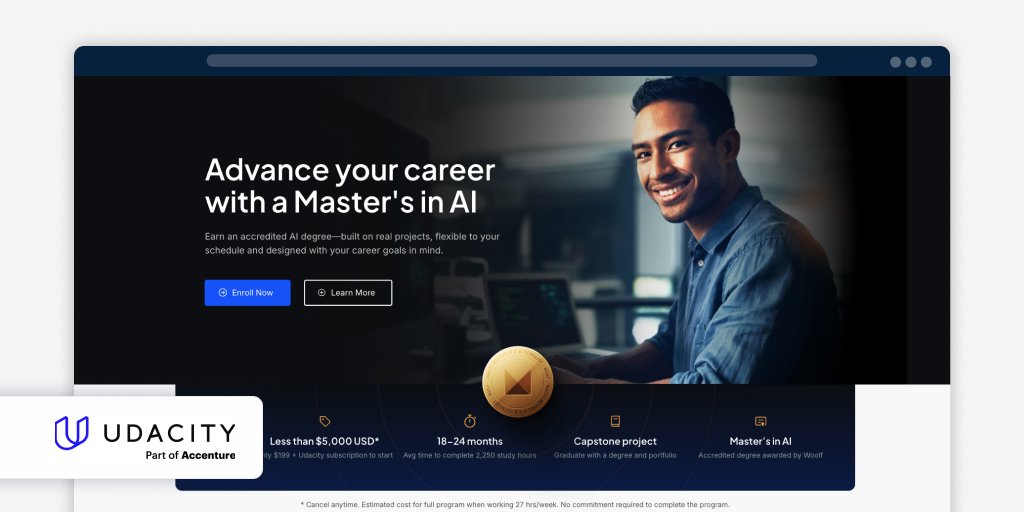
On October 15th, Udacity, part of Accenture, announced a fully accredited Master of Science in Artificial Intelligence degree, offered through the Udacity Institute of AI and Technology, a member college of Woolf, a European-accredited higher education institution. It’s the first time learners can earn a formal, globally recognized AI degree built entirely on Udacity’s signature project-based learning model.
And it’s changing what a master’s degree can be.
Why Now?
The world has reached an inflection point. AI is transforming industries faster than any technology before it, but the education system hasn’t caught up. Most universities still expect students to pause their careers, take on debt, and spend years in programs that teach theory more than practice. Unlike typical universities, Udacity’s practitioner-focused curriculum helps students develop AI’s most in-demand skills at an accelerated pace by requiring them to complete hands-on projects that demonstrate their understanding of the subject.
Udacity’s new master’s program aims to fix that. It’s designed for working professionals and lifelong learners who want advanced credentials without sacrificing flexibility, affordability, or hands-on learning. And it pairs that learning with the Udacity process that delivers proven outcomes. 90% of Udacity graduates mention that they achieved their learning goals, with many going on to start a new job or get a promotion in their current role.

The full program would cost just $4,681 ($199 + $249/month for 18 months) for a student who completes it in 18 months, making it 8X more affordable than the average cost of a master’s degree in AI. And you can do it at your own pace, part-time, entirely online.
How It Works
This program is comprehensive. Students need to complete 2,250 credit hours, equivalent to 90 European Credit Transfer System (ECTS) credits, to earn the master’s degree. This adds up to about 11 Nanodegree programs and a required capstone project. The core curriculum is required and includes 7 Nanodegree programs, with some of the hottest AI topics like Agentic AI, Generative AI, and AI Programming with Python.
Students can then finish the degree by choosing from over 20 electives. These include some of our most popular Nanodegree programs like Product Manager, Computer Vision, Natural Language Processing, AI Trading Strategies, and more. Our Nanodegree programs include highly relevant projects that set our students up for success in the workforce and academia. For example, with AI Trading Strategies, students must build a momentum-based algorithmic trading program for the S&P 500.
Already completed a Udacity Nanodegree? Through a process called Recognition of Prior Learning, eligible past Udacity coursework can be converted into academic credit, meaning the learning you’ve already done can count toward your degree.
The Enrollment Process
Enrolling for the master’s program is fast and easy:
- First, you need a Udacity subscription ($249 a month), and then you pay a one-time $199 enrollment fee.
- From there, you’ll complete the online onboarding process with Woolf. It’s straightforward and takes about 15 minutes.
- You’ll verify your identity, upload the transcript from your bachelor’s degree*, and write a short summary of why you want to get a master’s degree.
- It usually takes less than a day for the onboarding process to be verified by Woolf, and you can start the coursework immediately after submitting the application.
*If you don’t have a bachelor’s degree, no problem, you can still enroll based on your previous work experience and Woolf’s performance-based admission process.
How the Accreditation Works

The program bundles Udacity’s existing Nanodegree programs with required reading and assessments and maps them to fully accredited courses offered by Woolf, a global higher education institution. Founded in 2018, Woolf has pioneered a model that makes world-class education more accessible, recognizable, and transferable.
Woolf is accredited by the Malta Further and Higher Education Authority (MFHEA). All Woolf degrees are issued with European Credit Transfer System (ECTS) credits. The ECTS is the largest credit recognition system in the world. Students earn credits as they complete their courses, and these credits are recognized by hundreds of educational institutions and dozens of countries around the world, including the United States and Canada. This allows students to earn degrees that are recognized in 60+ countries and credits that are transferable to colleges and universities.
What Makes This Different
At Udacity, learning has always been active, not passive. Each Nanodegree program includes multiple projects that simulate real-world challenges, from designing AI-powered trading systems to building natural language applications. Every project is reviewed by an experienced mentor who provides detailed feedback to help you improve.
Students also get access to weekly mentor office hours, career services, and a dedicated community platform where they can collaborate with other master’s students. You’re never learning alone.
This is what sets Udacity apart: it’s education designed for the world of work.
Why It Matters
Udacity was founded on a simple idea: education should be accessible, relevant, and life-changing. For years, we’ve helped people learn the skills to transform their careers. With this master’s program, we’re helping them earn the formal recognition to match those skills, without the financial or geographic barriers that traditionally stand in the way.
Udacity’s Master of Science in Artificial Intelligence, offered through Woolf, is one small step toward that future. But for learners, it might just be a giant leap.
Learn more and apply today at www.udacity.com/masters-artificial-intelligence.
This article was produced in partnership with Udacity.
The post Udacity Just Launched a New Masters Degree in AI: Here’s a Look Inside appeared first on The Report by Class Central.