
From the Cool Cat Teacher Blog by Vicki Davis
Subscribe to the 10 Minute Teacher Podcast and Cool Cat Teacher Talk anywhere you listen to podcasts.
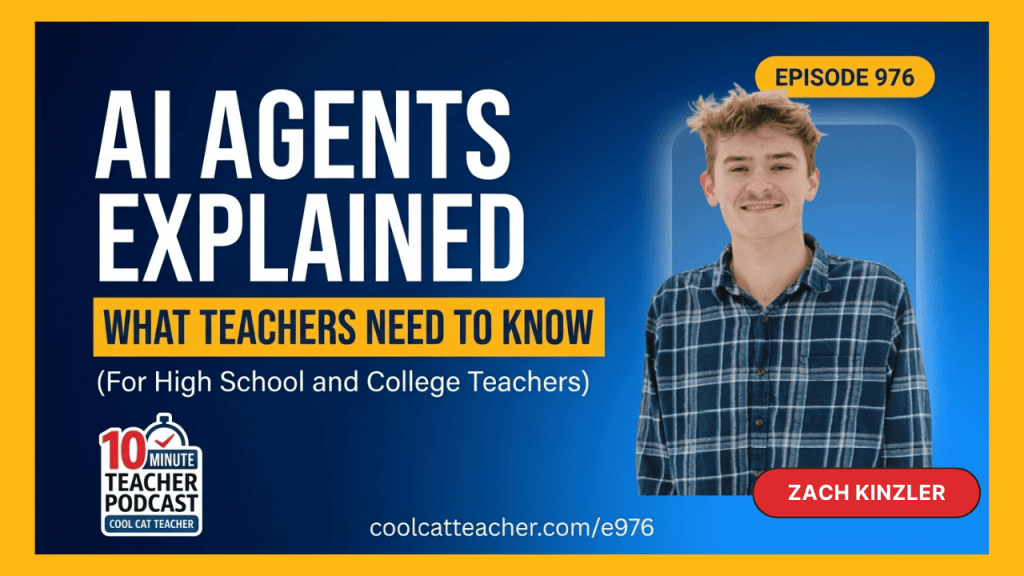
I find this conversation interesting because it tells a story from when ChatGPT was released about how a college student responded to it. Zach Kinzler was a junior in college. He was sitting in the front row of a systems engineering class when a friend punched him in the arm and said, “Look at this.” The student had just used ChatGPT to solve the problem on the board. And Zach’s journey began as he not only used ChatGPT to help him in his work but also talked openly with his professors about it.
He did write his papers with ChatGPT. (OK, now I’m not for this, but this is Zach’s story, and it is worth a listen.) Understandably, professors got upset. But when they did, Zach asked them to quiz him on what he wrote and what he had learned. He felt like he was learning faster.
Zach leads academic sales strategies at Boodlebox and hosts the Smarter Campus Podcast. We discuss the difference between using AI to learn and using AI to skip learning. He also discusses AI agents and how they work. But here’s a point I want us all to understand – Zach has struggled with reading his whole life.
As I told a commenter today, not all uses of AI are good. However, not all are bad. I believe AI should improve human flourishing and never detract from it. Yes, AI is a flashpoint issue. People who are angry and hate it really hate it. And some who are fans really love it. I find myself somewhere in the middle. Just like in Web 2 days, actually, when I knew that social media could do good but also had the potential to do great harm.
And I don’t like to call AI a brain, but I also know that there is (and should be) room for different opinions and the voices should be heard. I’ve aired interviews of pundits and pro-AI advocates. But we need to listen, because often the way forward is in the conversation that helps us see what the future can look like. All the AI haters in the world, I don’t think, can make it go away. Nor can all the AI advocates every convince me that AI should be student-facing for many of our younger students. I am interested to see what you think after you listen to this show.
I do want to note that, as I cared for my Dad last year, I fell behind on airing some of my shows. This interview was recorded in 2025, but we’ve worked to preserve the story and relevant arguments. That delay was all mine, so if you hear anything dated, just know that’s on me. As always, thank you for listening to the show!
AI is really just a second thinking brain, if that makes sense.
Zach Kinzler, Head of Academic Sales Strategies, BoodleBox
Listen to the Show

Watch this video on YouTube.Subscribe to the Cool Cat Teacher Channel on YouTube
Resources Mentioned in This Episode
- BoodleBox — the company Zach works for. Kinzler and the company describe it this way: a collaborative AI workspace that puts multiple AI models in one place so a team, a class, or an institution can work in a shared space rather than in separate private chat windows. It offers a free tier and paid institutional plans. They didn’t sponsor this episode and all opinions are his own.
- The Smarter Campus Podcast — Zach’s own weekly show, where he interviews students, professors, and administrators around the world about what is actually working with AI on campus. Vicki has been a guest on it.
- Zach Kinzler on LinkedIn — where he posts short explainers and clips, and the place he named on the show as the best way to reach him.
- ChatGPT — the OpenAI tool Zach got on the waitlist for as a college junior, and the one he was using when he told his teachers about it. Free and paid tiers.
- Perplexity — the AI answer engine Vicki mentions offloading research to so she can spend her own time writing instead of reading for hours.
- NotebookLM (now branded Gemini Notebook) — Google’s research and study tool. You load in your own sources, such as the PDFs Vicki gives her students, and it works only from those documents. This is the tool Vicki calls “fantastic for studying.”
A note on the first item: Zach Kinzler works for BoodleBox, and this is an editorial interview, not a sponsored one. The description above comes from the company’s own materials and from what Zach said on the show. I have not independently tested or verified BoodleBox’s security, privacy, or compliance claims, and nothing here should be read as an endorsement. Evaluate it the way you would evaluate any vendor describing its own product.
The most useful thing in this whole episode is not a tool at all. We know that tools like Google Notebook LM can do this, but this is something worth testing when you’re learning.
Make the AI ask you the questions. Zach’s habit is the reverse of what most students do. Instead of “write this for me,” he types “ask me questions about this and I’ll answer them.” Then, when something still isn’t landing, he climbs a ladder: explain this to me like I’m five, then like I’m 10, then like I’m 15. Give your students both moves at the start of one class period, in any subject, with whatever tool your school already allows. Neither one produces a single sentence a student could turn in as their own work, which is exactly why they are worth teaching first.
About Zach Kinzler

Zach Kinzler is an education and AI enthusiast with a unique blend of industry and academic experience. His career has focused on empowering students and educators through innovative technology, including his current role leading academic sales strategies at BoodleBox.ai, where he helps higher education institutions prepare students for an AI-powered future. He holds a BS in industrial engineering and a master’s degree in business analytics from the University of San Diego (CA).
Connect with Zach: LinkedIn · The Smarter Campus Podcast
Other Shows for Teachers Working Out Where the Line Is With AI
- AI in the Classroom: Assignments Students Can’t Fake with Nancy Frey — the closest companion to this episode. Zach describes what honest AI use looks like from the student’s side; Nancy takes the same problem from the assignment-design side and her expertise in learning science. Another one to listen to as well.
- Brain First, AI Second: Teaching Writing in the AI Era with Philip Seyfried of Teachers College, Columbia shares information on MIT Media Lab research, why AI detectors fail, and building classroom trust around AI. It is the research backbone under Zach’s “want to learn” argument.
- Vibe Coding, Agentic AI, and What Schools Must Teach Now — the full-hour Cool Cat Teacher Talk show on agents, if Zach’s ninety-second explanation left you wanting more.
- Honest Conversations About AI: The Need for Truth — a full hour on honesty, integrity, and transparency with AI, which is the thread running underneath everything Zach says here.
Listen and Subscribe
If this one gave you something you can use tomorrow, share it with the teacher down the hall who is still deciding what to do about AI — and leave a review wherever you’re listening. It genuinely helps other teachers find the show.
Episode Transcript
This transcript was generated using AI and has been reviewed by humans for accuracy. Minor errors or artifacts may remain but I worked my best to find any issues with the transcript as I reviewed the show. – Vicki
Click to read the full transcript
Vicki Davis (00:00): Happy Tech Tool Tuesday. This story from when ChatGPT came out lets us examine the question, can AI be used to learn and not just to cheat?
Announcer (00:10): This is the 10 Minute Teacher Podcast with your host, Vicki Davis.
Vicki Davis (00:15): Today, I’m so excited to be with Zach Kinzler from BoodleBox. A lot of research is coming out about the need for transparency with teachers. We need to help our students know how to use AI in the right ways, how to hold them accountable when people just have AI write for them and turn it in as their own work. That’s not only dishonest, but it defeats the whole education process.
Zach works with BoodleBox, and I really like it for some different reasons in that you can use all the different AI models. And we’re going to dig into it a little bit. But Zach, first, talk a little bit about what you do. And because you’re a young person involved in an AI startup, BoodleBox, and you’re working with higher education institutions. And now a lot of us, well, what’s your job like every day?
Zach Kinzler (01:05): Thanks for having me. First off, it’s a very fun day today. What I get to do is I get to talk to educators from all over the world. I work with students in Africa, the US, Australia. And pretty much what I do is just figure out what’s working, what’s not working, show them BoodleBox, do some general AI education, right? Prompt engineering, safety. I have my own podcast, which I’ve had you on one time, which is awesome.
And really what I get to do is just work with people and actually help them use the tool. My job’s kind of transitioned from introducing it to implementing it. So I get to go into education systems and kind of say, hey, here’s an example of how you can take what you had before and make it better with AI in a safe, kind of ethical manner.
Vicki Davis (01:48): So tell everybody the name of your show.
Zach Kinzler (01:48): It’s called the Smarter Campus Podcast. So I have teachers on from all over the world. Lots of kind of interesting conversations of just learning about how people are actually doing it the right way, which is super, super cool to see. And I learn a lot from every single one that I do, which is fun.
Vicki Davis (02:03): One more question. How did you decide to go to the AI direction? Because, you know, there are a lot of people your age in their 20s actually hate AI. When you talk to them, they don’t like AI and they’re scared of AI. What led you to embrace AI? How’d you come across it, and why are you jumping in?
Zach Kinzler (02:19): I was a junior in college when ChatGPT came out. And one of my friends was very like Discord, Reddit, always super interested in like how technology is changing and stuff. And we both got on the wait list of ChatGPT because I was like, I don’t even know what this is. This kid just thinks this is going to be really cool.
And I’ll never forget, we were like sitting in the front row of a systems engineering class and my friend like punched me. Look at this. And ChatGPT did the problem on the board. And I just like — both of us got so infatuated with it, where I did every single thing with ChatGPT when it came out. And it was really bad then. Luckily, I had a teacher that was super interested in it, an engineering professor, that kind of helped us.
And then what we ended up doing was just go tell my teachers that I like wrote my paper with AI, and then they would get upset about it. But then I’d be like, I guarantee you if you ask me questions about this versus everyone else in the class, I probably know a lot more about it.
Like ignited the passion. Wow, no one has any idea what’s going on and this is going to be a big mess, right? I just started interviewing college students and teachers, really anyone that would talk to me, so that when a teacher would be like, this stuff’s bad, I would like show them interviews of other people, which is really cool.
I didn’t have thought it was super cool. I’ve always been a very ideas person, where I have lots of business ideas and I have lots of things that I like to do. But I would hinder myself a lot of the time because I couldn’t do the technical part. Like I couldn’t finish the idea that I had. And that’s why I love this thing so much, is that I can do anything and anyone can do anything.
Vicki Davis (03:43): You feel like you were very transparent with your professors. How did you use ChatGPT or any AI tool and not cheat yourself out of the education? What’s the difference between how you used it when it started and how people are using it now?
I had a kid I was talking to anonymously. He’s like, I can’t even write a paragraph anymore. I’m like, okay. And I was talking to him about what he’d written about and he couldn’t even recall anything he’d written about. There’s obviously a difference between what you did and what this student did.
Zach Kinzler (04:10): Really, I made a video about it this morning. It’s like just the want to learn. If you don’t care about something and you don’t want to grow from that, you’re not gonna be able to write a paragraph. I think it’s more of a reflection of self than people talk about.
AI is really just a second thinking brain, if that makes sense. Like the thing that I do a lot more that I don’t think people do is I get it to ask me questions. What don’t you understand about this? Ask me questions and I’ll help you with this. And then it’s like the other, explain this to me like I’m a five-year-old. I probably use that more than just about anything else on AI.
And just to explain something super simply, and then it’s like, okay, explain this to me like I’m 10. Explain this to me like I’m 15.
I struggle with reading. I always have struggled with reading. I’ve been a terrible reader and writer my whole life, but now I really like writing, reading and creative stuff, when I didn’t like that, because a lot of the things that would hinder me or just the actual doing of it. But you know what a good paragraph sounds like. And if you read, you can’t not read what you do. And that’s the other thing that people do shockingly so often. They just make things and then get rid of it.
Vicki Davis (05:09): This is a great example for those who are dyslexic or dysgraphic, like a lot of students I work with, to understand that if you use this as a learning support, you’re still learning. We’re the only place you can learn is in your brain, right?
If you’re truly supporting learning and you’re holding yourself accountable that I’m going to learn this, I’m going to use it to help me where I’m weak. I’m actually a very good writer. I love writing. I love reading. So for me, writing is a different experience with AI, because I love researching, but I can research for hours. Offloading the tools like Perplexity and some of these other tools, the research piece frees me up to write.
You and I are both using it in different ways, but we’re using it to support places that help our unique needs as a human being.
Zach Kinzler (05:58): I think that’s it. That’s what it’s all about. Taking what you’re good at and freeing up time, using what you’re good at to use the things to effectively do what you’re not good at.
Vicki Davis (06:07): Well, this conversation makes me so happy, Zach, for my kids, my students. I call them kids. They’re adults now. To hear this conversation about the effective use of AI I think is as important as the BoodleBox face.
[Editor’s note: the word after “BoodleBox” is unresolved. All three transcription passes render it as “face,” which does not make sense here. It is left exactly as transcribed rather than replaced with a plausible guess, and will be corrected from the audio.]
Agents are — so my personal learning objective for this summer 2025, as we’re recording this, is I made this my summer of agents. So I’ve been digging into just creating agents, using agents, understanding agents. Could you give a simple explanation of what an agent is and why it’s so important?
Zach Kinzler (06:39): That’s high level BoodleBox. So an agent is super important for people to understand, because the difference between a bot and an agent is a bot, you have to prompt it, right? So you have to tell it, hey, complete this task. But an agent, you can set up where, hey, every time I get an email, you’re going to read it, you’re going to give me a draft, and then you’re going to put it in an Excel sheet so I can see the emails that were sent today. So as you can see, there was only one instructions and lots of tasks were accomplished afterwards.
And agents are a very interesting concept. I totally recommend everyone going to read into it further on, because there’s lots of misconceptions that agentic AI is here right now, but a lot of it and the real value of it is just stringing together large language models. Very interested in it as well right now.
Vicki Davis (07:22): Specifically strange tasks. So thank you, Zach, for helping me create the first assignment for my AP kids. And you know what, kids, you’re probably — students, you’re probably going to end up creating some of your own bots.
I love that. I started giving all my kids a lot of PDFs, because not only are we using tools like this, but honestly, Google NotebookLM, fantastic tool for studying. So I want to give my kids the content they need to effectively train.
So thanks for coming on, Zach, for sharing this, for teaching my students, for sharing all those out there. And what’s the best way to get up with you if they want a demo of BoodleBox?
Zach Kinzler (08:00): Totally reach out. I’ll send my LinkedIn, email, all that stuff, and I’d love to connect and stay in touch.
Announcer (08:06): Thank you for tuning in to 10 Minute Teacher Podcast. Join us here every weekday and subscribe to the Classroom Matters newsletter. See you later, educator.
Disclosure of Material Connection: This is not a sponsored episode and this post contains no affiliate links. No company paid for or influenced this conversation. Zach Kinzler works for BoodleBox, which is discussed in the episode, so his description of that product is his own and I have not independently verified the company’s product, privacy, or compliance claims. I am disclosing this in accordance with the Federal Trade Commission’s 16 CFR, Part 255: “Guides Concerning the Use of Endorsements and Testimonials in Advertising.”

The post AI Agents Explained: What Teachers Need to Know appeared first on Cool Cat Teacher Blog by Vicki Davis @coolcatteacher helping educators be excellent every day. Meow!
If you’re seeing this on another site, they are “scraping” my feed and taking my content to present it to you so be aware of this.