From the Cool Cat Teacher Blog by Vicki Davis
Subscribe to the 10 Minute Teacher Podcast and Cool Cat Teacher Talk anywhere you listen to podcasts.
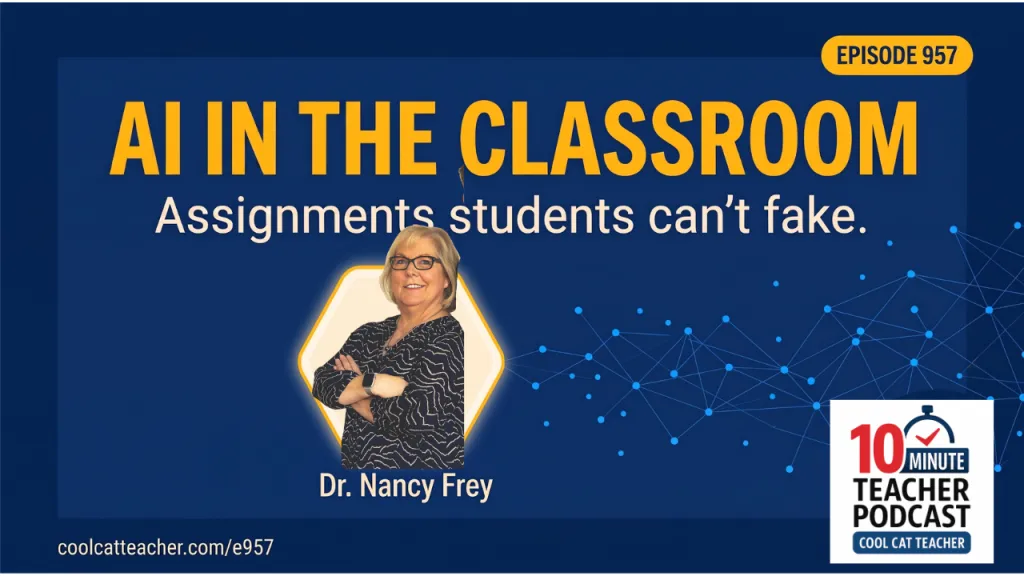
Nancy Frey is an expert on many things and now has taken that expertise and applied it to AI in the classroom.
Watch on YouTube and subscribe for new episodes every week.
Key Takeaways for Teachers from Dr. Nancy Frey
- Collect the dialogue, not just the product. Nancy asks students to turn in the conversation they had with the chatbot — “I’m interested in the questions that you ask.” The questions a student asks tell you more about their thinking than the paper does.
- Verbal assessment works even at scale. Face-to-face is the gold standard, but with 180 students on a roster it isn’t practical — so she points to Google Docs extensions that let you leave a spoken question right on a student’s draft and require a spoken answer back.
- AI literacy is a K-12 progression, not a high school unit. In K-2 she calls them “truth detectives” asking “is this true?” long before a child touches a keyboard. Grades 3-5 grow into “information investigators” watching a teacher interrogate a chatbot’s answer.
- Redesign the task instead of hunting the cheater. When a student says he got it all off QuillBot, Nancy’s question isn’t how to catch him — it’s what was it about that assignment that made QuillBot so easy?
Try This Tomorrow
On the next assignment where students may use AI, require two things instead of one: the finished work, and a link or screenshot of the conversation they had with the chatbot. Tell them you’ll be reading the questions they asked, not just the answer they got. It costs you one line on the assignment sheet and it changes what they pay attention to.
Carol Jago’s reflective questions are the other move worth borrowing from this conversation. At the end of an essay, ask:
- what did you find the most difficult thing to do?
- If you had more time, what would you do with this next?
A student who generated the work can’t answer those without going back and actually reading it.
Resources Mentioned in This Episode
- Teaching Students to Use AI Ethically & Responsibly: Exploring AI With Intentionality, Curiosity, and Care — Nancy’s newest book, co-authored with Salman Khan, Douglas Fisher, James Marshall, and Meghan Hargrave. Also available on the Corwin book page.
- Fisher and Frey — Nancy Frey and Douglas Fisher’s site, where you can reach them both and find their professional learning work.
- Sam Wineburg — the Stanford professor emeritus Nancy credits for lateral reading. He founded the Stanford History Education Group, and his research focuses on how people judge the credibility of digital content.
- Carol Jago — past president of the National Council of Teachers of English, 32 years teaching middle and high school English, and the source of the reflective end-of-essay questions Nancy uses.
- Google NotebookLM — the research tool Vicki’s ninth graders use to build source-grounded notebooks and generate audio overviews.
- Perplexity — the AI research tool Vicki has students use before making them go back and calculate its error rate.
- QuillBot — the paraphrasing tool referenced in the conversation about AI-resistant assignment design.
About Dr. Nancy Frey

Nancy Frey is a Professor in Educational Leadership at San Diego State and a teacher leader at Health Sciences High and Middle College. She is a credentialed special educator, reading specialist, and administrator in California. She is a member of the International Literacy Association’s Literacy Research Panel. Her published titles include How Teams Work, Kids Come in All Languages, The Social-Emotional Learning Playbook, and How Feedback Works. She can be reached at nfrey@sdsu.edu.
Nancy’s bio above is the one she provided us. Her newest book came out after she wrote it: Teaching Students to Use AI Ethically & Responsibly: Exploring AI With Intentionality, Curiosity, and Care (Corwin), co-authored with Salman Khan, Douglas Fisher, James Marshall, and Meghan Hargrave — that’s the book we talk about in this episode.
Blog: fisherandfrey.com
Other Shows for Teachers Navigating AI
- Transform Your School with Ethical AI: Insights from Experts — the full Cool Cat Teacher Talk episode this conversation came from, with Nancy Frey and Vickie Echols.
- Successful Distance Learning for Young Kids — Nancy on the Distance Learning Playbook.
- Rebound: How Do Schools Bounce Back after the Pandemic? — with Nancy’s co-author Douglas Fisher.
- How Does Acceleration Research Help Schools and Kids Rebound?
Listen and Subscribe
If this episode gave you one thing to try, share it with the teacher down the hall.
Episode Transcript
This transcript was generated using AI and has been reviewed by humans for accuracy. Minor errors or artifacts may remain but I worked my best to find any issues with the transcript as I reviewed the show. – Vicki
Click to read the full transcript
Vicki Davis (00:00): Happy Wonderful Classroom Wednesday. Today, we’re talking with education expert Nancy Frey about AI in the classroom, our struggles, our dilemmas, and some solutions she recommends. Let’s learn.
Announcer (00:14): This is the 10 Minute Teacher Podcast with your host, Vicki Davis.
Vicki Davis (00:18): Nancy Frey is a professor in educational leadership at San Diego State and a teacher leader at Health Sciences High and Middle College. She is a member of the International Literacy Association’s Literacy Research Panel. She and her co-author, Douglas Fisher, can both be reached at fisherandfrey.com. She has co-authored with Douglas Fisher and Sal Khan in the book, Teaching Students to Use AI Ethically and Responsibly. Nancy, isn’t that the question of the moment right now?
Nancy Frey (00:53): It sure is, Vicki, as all of us are trying to figure out what are the best ways to be able to utilize this in ways that are practical, ethical, and will assist our students in being able to learn more.
Vicki Davis (01:07): I’ve got a big research project my ninth graders are doing on new technology. I required them to create a Google NotebookLM and to generate a certain number of podcasts and require 20 sources of information, including videos, and I wanted them to demonstrate their knowledge of how to use it. But then after that, the next assignment was, you’re going to sit at my desk and verbally, without notes, explain this particular technology to me.
And the pushback that, as I’ve talked about this on the show before, of the role of verbal assessment has just grown in our classroom. And I have designated at least three to four times per semester to have a one-on-one verbal interaction with my students. And it has required me to shift things. And the pushback is that’s not practical in every classroom. My classroom sizes are a little smaller than some would have. But is it practical that we do have to shift assessments? Because I don’t see any other way forward myself.
Nancy Frey (02:06): I totally agree with you. One of the things I was thinking about is, as you were describing that particular assignment, my guess is that wasn’t an assignment that you were doing 10 years ago.
Vicki Davis (02:17): Well, it was an assignment, but not how they researched. They researched totally differently.
Nancy Frey (02:20): There you go. Being responsive and being able to understand it’s a different landscape where students getting information is really important.
But let me talk about the verbal aspect of that, because I think that dialogue is so essential to understanding what it is that young people know. And one of the methods for doing so is exactly what you offered. Face-to-face, we’re going to have dialogue, we’re going to talk with one another. And you’re right, it’s not necessarily practical if you’ve got 180 students that are on your roster that you see across the day.
But there are other tools that help to accomplish those same kinds of things. I’ll give one example. Google Docs, which of course has been around for quite a while, has extensions that you can add where you get to — perhaps you’re reading something that a student has written, and you get to be able to ask questions verbally and have it posted right on that document. And then students have to respond back to you as well. So it’s not necessarily in real time, but you can foster some dialogue that way.
We can also foster dialogue by requiring students to turn in to us what was the dialogue that you had with the chatbot. I’m interested in the questions that you ask. I want to be able to see that particular transcript. It isn’t always just the final product. I want to see the dialogue that goes along with it. So I’m with you on this.
Vicki Davis (03:56): And coaching on prompts. I mean, you’ve hit on something that’s so important. I really like my students to use Perplexity. I’ve just found that the error rate is a little bit better. A lot of times I’ll have my students, they’ll generate their Perplexity report and they’ll go, “Oh, here it is.” And then I go, “Okay, now go back and calculate the error rate.” They’re not as much a fan of that one.
The depth of knowledge required to evaluate all those sources is just so much more, because then it’s about learning. And they realize they can’t park their brain at the door, that they’re going to be learning. And I find they’re more excited and more engaged. I really don’t think they want classes where they can copy and paste. I think they want to be engaged.
Nancy Frey (04:37): I don’t either. And I think that we’re starting to see some of that turn that is happening. When the internet was first invented, we as a society had to kind of figure out, how do we interact with this tool? And if you think back now to how it was that you performed a search, for example, in 2002, you would look at it now and you’d go, well, that was really simplistic, right? I mean, I’ve developed the skills to be able to do that.
We are, as a society, starting to engage with these tools in more sophisticated kinds of ways. We’re recalling at higher levels how very important it is to keep the human in the loop.
Vicki Davis (05:19): I’ve even seen some talks on the internet about people basically saying ChatGPT is my decision partner. And I think that’s where I balk a little bit, just because there is a randomness, a probability behind the words that are generated. And it doesn’t have a moral framework.
And so I caution my students just because of the young man that took his own life, started off using ChatGPT for homework and it didn’t correct his suicidal ideations. It really became a suicide coach for him. And that’s the part, Nancy, concerns me — is the safety guardrails don’t seem to be there yet with some of the major LLMs that a lot of people are using.
Nancy Frey (06:01): And there certainly are terrible things that are happening and misuses of all of that, which to me suggests even more so that we need to get in front of what these conversations are.
Vicki Davis (06:20): What are some strategies to identify bias in algorithms and to critically evaluate AI-generated information that you recommend?
Nancy Frey (06:29): Isn’t this a skill that has become even more important in an age of AI, but certainly also predates the development of AI? So, for example, the idea of informational literacy, the idea of data literacy are absolutely essential.
I’ll use as one example, and Sam Wineburg’s work with lateral reading is incredibly interesting. In other words, how do you read across documents? And not just inside of a single document. What we’ve done is we’ve taken that idea of lateral reading, which I think is brilliant, and now how do you interrogate that across AI-generated content?
What are those questions that you can pose to that AI chatbot to be able to verify? And that’s another one of those important literacy skills. How do you verify whether this information is correct or not? What are the limitations of what any AI chatbot can generate? For example, do students know that AI is not a good source whenever you’re talking about, like, current events — because the LLMs, they’re not as current, they’re not as up-to-date?
So really being able to think about what it is that you are asking for when it is appropriate to turn to AI. How will you interrogate, analyze what the content is so that you can make decisions about what is the final product? Those are all essential skills that are teaching kids about how to use it ethically.
One of the useful things for us to engage in as education systems is to start thinking about your skill progressions across those grade bands. What does AI usage look like when it comes to K-2?
Nancy Frey (08:28): And AI usage in K-2 is not kids getting on a chatbot and working away at that. But it’s, in fact, when the teacher builds the habits and the dispositions about asking simple questions like, “Is this true?” We call them truth detectives. How do we interrogate materials of any kind? How do we notice when something is true versus when something is pretend? Those are appropriate kinds of questions for the very youngest children to be able to engage in. And it’s building those habits and those dispositions around verification before they’ve ever touched a keyboard.
And then we go into grades three to five, and now we’re growing those information investigators. And so in many cases, it’s the teacher that is the one who is conducting the search with students and letting them see what it is that the chatbot is generating. How do we push back on it? How do we notice whenever something just doesn’t sound right? Where did this information come from?
So in the elementary grades, it’s way less about kids touching a keyboard and engaging with a chatbot and a whole lot more about building the habits and building the dispositions around how it is that you verify information. How do we as adults show young people how it is that we verify information?
And that’s just one example. But I think that that idea of skills progressions and what this looks like in those different grade bands can be a starting point for teachers and for systems to be able to look closely at what’s appropriate AI use and what is not.
Vicki Davis (10:20): How do we help teachers in this time period where I’m having to hold them accountable, but if they’re a good liar or if they’re a really good student, they always spell everything right anyway, they’re not going to get caught?
Nobody likes to feel like they’ve been made a fool out of. Too many teachers who feel that way of, “I can’t catch it. They’re all going to write right in front of me. I’m going to do the blue book. They’re going to write on paper.” And there may be times for that. But how do we grapple with this as teachers where we’re not deceived?
Nancy Frey (10:49): I agree with you. We do a lot of in-class writing, timed writing. You have 20 minutes. This is what the prompt is, and you’re going to do it right in front of us. That is definitely one of the approaches to be able to use, for sure.
But the other is, how do we think closely about how it is that we redesign some of the tasks that we’re asking students to do so that they’re a bit more AI resistant? And use the example of a student who says, “Yeah, I got everything off of QuillBot,” which is definitely not a cool thing to do in any way. But it also causes some wondering: what was it about the assignment, in the way that it was written, that made it easy for that student to use QuillBot?
I’ll use as another example, and this is Carol Jago’s work that she’s been doing for decades now — at the end of an essay, asking some questions about what did you find the most difficult thing to do? If you had more time, what would you do with this next?
Asking some of those reflective questions that are not questions that a chatbot is easily going to be able to fulfill helps to be able to make sure that the young humans in front of us are present in those assignments.
Vicki Davis (12:07): We’ve been talking to Nancy Frey, professor of educational leadership at San Diego State. The book is co-authored with Douglas Fisher and Sal Khan. I like that you say, okay, these are the conditions where you might want to ban it. And that’s okay. But I think even if you have a ban, hopefully you have a plan.
Nancy Frey (12:29): I love that. You can have a ban, but have a plan. I’m going to use that in my own life.
Vicki Davis (12:35): Thank you for coming on the show, Nancy.
Nancy Frey (12:37): Thank you so much.
Vicki Davis (12:39): Thanks for tuning in to the 10 Minute Teacher Podcast. Watch the video version of this podcast and catch my new radio and TV show, Cool Cat Teacher Talk, on YouTube and a radio or TV station near you. Join my Cool Cat Teacher Classroom Matters newsletter at coolcatteacher.com/newsletter. Leave a review if you found this helpful. See you later, educator.
Disclosure of Material Connection: This episode includes some affiliate links. This means that if you choose to buy I will be paid a commission on the affiliate program. However, this is at no additional cost to you. Regardless, I only recommend products or services I believe will be good for my readers and are from companies I can recommend. I am disclosing this in accordance with the Federal Trade Commission’s 16 CFR, Part 255: “Guides Concerning the Use of Endorsements and Testimonials in Advertising.” This company has no impact on the editorial content of the show.
The post AI in the Classroom: Assignments Students Can’t Fake appeared first on Cool Cat Teacher Blog by Vicki Davis @coolcatteacher helping educators be excellent every day. Meow!
If you’re seeing this on another site, they are “scraping” my feed and taking my content to present it to you so be aware of this.