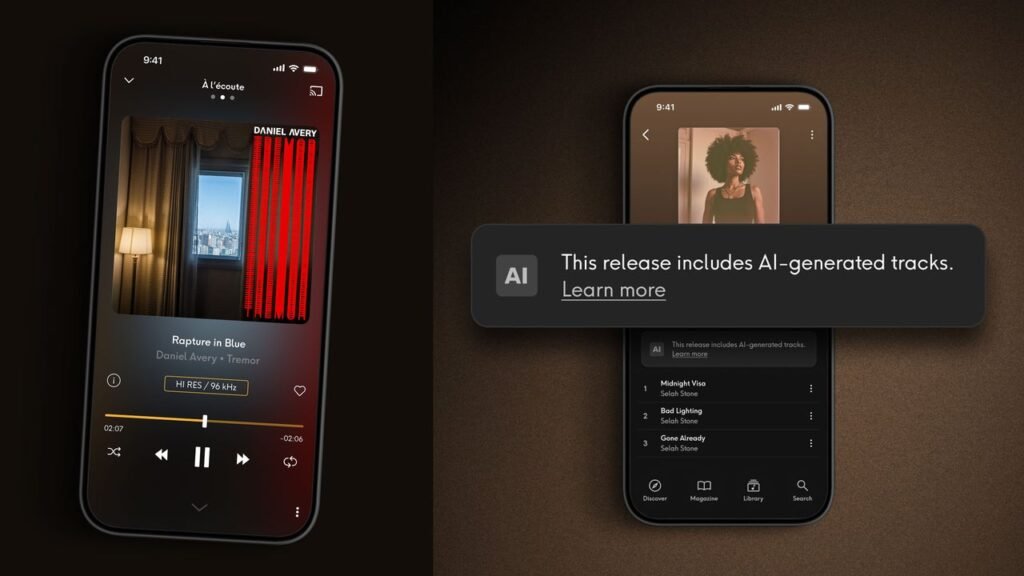
Like every other music streaming service, Qobuz has been enduring a sudden and violent surge of AI-generated audio, but Dan Mackta, Managing Director at Qobuz, refuses to use the term “AI music.”
“I’ll call it music-esque content,” Mackta says of the tens of thousands of AI-created songs that hit music platforms daily. “Music goes straight to people’s emotions. It’s not something to fool around with.”
Deezer, another prominent streamer, recently shared that it’s receiving 90,000 AI-generated songs per day. Mackta doesn’t care to find out the exact number coming to Qobuz, but he knows it’s a lot.
“Who asked for this? It’s all just fraud,” Mackta says. “It’s a shame that we have to put so much energy and resources into combating it. But of course we do. We have to. It’s an industry-wide problem.”
And yet, from a certain perspective, “music-esque content” might actually be a blessing in disguise for Qobuz. Since AI slop has been flooding platforms, Qobuz has seen massive growth. The company saw a 45.7% revenue increase in 2025 compared to 8.8% for the overall streaming market with their monthly active users reaching 1.2 million .
These kinds of spikes can involve numerous factors such as increased brand awareness, product endorsements, and, in 2026, viral internet moments. Qobuz has benefited from all three of late. Its viral moment came when Spotify was running ICE ads, leading to a land rush towards Qobuz.
Human by design
But something Qobuz has kept at its center as it has grown is its focus on authentic creativity. The French streamer, which expanded into the US in 2019, has clear tenets for approaching the concept: high-quality audio, human curation, original editorial. So, when listeners want to be sure they won’t be subjected to music-esque content, Qobuz is a natural choice.
As soon as they open the app, they see the words “New Releases Handpicked by Qobuz” front and center. Instead of flaunting an algorithm that tracks their every click, Qobuz shows that its team is working to find the best music possible.
“Music is totally unique, as an art form,” Mackta says. “It really doesn’t work like any other medium, even other arts, in the way that it is a vehicle for human-to-human communication.”
Part of maintaining that vehicle involves regularly cleaning it up. The company has removed some four million AI-generated tracks from its internal search tool because they had no listening activity. It has also excluded about 60% of streams on AI tracks from royalty payouts due to fraud activity. Additionally, in September, the company rolled out a tag that identifies tracks as AI-generated.
Those are just the latest efforts to keep quality at the center of its offering. When Qobuz started as a digital music store in 2008, it was the first to offer CD-quality lossless (16-bit FLAC) downloads. The company expanded into streaming in 2014, offering lossless playback at launch—a full 11 years ahead of Spotify’s global lossless audio launch. And even now, Qobuz’s lossless streaming is slightly higher quality than Spotify’s.
Human curation is a weekly process. Qobuz’s global team discusses their favorite music they’ve heard recently, whether it’s an album they got from a label or something a friend recommended. From there, they select which releases are best for the app as a whole and individual regions, such as the US, UK, Australia, and Japan (it operates in 26 countries total). The new releases slider on the app homepage, Album of the Week, and even mood playlists like Summer Reggae are all handpicked.
Finally, Qobuz has an in-app magazine that also pairs articles with artist profiles. Users can read and listen simultaneously, fully immersing themselves in the music.
Qobuz accomplishes all this with 120 full-time employees. Spotify has over 7,000.
“The biggest companies that have ever existed are our competitors,” says Mackta. “It would be nice to be able to introduce new features in our apps faster, but we don’t. Instead, we try to be the best online music store with a built-in fanzine that we can be.”
It’s doing some of that work with the help of AI, in line with its AI charter that outlines exactly how AI is used in its business operations. For example, on the recent introduction of the new UI, Qobuz engineers used AI tools to make their back-end work more efficient, but no AI was used in graphic design or anything else creative.
“We can’t be saying one thing about music and another thing about photography. It’s not consistent,” Mackta says.
The industry is all about it
Qobuz’s values are resonating with artists, too. Yasiin Bey, the rapper formerly known as Mos Def, who once said the streaming revenue model is “gross,” made his 2009 opus The Ecstatic exclusively available on Qobuz.
“It’s not so crazy to think that starting from a position of respecting the art and the artist actually resonates with people, but it’s as simple as that,” Mackta explains.
That’s why Emma Wilkes, a professional music journalist, chose Qobuz as the first streaming service she’s paid for. Prior to signing up, she used Spotify’s free tier to discover music but mostly bought her music on iTunes. She especially appreciates Qobuz’s sound quality because she writes a lot in punk, metal, and hardcore.
“When you try and listen to Napalm Death on Spotify, you see how bad Spotify sound quality is,” Wilkes says, going on to mention how Qobuz provides relief from AI as well.
“I don’t think Spotify is doing enough about AI. That’s genuinely really damaging to music, ” she says. “I very much appreciate that Qobuz values human curation as much as it does. It’s about creating and supporting an ecosystem.”
The reality of AI on streaming
Many people may have switched to Qobuz, but Tatiana Cirisano, Vice President of Music Strategy at MIDiA, doesn’t foresee a mass exodus that will drastically affect Spotify’s dominance of the market.
“The vast majority of people will choose convenience regardless of their personal attitudes or values,” Cirisano says. “People might say, ‘I don’t want to listen to AI-generated music,’ but they may end up listening to it anyway and not notice or care.”
As such, Cirisano relates the rise in Qobuz usership to music superfans such as Wilkes. Spotify has 761 million monthly active users. Only a fraction of that number are willing to buy merch or attend a three-day festival because Spotify, by nature, attracts a less-invested fan. $13 a month provides ad-free access to almost every song in history, and an algorithm constantly feeds them new things.
Pair that with an explosion of AI content, and you have artists competing with AI for a dwindling piece of Spotify’s royalties.
“Not only were a lot of these AI-generated tracks made using tools that were trained on human catalogs without permission, but that music is now competing for the same listeners,” Cirisano says. “The pot of money that can be paid out to each song and each artist isn’t growing as fast as the number of mouths to feed.”
So, in the wake of AI, when Cirisano consults with streaming services on how to handle this discrepancy, her advice would likely sound familiar to Mackta.
“If we were in a place where people listened to artists and not just songs, where there was context about the artist presented alongside the song,” she says, “I don’t know that AI-generated music would be disrupting the market in the way that it is.”