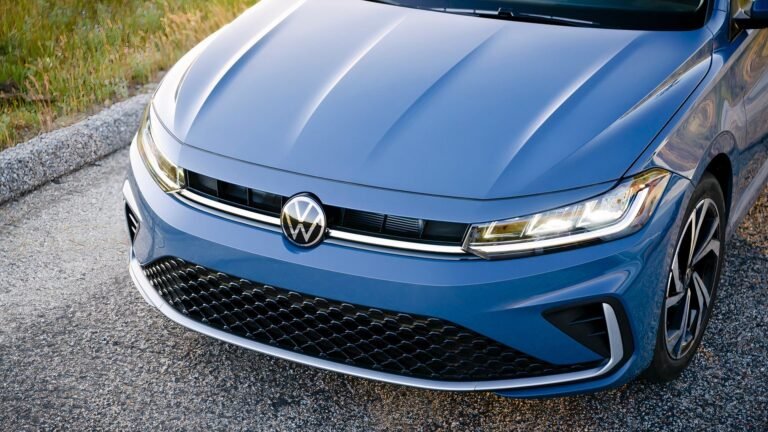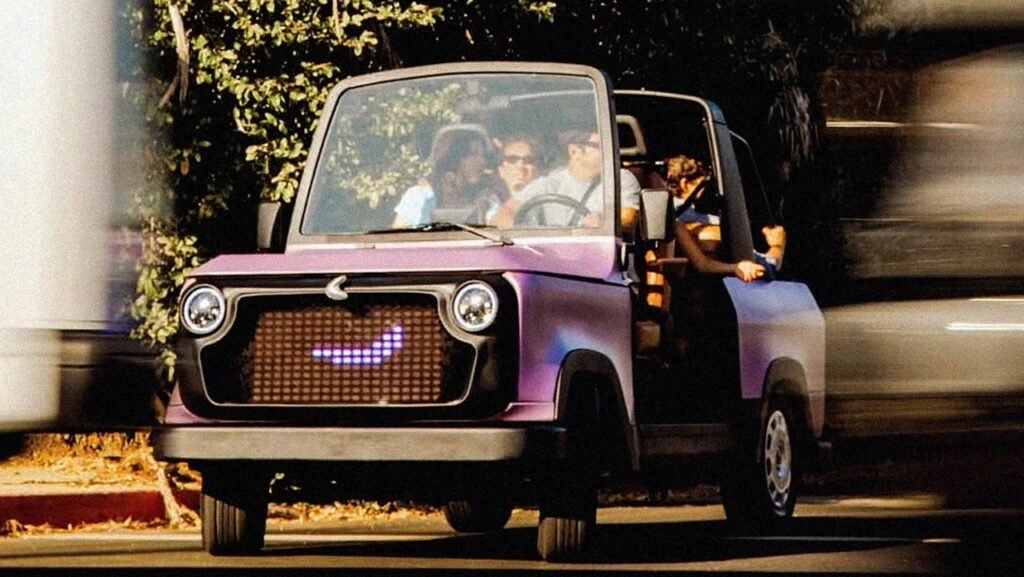
For decades, automakers have been designing cars to look like they have faces. Headlights resemble eyes, grilles look like mouths, and the shape of a hood can give a vehicle something resembling an expression. That is, of course, no accident. Designers have long played on our tendency to see human features in inanimate objects, giving sports cars aggressive scowls and family-friendly vehicles softer, more approachable expressions. The idea is to make us feel something about a car before we ever get behind the wheel. The Lamborghini designer Mitja Borkert said you want to find a “character” on the front of your vehicle.
But until recently, those expressions were essentially frozen in place. Last month, during a test ride in a new vehicle called Chip, I encountered something different: a car that actually smiled at me and said hello. Its headlights even blinked.
I was riding around Los Angeles in October in a slender, souped-up lavender minicar called Chip, namesake product of the Miami-based startup Chip Motors, which was founded in 2024. The reactive facial expressions and voice feature for the vehicle—still being finalized for delivery to customers starting in the second half of 2027—underscore the idea that this six-seater, which tops out at about 25 miles per hour, offers a different take on what the American family wants out of an everyday vehicle.
Taking an hourlong spin around Venice Beach, past the Washington Street Pier and over the famous canals, the ride was certainly leisurely. Cars kept passing us as we slowly ambled toward the Pacific Ocean, and it felt and looked like riding a golf cart. But as we perched on leather seats, the open-top ride felt relaxing in the sunshine, and passersby, who were keen to strike up conversations due to the lack of a traditional door and window, kept giving the vehicle second glances as it rolled along.
Eventually, this so-called “Life Utility Vehicle” will offer amenities and features, including enclosed roofs, that its designers hope make it a family vehicle of the future. A planned driverless feature will enable Chip to go to the grocery store and pick up your order, or even go home and charge (maximum range 100 miles) after dropping you off at a restaurant.
A four-seater version will start at $15,000, with a six-seater priced at $18,000; the company plans to take orders soon and begin to deliver early production runs by mid-2027. Still-in-development agentic AI will allow you and your family to talk with Chip, which can change the stereo, understand your family calendar, and even talk to passersby.
Chip symbolizes a number of intersecting transportation trends: the growth of electrification, the ballooning cost of car ownership and gasoline pushing families to find cheaper options, and the explosion of golf cart sales, set to grow by $1 billion globally over the next 7 years (the U.S. makes up roughly 50% of the market).
“It’s so rare that consumer behavior changes, and particularly around cars in America,” said Jameson Detweiler, CEO and cofounder of Chip Motors. “I do think that the American love affair with the car has been dying a slow death. Cars have gotten more boring.”
The golf cart craze, explained
Golf carts have become more and more popular as a way to navigate neighborhood errands and school drop-offs—a majority of U.S. car trips are under six miles—and a number of cities have passed ordinances to allow them, or are considering plans to lower speed limits to accommodate these smaller rides.
Sales of golf carts in the U.S., roughly $1.1 billion in 2025, have hummed along at annual growth of more than 6% for years, and the increasing use of these vehicles outside golf courses has been called a “craze.” Just south of Los Angeles, there are plans in the works between communities such as Manhattan Beach and El Segundo to create a loop of lanes, called the South Bay Local Travel Network, to help these vehicles navigate around nearby communities.
The great American family car has been expanding for years due to car bloat; roughly four in five cars sold in the U.S. today are SUVs or pickup trucks, which had only a quarter of the market back in 1990. But increasingly, especially in Sun Belt suburbia, the second car (or cart) may be shrinking.
Often grouped together due to a similar form factor, golf carts and these low speed vehicles have become a fast-growing sector. A number of other entrants seek the same market that Chip wants to own. Fiat is importing its Topolino, and a former Apple designer has created the futuristic Amble. In New York City, the Wink Mark3, a five-door hatchback with heat and AC that starts at just under $14,000, is one of a number of “small city scramblers” that may be positioned to capture a more cost-conscious consumer. They all offer more amenities, and safety features, than traditional golf carts, but don’t meet the same safety standards as small cars.
Low-speed vehicles (LSVs) come with federally mandated safety features and are generally permitted on roads with speed limits of 35 mph or less, though state and local rules vary. Golf carts technically need to meet these standards to be able to roam on neighborhood streets. Chip’s form factor, a retro-futuristic design compared to Jeep, Bronco, and the Citroën Méhari beach car, was a deliberate attempt to inject personality into staid auto design, as well as escape the uncool associations of golf carts.
Chip’s designers see it as a lifestyle vehicle as well; owners will be able to purchase accessories such as surf racks or a TV and speaker that fits under the hood for tailgating (party in the front package).
More such golf carts and LSVs would be a boon for many of America’s transportation issues. Lower speeds mean fewer traffic accidents, a seemingly intractable American problem, and electric models can help decrease our significant amount of vehicular emissions.
This future, a low-speed transportation paradigm, can already be viewed, most notably in retirement villages and planned communities. Florida’s Babcock Ranch, a solar-powered master-planned community of more than 15,000 people outside Fort Myers, Florida, promotes golf carts and low-speed vehicles with on-site repair shops, right-sized parking spots and roundabouts for safer rides. Roughly 80% of homes have a cart. “It’s the infrastructure,” says Syd Kitson, the development’s founder. “There’s also a culture, and people take a lot of pride. They embrace the golf carts.”
Small cars, big safety questions
But for all the fun these vehicles promise, there can also be some trepidation about safety issues. Having golf carts and these LSVs—which are smaller, have slower acceleration, and fewer safety features—share the road with oversized SUVs driven by distracted drivers raises significant concerns. It’s common to see news reports of golf cart accidents. (However, National Highway Traffic Safety Administration data from 2020 to 2024 shows a decrease in crashes involving golf carts and neighborhood electric vehicles, which peaked around 2022.)
Transit experts like Katherine Hunter-Zaworski, a professor at Oregon State University who agrees these vehicles offer sustainable, affordable last-mile transportation options, say they tend to have very little in the way of safety features. Chip, according to Detweiler, the company CEO, is being designed with active safety measures, including warning systems and sensors, and the body will have crash safety testing.
Hunter-Zaworski fears these vehicles, very lightweight compared to the other vehicles on the road, just aren’t designed for city streets.
“What’s happened is these vehicles have escaped protective custody,” she says. “We need to actually look at our road real estate and decide how we’re going to allocate that real estate. That’s the big question.”
Narrower streets and assigned lanes would be safer, says Hunter-Zaworski. She’s pessimistic that change will happen during the Trump administration, when car-free transit funding is being cut and bike lanes are attacked.
But industry backers believe in a future where model safety codes, and investment in better infrastructure, create more space for these types of vehicles on our roadways. Take the LUV Initiative, for instance, an industry group including players like Chip and the scooter company Bird, as well as city transit departments and national transportation groups. LUV (for local use vehicles) is seeking to create standard definitions for vehicles, safety regulations, and infrastructure to promote their use.
Marla Westervelt, a longtime transportation researcher, policy expert and coleader of the initiative, says the group, which started meeting over the last year, is pushing for state regulations, city guidelines, and lowering speed limits to accommodate more of these vehicles.
“Cities are excited about these vehicles because they are more affordable, so it’s providing equitable access,” says Westervelt. “There are economic forces that are pushing towards these smaller vehicles, as well as preexisting pushes in the urban planning community and transportation community to make roads safer that do kind of converge.”
Other technological shifts could help accelerate the adoption of LSVs. Westervelt believes logistics companies, which are increasingly using e-bikes and quad bikes for urban deliveries, have the financial incentive and resources to help fund infrastructure for smaller, slower vehicles, benefiting cities eager to reduce congestion and pollution.
Detweiler at Chip, meanwhile, sees the rise of autonomous vehicles as another potential catalyst. As services like Waymo become more common for longer trips, families may be more inclined to trade their full-size cars for smaller, cheaper vehicles designed for everyday neighborhood travel. “There was a time not all that long ago where our vision of the future looked positive, looked bright, looked colorful, and was inclusive and accessible to everybody,” he says. “That’s the vibe we’re bringing here.”