I’m an artist who also curates exhibitions. Most of my friends are other artists, who often want to be included in the shows I put together. Increasingly, I can’t tell who my friends really are because everyone needs something from me. How do I know who is an actual friend versus a transactional friend? —Friendly Fire
You’re navigating a power dynamic dilemma that isn’t uncommon in the art world: You curate art for venues where your friends want to show, but your friends may not be able to return the favor. Plenty of relationships weather this power dynamic just fine, but usually, there’s a long arc to the relationship. Over decades, a relationship will absorb periods of imbalance and still hold.
More problematic relationships suffer from two types of issues: inappropriate asks and requests you can’t fulfill.
Part of what makes this so exhausting is that the ask often misreads the relationship. The most effective way to engage a curator in conversation is to ask them what they’re working on, and then let them know if anything you’re working on relates to it. However, it’s not unusual for artists to make brash requests. Almost every curator has heard some version of “you should put me in your show.”
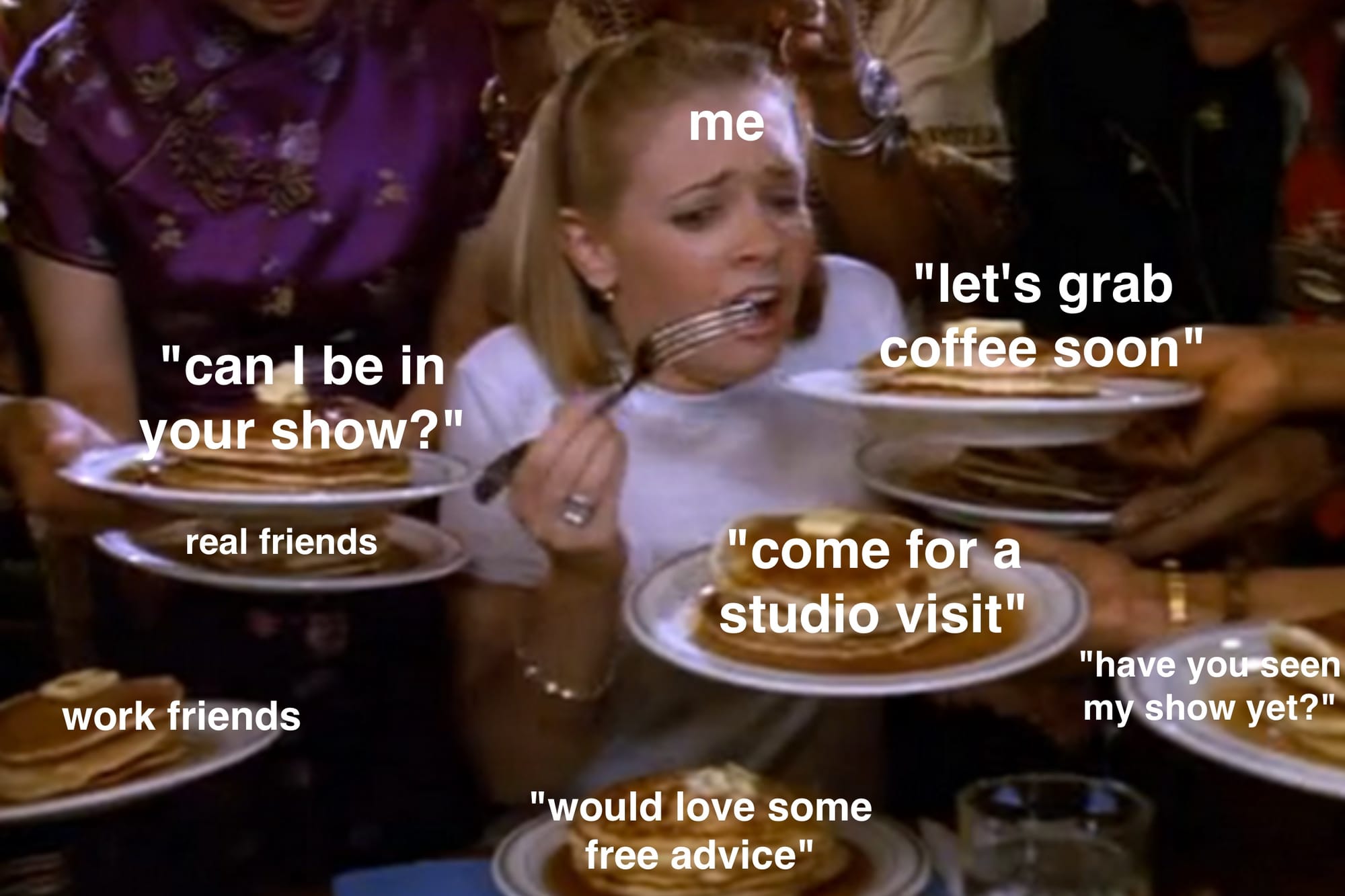
During a recent workshop for grantees at the Trellis Art Fund retreat in Neversink, New York, independent curator Dexter Wimberly described this common error as “leading with your ego.” Ego-first asks take many forms. To the press, the pitch looks like, “I have a story for you” — only it’s not a story, it’s an exhibition attached to the desire to be written about. Consultants are often asked, “Do you want to get a coffee?” — only it’s not coffee among peers, it’s an hour and a half of free coaching. Gallerists field solicitations in their showrooms like “Can I get your feedback on my work?” — only, it’s not a conversation, it’s a question about whether they can have a show.
Name the profession, and if there’s an opportunity to be had, someone will ask for it poorly — even our actual friends. I’ve had friends ask for press in circumstances that would clearly create a conflict of interest, and for a favor without even realizing they’re asking for one. At the same time, I’ve had colleagues provide the kind of support I would only ask of my closest friends.
As an artist-curator, you may never know how to accurately describe all your relationships. On the surface, your real friends are the people you call when you have a personal problem. Your work friends are colleagues — you connect well with them and get drinks, but you’re not asking them to come to your wedding or help you move.
But life is messy, and relationships rarely fit into such clean categories. The question of who counts as a friend may be best answered by considering the terms of the relationship. What is the implicit give and take, and do your friends’ requests fall in line with that? If not, you may need to have a conversation about boundaries in your working relationship.
It’s easy to confuse friends and colleagues when you’re constantly asked for things you can’t deliver. Sometimes, an artist asking for inclusion in a show can come from a place of entitlement, a request for access they haven’t earned but feel they deserve nonetheless. Other times, you may not be able to fulfill the request because it’s not the right fit. Either way, you have to say “no,” and it can take a toll on the relationship if the artist has framed their request as something a real friend would fulfill.
For many artists, inclusion operates not just as an opportunity for visibility and income but as evidence of artisthood. A friend outside the industry can ask, “Are you still an artist?” That can be triggering, but not as much as when a curator turns them down. The rejection becomes a challenge to the artist’s identity.
That’s part of why the ask feels so entitled on your end, and so reasonable on theirs.
For you, though, the exhaustion comes from the same place: the use of the friendship as a negotiating lever where saying “no” seemingly signals something about the relationship itself, not just the request.
Setting expectations early on in the relationship reduces friction. Letting a friend know that you hope to include their work when the timing is right, but that there are no guarantees, is easier than managing the fallout later. Reframing the question as a cost can help, too. Sometimes, you include people in shows because you decide the cost of omitting them is more than you want to pay. Other times, it may feel too great a compromise. Either way, the decision is yours to make.
Editor’s Note: If you have a problem you’d like advice on, send your questions to paddy@netvvrk.com. Include your name and location, or a request to remain anonymous. Letters may be edited.