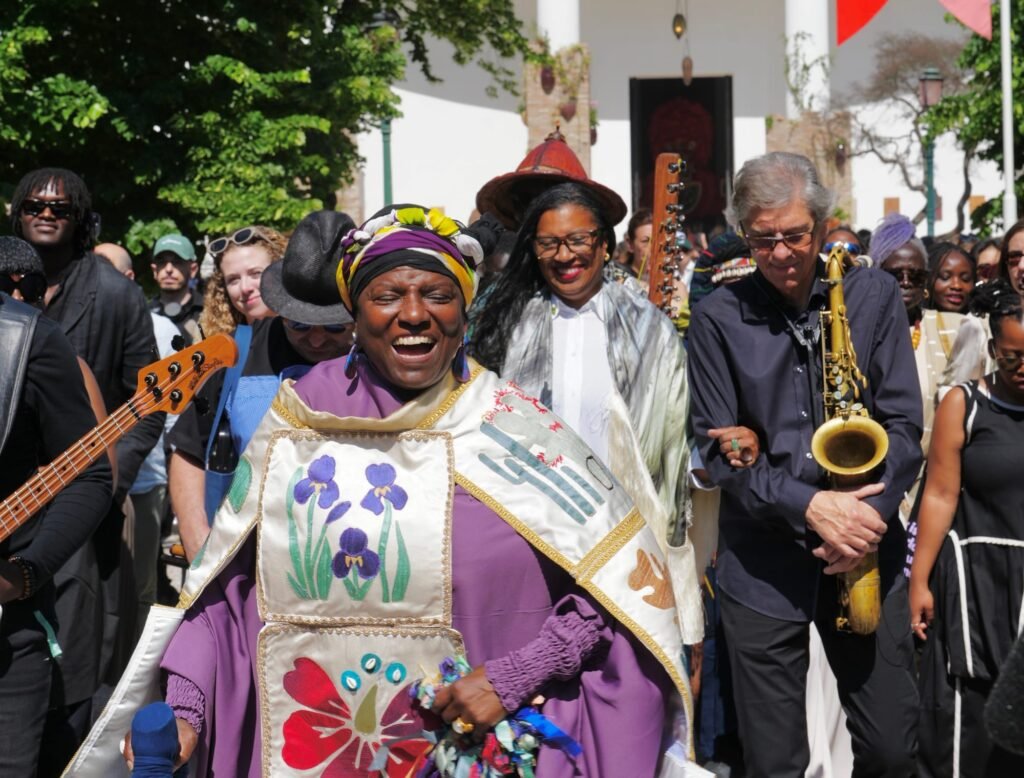
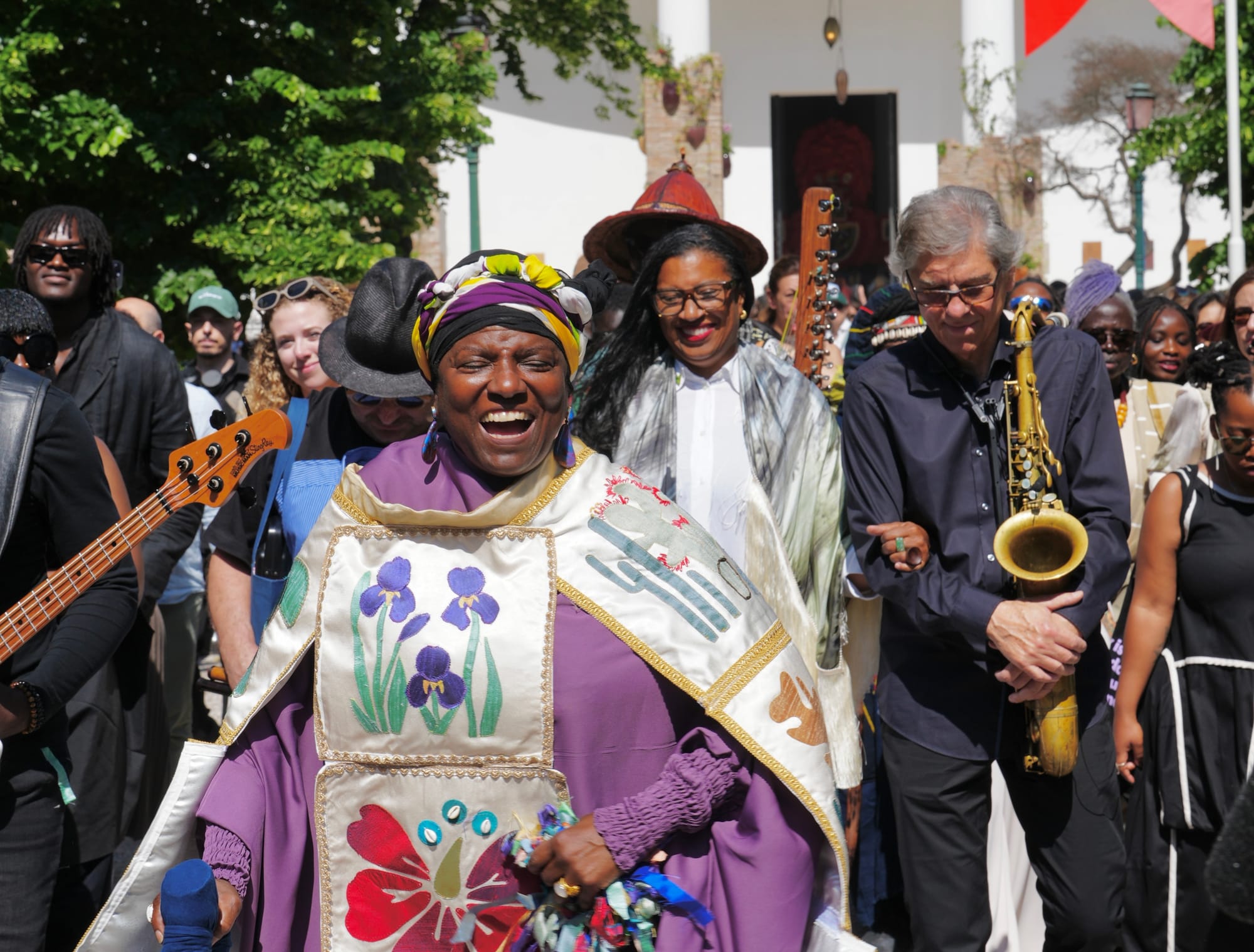
VENICE — In the middle of the second day of the Venice Biennale’s opening preview, Cuban artist María Magdalena Campos-Pons took the first step of a poetry caravan across seven locations in the Giardini in honor of Koyo Kouoh, the late curator of this year’s main exhibition, In Minor Keys.
“Today and forever, Koyo Kouoh, you are here with us… We are coming. Almost there, mother of the water. Almost there, mother of the ocean,” Campos-Pons announced to the growing crowd, some of whom were fellow artists that Kouoh selected for the Biennale. Many more were unsuspecting bystanders standing in line for free Illy-sponsored espresso, now forced to confront the conscience so often separated from commerce at this art-world spectacle.
This was a gift to Kouoh, Campos-Pons continued, “a minor key to keep fighting and working for the center of our core, for the center that is what is to be human. And be a daughter, a son, of the original continent of humanity, Africa.”
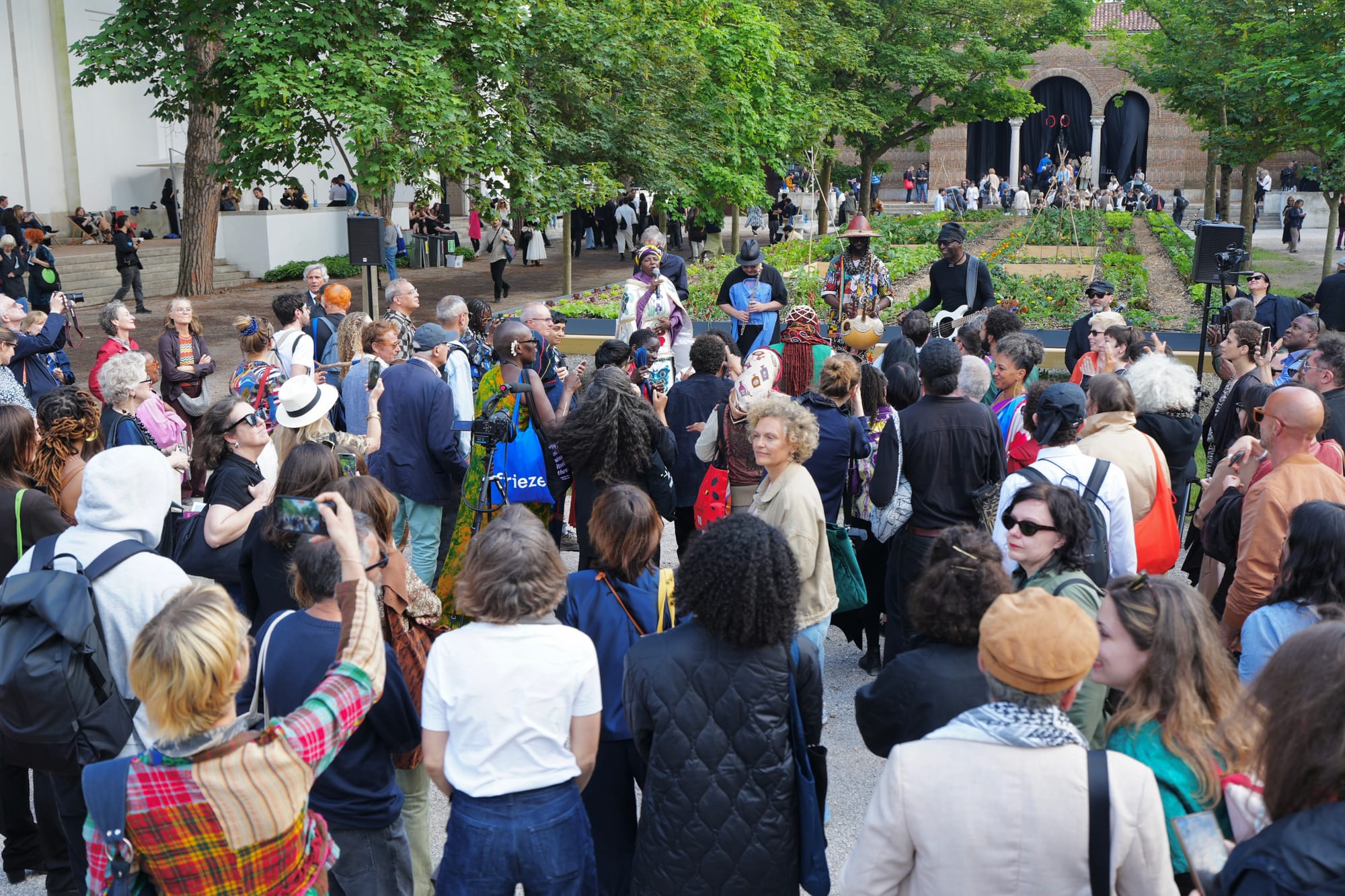
After Kouoh died suddenly of cancer at age 57 last May, a five-person team of her assistants and advisers worked to channel her curatorial practice in her absence. They took to the ad hoc stage today, a slightly raised pavilion suddenly erected along the Giardini’s main promenade, indicating that while this procession was absent from an official schedule, it was sanctioned.
Marie Hélène Pereira, curator and stand-in lead of the 2026 Biennale, explained that this poetry caravan takes inspiration from a voyage Kouoh took with nine African poets from Dakar to Timbuktu in 1999.
“Today, we would like to convey prose as a form of expression, nascent from the unspeakable feelings which emanate from various streams of oppression around the world. We have gathered voices that hum, speak, sing, chant, and howl,” Pereira told the crowd.
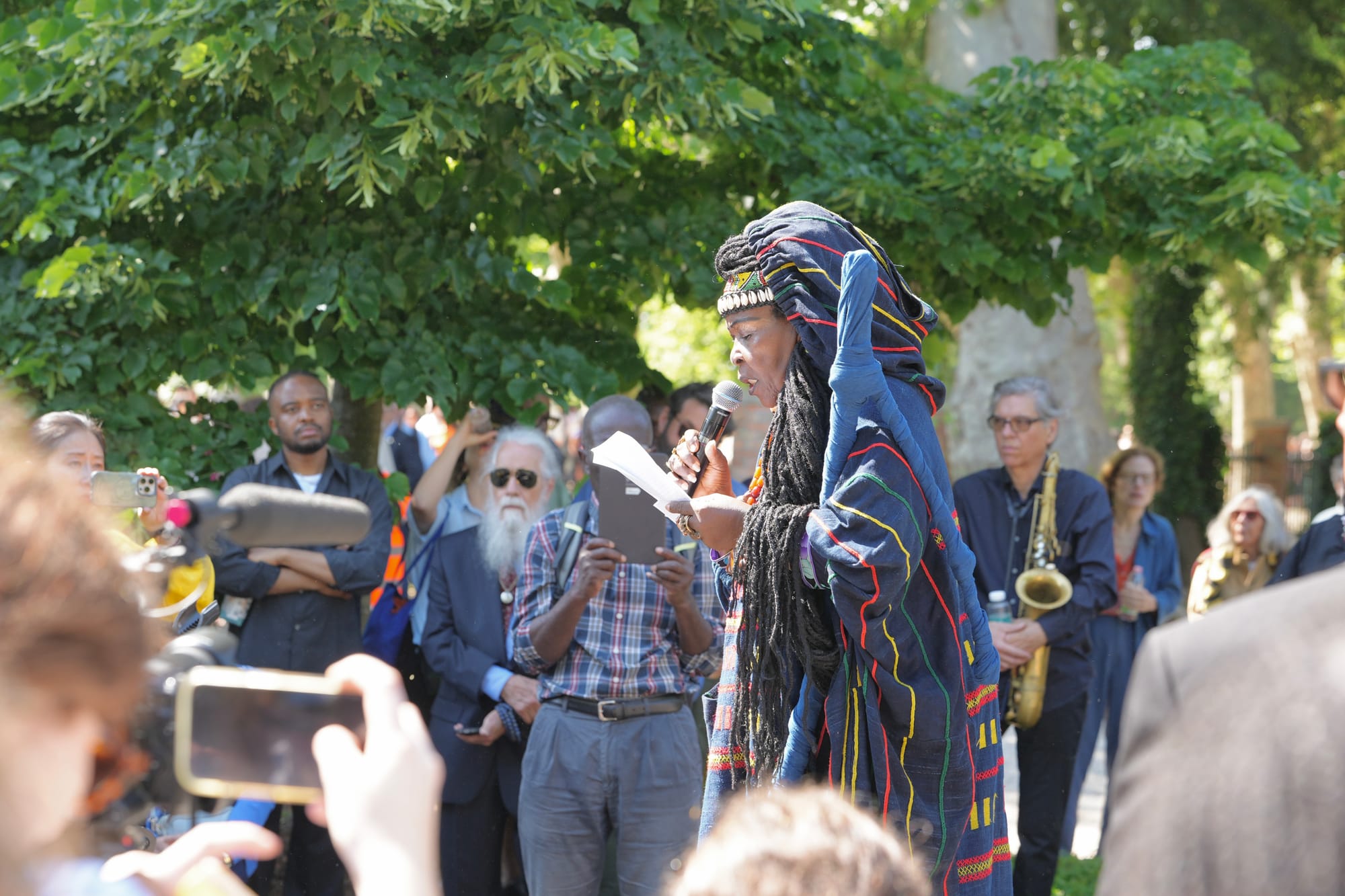
More than a dozen people spoke under the hot afternoon sun, in several languages, among them the acclaimed poets Natalie Diaz, Robin Coste Lewis, Batool Abu Akleen, and Anne Waldman. “We must protect all the beauties of our civilization,” Waldman said before reading a work about the power of the archive. “We’re still waiting for the next level of transition, and this helps.”
There was poetry without words, too, from virtuosic kora player Saliou Cissokho, who seemed to bring a calm to the Biennale, and from Swiss saxophonist and composer Philippe Mall, Kouoh’s husband. He played an original composition titled “Wise One,” dedicated to his “beloved friend and wife,” as well as Nat King Cole’s “Nature Boy.”
“That song has everything; it transposes the ‘minor feeling’ exactly,” Mall told Hyperallergic. “It’s a good thing that I can play an instrument, because when I try to talk about her [Kouoh] it’s almost impossible.”
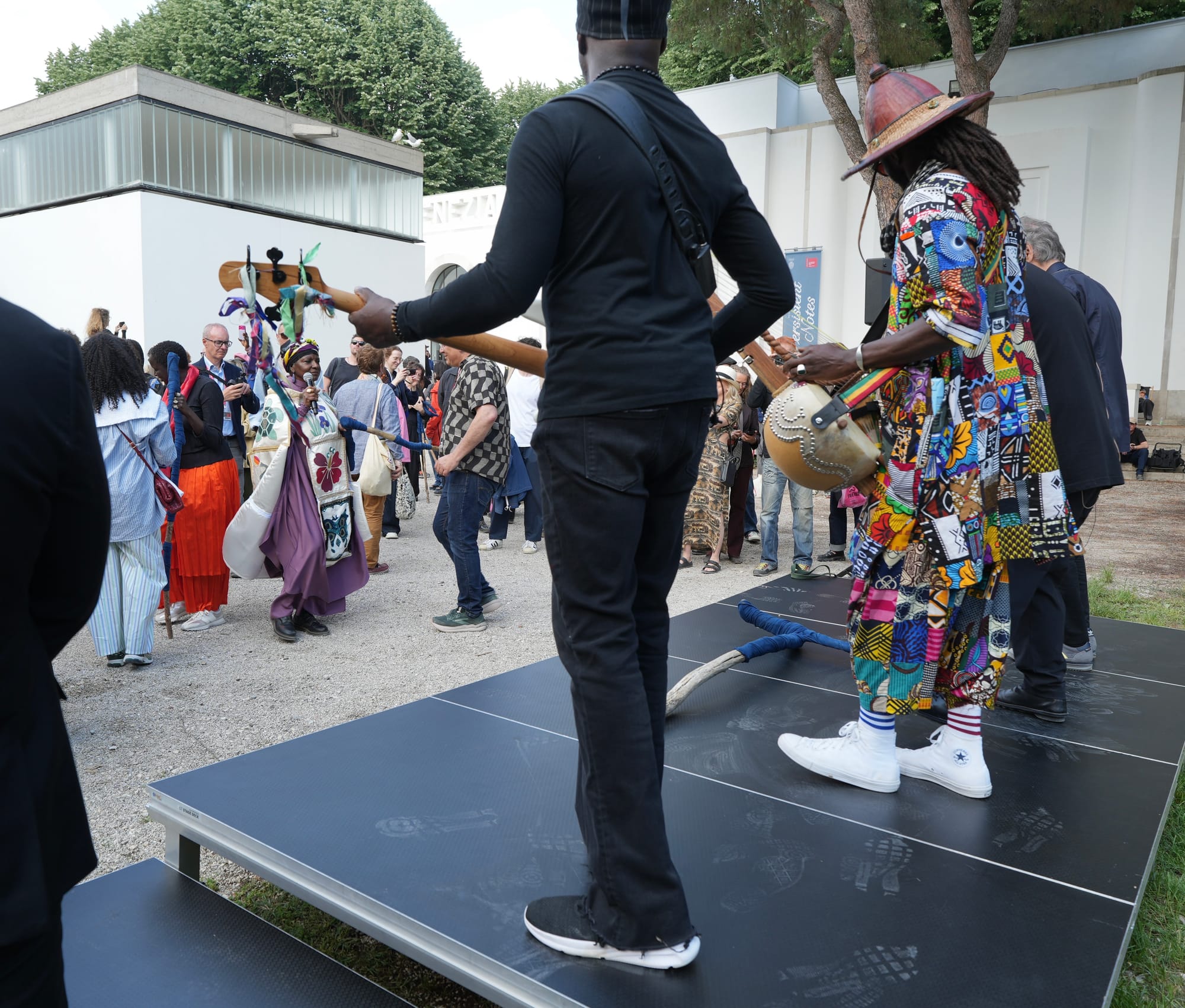
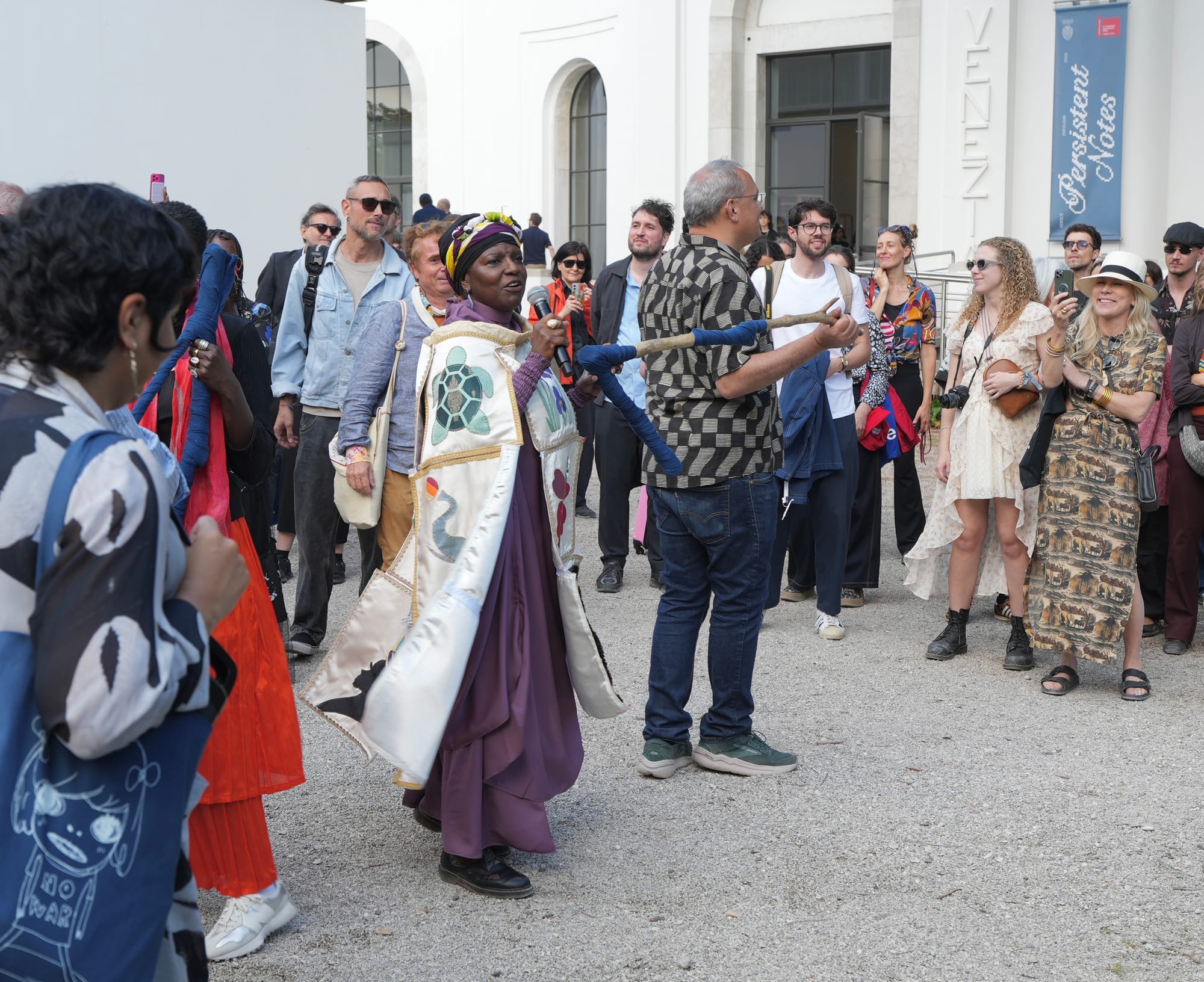
Romanian photographer Radu Neacșu was on his way to grab food when he was pulled in by the slowly moving mass of bodies.
“I am Orthodox, and it reminds me of the Easter tradition, of going in a group to church,” Neacșu said. “We are connected to one another through an invisible bind, and the world needs exactly these kinds of performances now.”
In between “Orange Elegy” by Bahamian-Trinidadian poet Christian Campbell — “I thought an elegy was appropriate in the context of mourning Koyo and a mourning of the world,” he told Hyperallergic — and remarks from Kouoh’s younger brother, Bonaventure Soh Bejeng Ndikung, Anna M. Dempster, a curator and a Fellow at Cambridge University’s Wolfson College, mused that this poetry caravan was different from other gestures she’d seen at the Biennale.
“So much is about anger,” she said, recalling yesterday’s protest against the Russia Pavilion, staged by Pussy Riot and FEMEN. “This feels like a reflection of African culture’s joyfulness despite the depths of pain.”