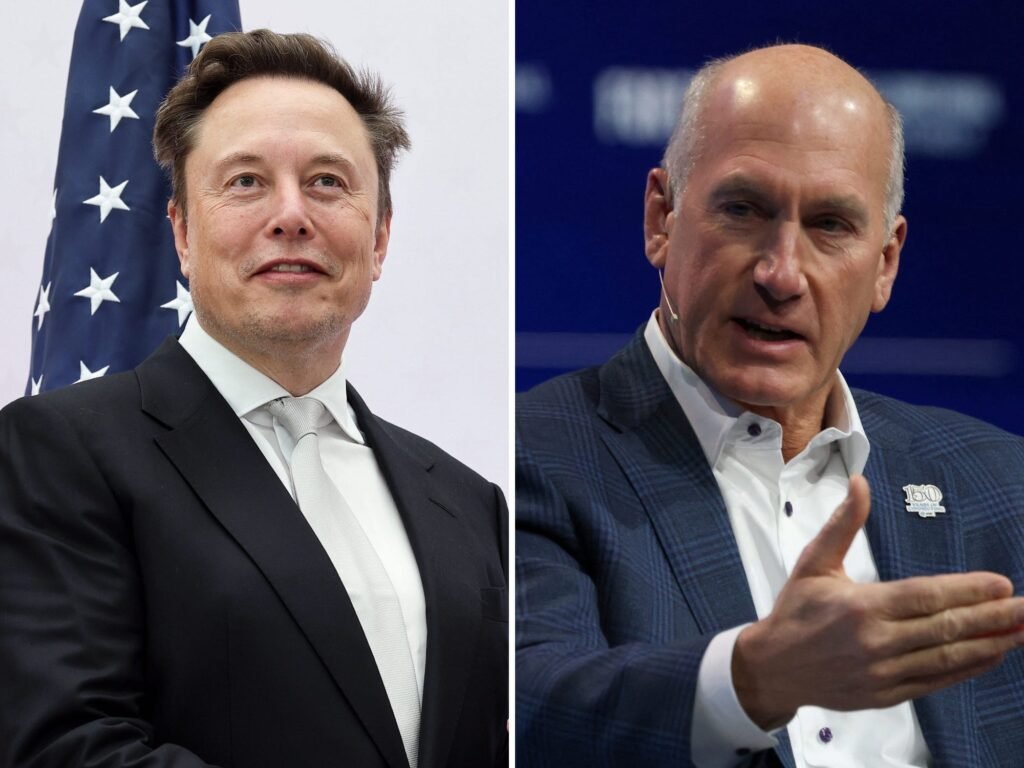
Win McNamee/Getty Images (Musk); Lluis Gene/AFP via Getty Images (Stankey)
- AT&T CEO is brushing off concerns that satellite-based internet could threaten his business.
- “I think LEO constellations are fantastic for delivering bandwidth to rural areas,” he said.
- When it comes to where lots of people live, he said fiber-connected performance can’t be beat.
Elon Musk wants SpaceX to become a major US mobile carrier. AT&T CEO John Stankey says: not so fast.
AT&T has an advantage from years of investment in dense urban and suburban areas, he said on AT&T’s third-quarter earnings call, a day after Musk and SpaceX chief operating officer Gwynne Shotwell reported more than 22 million monthly Starlink Mobile users.
“Our competitors cannot and will not match our operating proficiency, network performance, or exceptional converged value proposition,” Stankey said.
Stankey sees a use case for satellite-based internet to soften the edges of fiber-connected and 5G networks, especially in places where it’s too expensive to build out the physical infrastructure, he said.
“I think LEO constellations are fantastic for delivering bandwidth to rural areas,” he said, using the acronym for low-Earth orbit satellite arrays.
Shotwell said Tuesday that Starlink recently got FCC approval to launch 15,000 V2 satellites. She also noted a recent agreement to acquire a portfolio of low-band transmission spectrum, or wireless frequency licenses, which better penetrate buildings to reach indoor devices.
Stankey was unimpressed.
“How you perform indoors, of course, is extremely important, and we shouldn’t think about those as being nominal loads,” he said. “They’re significant loads, even with robust Wi-Fi networks that are out there.”
This is especially critical in crowded environments like stadiums and hospitals, where he said AT&T has been focused on beefing up signal support.
“I wouldn’t over-rotate on what I would call one carrier of low band spectrum,” he said, referring to Starlink.