Electricity prices keep rising in the U.S. Last year, home electric bills surged at more than twice the rate of inflation. By 2030, by one estimate, residential electricity prices in some areas could be as much as 40% higher than they were in 2025. At least one in three American households struggle to pay energy bills.
But the opposite is happening in Australia. Over the past 12 months, wholesale electricity prices dropped nearly in half. And millions of consumers can now sign up for three hours of free power in the middle of the day.
The country shows how a more distributed energy system—built around rooftop solar and home batteries—can make electricity much more affordable when it’s done right.
Batteries are changing the economics of the grid
Home batteries have helped drive the cheap prices. Last summer, the Australian government rolled out a new 30% discount on home batteries. The response to the incentive was immediate. In the first three weeks, more than 1,000 home batteries were installed each day. Since the program launched in July 2025, Australians have installed more than 500,000 home batteries.
During the day, the batteries help store solar power. In the evening, when demand surges, so many homes now rely on power from batteries that utilities can avoid turning on more expensive gas power plants.
“This is about avoiding the 6 p.m. peak when everyone gets home and turns on the TV, which is when the whole electricity network is stressed,” says Saul Griffith, cofounder of Rewiring Australia, a nonprofit that advocates for electrification. “And that’s a perfect job for batteries.”
Griffith, an engineer and serial entrepreneur in energy technology, previously cofounded Rewiring America in the U.S., a nonprofit that helped shape parts of the Inflation Reduction Act. During the pandemic, Griffith returned to his native Australia and began advocating for better policy there. As the government looked for ways to replace aging, unreliable coal power plants, Griffith’s modeling helped show that batteries were the best approach.
“If you just did the math on the cost of shutting down a coal plant and building a gas-fired power plant or whatever to replace the coal, it was cheaper to just heavily subsidize batteries,” he says. “And then also hugely politically popular.”
The government originally aimed to support 1 million home battery installations by 2030. But the program was so popular that lawmakers have doubled the goal to 2 million. Meanwhile, electricity prices continue to fall.
Australia made rooftop solar cheap—unlike the U.S.
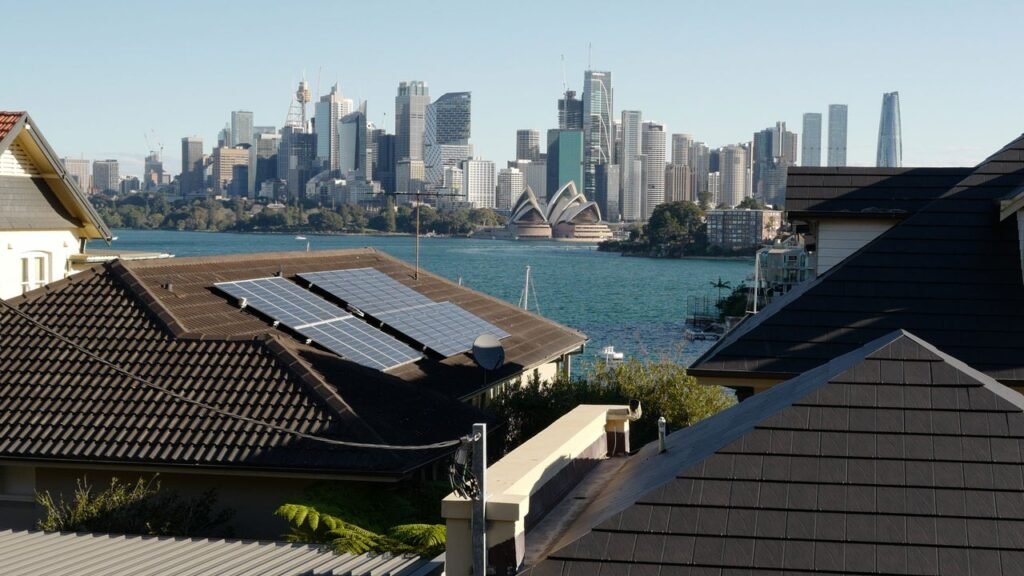
All of this is possible because rooftop solar is also widespread in Australia. More than one in three homes has solar panels. That’s not just because the country is sunny—Griffith points out that two-thirds of the U.S. is equally sunny. Instead, it’s because solar panels are cheap to install there.
Globally, the cost of panels themselves has dropped by more than 90% since 2010. But the cost of getting them installed is still relatively expensive in the U.S.
In Australia, the process avoids much of the red tape that adds to cost. Homeowners can request a permit via an app on their phone, and have it within 24 hours. You can decide to get solar panels and literally have them installed the next day, rather than the two or three months it can take in the U.S. Australia doesn’t require as many inspections. A government program has trained workers to high safety standards, helping contractors avoid liability and reduce more insurance costs. The industry has fewer middlemen; some installers buy directly from Chinese manufacturers.
In the U.S., there are added costs from tariffs. Local jurisdictions also have their own permitting rules, adding to complexity. “It’s death by half a dozen paper cuts in the U.S.,” Griffith says, adding, “It’s just bureaucracy, red tape, tariffs, and ideology that is standing in your way. [The U.S.] should have a ‘get the government off my roof’ campaign.”
The end result is that installing rooftop solar in the U.S. can cost six to eight times more than it does in Australia. In Australia, solar is the cheapest form of electricity for consumers, which is why so many people have adopted it. Now, many electric substations “run negative” on some days, meaning that they don’t need to pull electricity from generators on the grid because so many local homes are producing solar power.
Living with abundant electricity
The abundance of solar power meant that some of it was being wasted, something that the batteries can help address. In three Australian states, a new “Solar Sharer” plan also now requires utilities to offer customers the option to sign up for three free hours of electricity in the middle of the day, whether or not they have solar panels.
“It’s a giant signal from the top down that in the future, electricity is going to be prolific at noon, so learn to change your behavior to use it when it’s prolific,” says Griffith. “Using it can mean charging your car, filling your battery or otherwise taking advantage of it. So I think this is a temporary market measure to help Australians change their behaviors appropriately.”
The cheap solar power in Australia makes it easier for households to decarbonize everything at home. Griffith says that households can save between $5,000 and $6,000 a year if they electrify all of their appliances and their cars. If they add a battery to store their solar power, they can save more.
Large, grid-scale batteries are also growing quickly in Australia, but home batteries paired with rooftop solar have advantages. “The majority of the price of your electricity is the price of delivery—transmission and distribution,” says Griffith. “So even if electricity was free from some magical fusion source that AI designs tomorrow, it cannot get to your house cheaper than rooftop solar. The strategy for the lowest-cost electricity system is always maximize rooftop solar, and then put in a shit ton of batteries.”
At least, he says, that’s true in Australia. “It’s not exactly true in the U.S., because you’ve done so many stupid things to corrupt the rooftop solar market,” he says. “This is a diabolical problem of America’s own making, and it’s driven by ideology and the U.S. utility monopolies.”