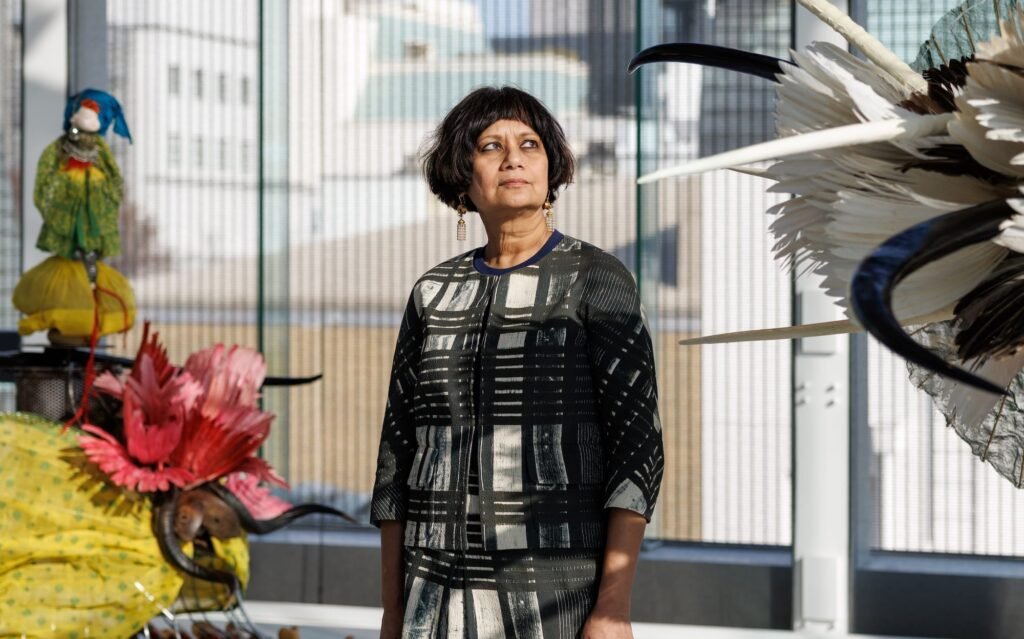
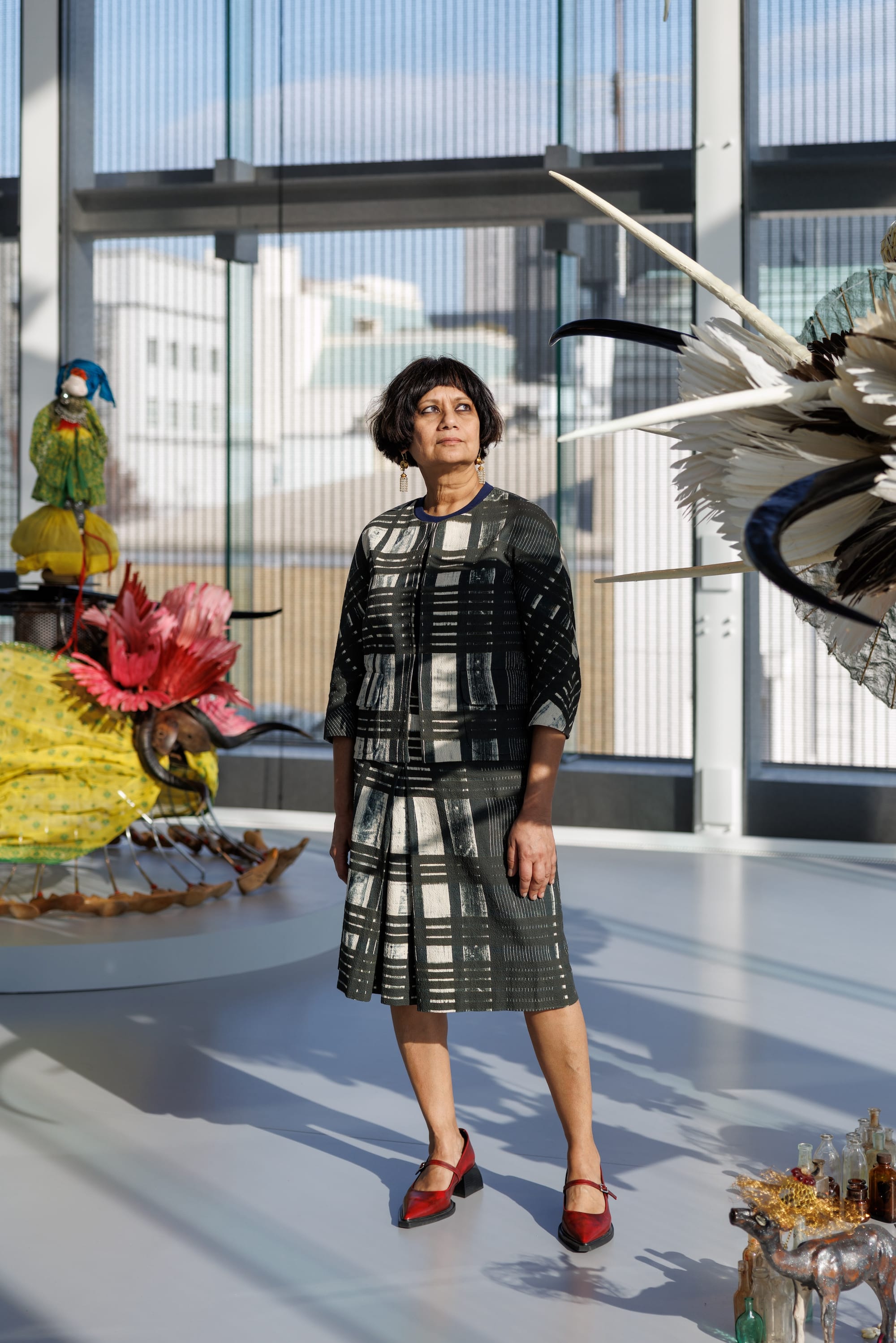
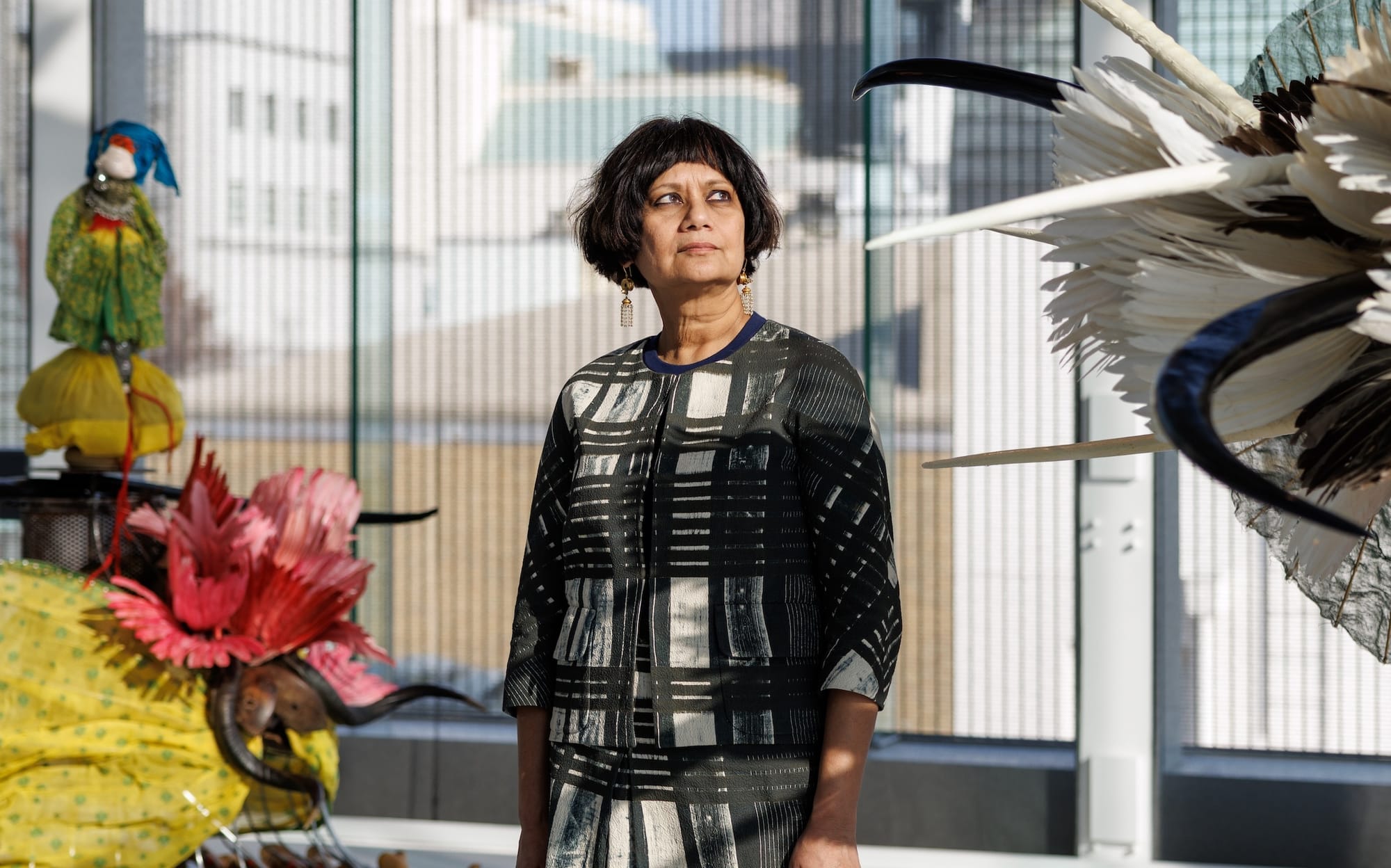
In Rina Banerjee’s world, fingers become tree roots, hair blends with clouds, and the insides come out. We met at her new studio in Dumbo, Brooklyn, and continued the conversation by phone last month. She had come from an errand at the Social Security Administration office and was preoccupied by concerns about how the second-language English speakers would fare — an empathy deeply connected to themes in her work. Her sculpture comments on societal dislocations and separations, proposing a radical conjoining of the earth and feminine energy. A single sculpture might include light bulbs, incense, eggs, gourds, feathers, souvenirs, furniture, textiles, cowrie shells, and hair. Much like the works themselves, each title is a poem in itself.
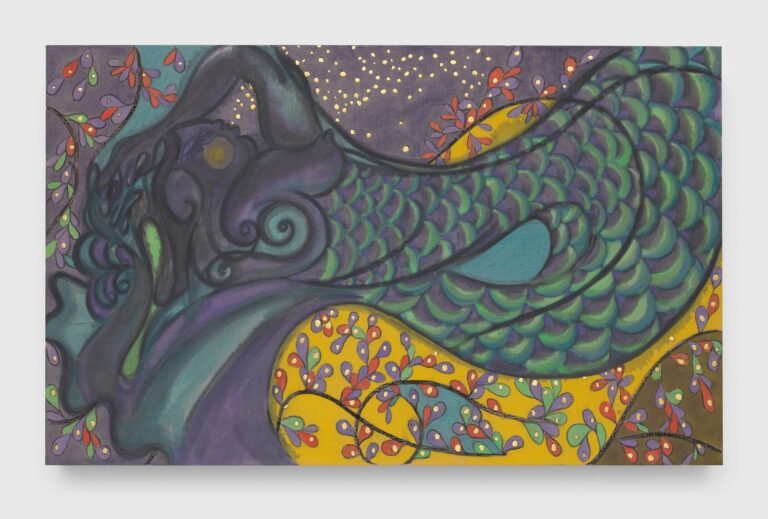
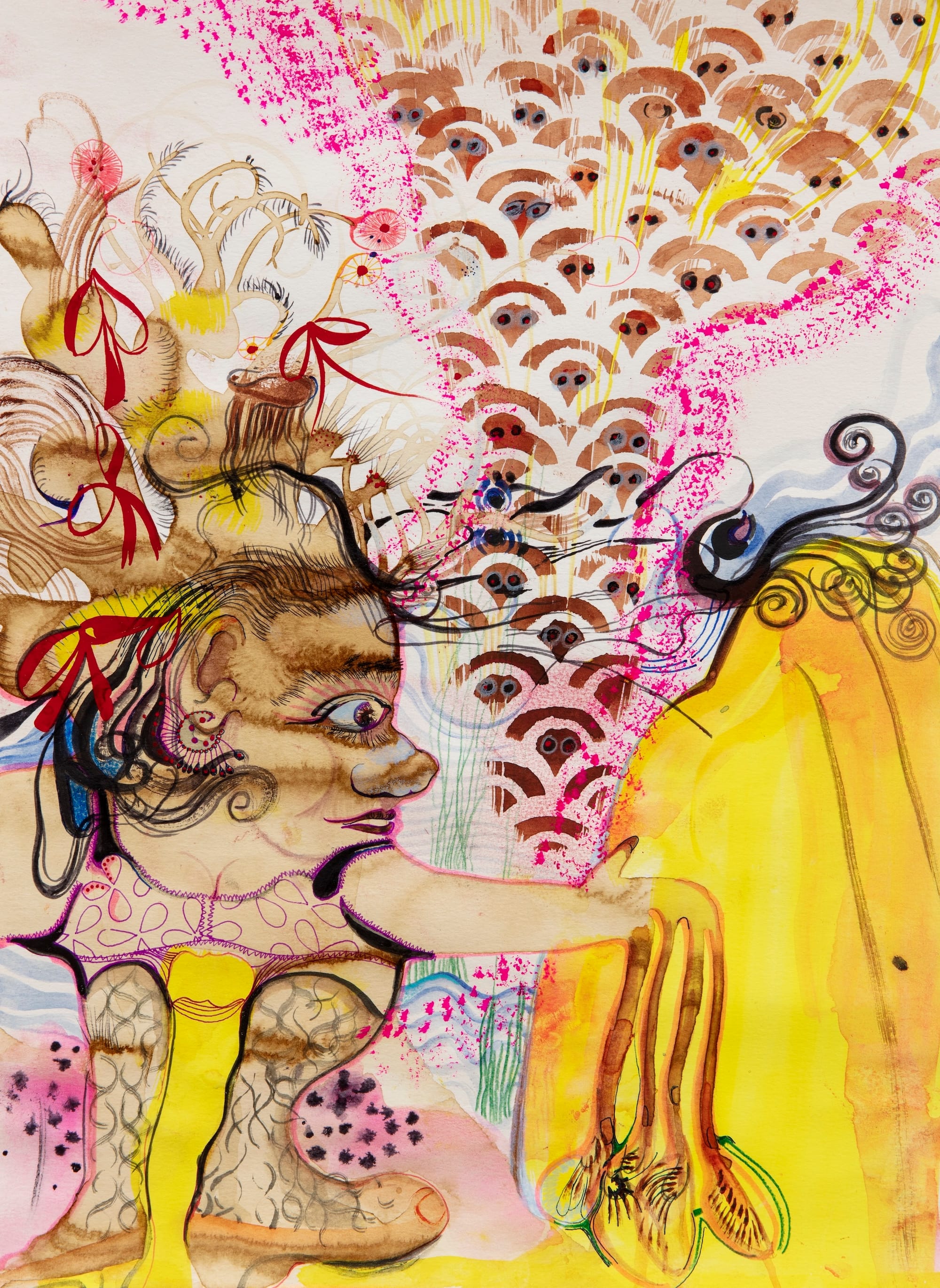
Banerjee’s paintings vivify watery worlds populated by hybrid animal-human figures, their hair or fingernails cascading into tendrils and melding into clouds, waves, and atmosphere. They float in space, just as her sculptures often hover above the ground. Her work is seductive in its organization of color, its variety of textures, and its arabesques, but she resists grounding her forms, figures, or even the viewer in a definable space. There is never solid footing. In this way, she expresses the experience of immigrant families and beauty found amid precarity.
Banerjee also highlights the women who have uplifted her work. Among them are Jane Farver, who included her work in the 2000 Whitney Biennial; Courtney Martin, who curated an early group exhibition at Smack Mellon and was recently responsible for the Yale Center for British Art’s acquisition of her 2003 sculpture, a monumental Taj Mahal made from a steel-and-copper frame wrapped in a skin of pink plastic; Laura Steward Heon, who curated Yankee Remix at the Massachusetts Museum of Contemporary Art (MASS MoCA); and Jodi Throckmorton, who curated her traveling mid-career survey exhibition, Make Me a Summary of the World. We spoke about her journey from polymer engineering to painting, the symbolism of her materials as related to her family’s migrations in a postcolonial world, the influence of artists including Richard Mayhew and Santa Barraza on her work, and the pantheon of Hindu female deities.
Rina Banerjee was born in Kolkata, India, in 1963 and lived briefly in London and Manchester, England, before moving to New York City. She currently lives and works in Brooklyn. She received a BS in Polymer Engineering from Case Western Reserve University and an MFA from the Yale School of Art in 1995. Banerjee’s work is currently on view in two institutional exhibitions: You made me leave home… at the Louis Vuitton Espace in Tokyo, Japan; and Rina Banerjee: Take me, take me, take me . . . to the Palace of love at the Yale Center for British Art.