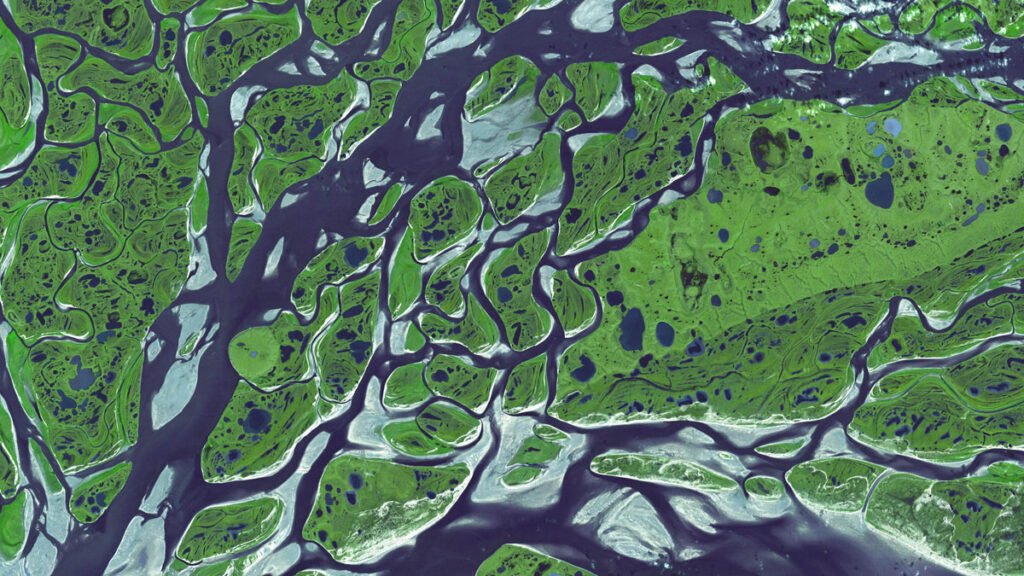
Wetlands are the largest natural source of methane on Earth. Though the waterlogged lands offer benefits that include hosting thriving ecosystems and protecting our shorelines from flooding, researchers are eager to better understand their contribution to the warming climate.
Researchers report that typical global wetlands surveys overlook an astronomical number of small wetlands: about 160 million of them.
In a paper published in Nature Climate Change, researchers report that typical global wetlands surveys overlook an astronomical number of small wetlands: about 160 million of them.
These small wetlands, which range in size from a large swimming pool to 100 hectares (250 acres), are responsible for 25% of the present global methane emissions, the research found. The results also revealed that these methane emissions increased by 9.9% from 2003 to 2022. This increase reflected both a growing number of small wetlands and climatic changes that spurred them to generate more emissions.
The work shows our current grasp on these environments is woefully incomplete.
The new research “points to the strong need to study these ecosystems further,” said Kyle Delwiche, a biogeochemical scientist at the University of California, Berkeley, who was not involved with the research.
Methane Mania
Wetlands come in myriad flavors and are found on every continent except Antarctica. Groundwater feeds peat-rich bogs and fens in places like Scotland and Scandinavia, and the Amazon and Congo Rivers support sprawling, forested swamps. Though the mechanisms underlying each wetland differ, the environments are united by a group of methane-producing microbes that thrive in their oxygen-starved soils.
Researchers have long known wetlands are major sources of global methane, a greenhouse gas with significantly more near-term warming potential for our climate than carbon dioxide. But quantifying these wetlands to assess their emissions is no simple task.
To study wetlands on a global scale, researchers typically use coarse-resolution satellite data, said Fa Li, an Earth system scientist at the University of Texas at Austin and lead author of the study. These data have a relatively low resolution (one pixel from these satellites represents 25 square kilometers) but can pierce through dense foliage, making them invaluable for wetlands research, Li said.
In the new research, Li and his colleagues turned to high-resolution satellite imagery. One pixel from these satellites is 30 square meters, which is just over half the size of an Olympic swimming pool. By combining this imagery with emissions data, the researchers were able to refine methane emissions calculations on a global scale.
Most of the 160 million small wetlands the survey revealed were concentrated in northern latitudes in places like Canada and Siberia.
“It’s really high, but I think this value [of 160 million] is certainly underestimated,” said Li.
Small tropical wetlands in particular tended to punch above their weight class, he added.
Such work will ultimately reveal “what level of atmospheric carbon dioxide and methane removal is needed to keep our planet hospitable.”
“Our results show that tropical small wetlands contribute disproportionately to methane emissions,” Li said. “Although tropical regions account for only 15.1% of global small-wetland area, they contribute 37% of methane emissions from small wetlands.”
Though higher-resolution satellite imagery can capture smaller wetlands, the technology is incapable of piercing through tree canopies. Because of this trade-off, forested swamps and other covered wetlands were excluded from the study.
“Methane emission rates are positively related to the temperature,” said Li. As the global temperature increases, these methane-emitting microbes become more productive. “It’s like a snowball that gets bigger and bigger,” he said. Rising global temperatures likely triggered the increased emissions and will continue to feed the tumbling snowball in the future.
Delwiche is excited about the new work and would like to see it extended to eventually cover forested wetlands. “We need accurate estimates of emissions and trends,” she said. Such work will ultimately reveal “what level of atmospheric carbon dioxide and methane removal is needed to keep our planet hospitable.”
—Taylor Mitchell Brown (@tmitchellbrown.bsky.social), Science Writer
Citation: Brown, T. M. (2026), Big trouble from little wetlands, Eos, 107, https://doi.org/10.1029/2026EO260232. Published on 17 July 2026.
Text © 2026. The authors. CC BY-NC-ND 3.0
Except where otherwise noted, images are subject to copyright. Any reuse without express permission from the copyright owner is prohibited.