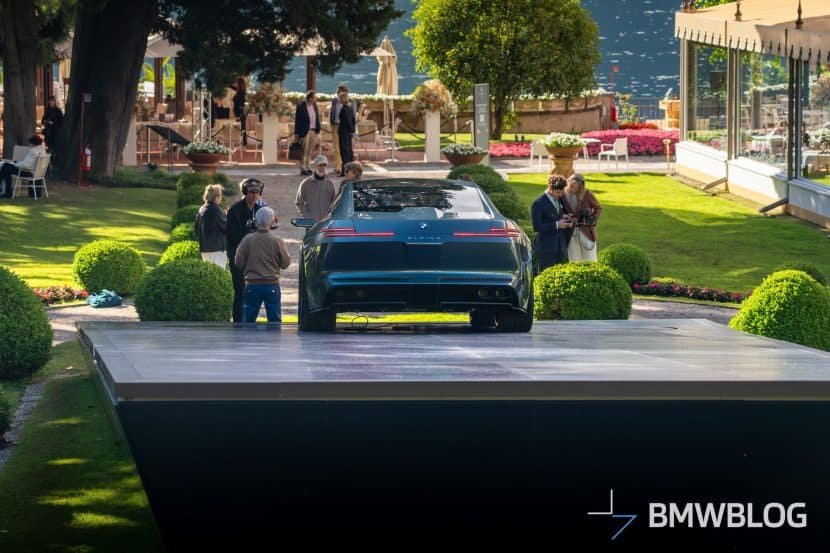
Villa d’Este has become BMW’s favorite stage for its most ambitious ideas, and the 2026 Concorso did not disappoint. We were on the grounds when BMW pulled the covers off the Vision BMW ALPINA — the first concept built entirely under BMW Group ownership — and we have exclusive photos, inside and out, that tell the full story. The setting is right too. BMW has used Villa d’Este to introduce the Concept Touring Coupe in 2023, the Concept Skytop in 2024, and the Concept Speedtop last year. So the new Vision car finds itself in great company, and it has not disappointed the fans.
What’s The New BMW ALPINA?

The ALPINA that enthusiasts grew up with was Buchloe’s doing. The Bovensiepen family turned BMW’s road cars into something quieter and faster and more particular than Munich managed on its own — the B10 V8, the B7, the B3 with its pinned-down body and split personality. That company still exists. It now builds the Bovensiepen Zagato GT and runs ALPINAa Classic for owners of historic cars. .
BMW ALPINA was formally introduced in early 2026 as a manufacturer of automobiles for enthusiasts who appreciate the extraordinary. The new word mark and brand emblem came first. Villa d’Este is where the public got to see what the design language looks like. Oliver Viellechner, vice-president of BMW ALPINA, described the brand’s positioning by pointing to Range Rover configuring to 200,000 euros and above, and Maybach showing resilience even in difficult markets. His conclusion: the understated character of ALPINA fits the way wealthy buyers are spending now. That is the market BMW is aiming at — not M buyers, not 7 Series buyers, but the segment above both.
An Exciting Design Language

The Vision BMW ALPINA measures 5,200 mm in length, with a wide, low stance and a long, raked coupe roofline. A V8 powertrain is part of the concept, tuned to produce the characteristic ALPINA exhaust sound: rich and deep at low speed, sonorous at high revs. At 204.7 inches long it is more than a foot longer than the outgoing 8 Series coupe, which BMW discontinued. Whether or not this concept previews a spiritual successor to that car, the proportions alone put it in a class with cars like the Bentley Continental GT, not the 4 Series.
The front end references the shark nose associated with earlier ALPINA models, including the late-1970s B7 Coupe based on the E24 6 Series. A six-degree feature line runs from the lower front corners, along the sides of the car and around the rear. BMW says this line is intended to structure both the exterior and interior design. ALPINA-style deco-lines also appear, but painted beneath the clear coat rather than applied as external graphics.

Other recognizable ALPINA details include 20-spoke wheels measuring 22 inches at the front and 23 at the rear, four elliptical exhaust outlets, and ALPINA lettering on the lower front apron. The lighting incorporates warm-white daytime running lights, illuminated grille surrounds, and crystal elements in the headlamps.
In person, the proportions read better than the press photos suggest. The greenhouse is slim but not aggresively so. It looks like something you could live with on an eight-hour drive from Munich to Monaco, which is presumably the point.
Luxury and Comfort Inside

The cabin has four seats, full-grain leather sourced from the Alpine region, metal trim, and restrained blue and green detailing. These colors have long been associated with ALPINA, but here they appear mainly in stitching and digital display graphics rather than as prominent exterior decoration. The dashboard includes BMW Panoramic iDrive along with a passenger screen and ALPINA-specific interface graphics. The displays shift their use of blue and green tones as the driver moves between Comfort+ and Speed modes.

The Comfort+ setting is the detail worth paying attention to. It is described as a calibration beyond BMW’s standard comfort setting, intended to give the car a softer and more refined character — which has traditionally been the thing that set ALPINA apart from M. M adds tension. ALPINA took tension away. BMW says it intends to preserve that distinction.

Behind the rear console is a glass water bottle and a set of ALPINA-branded crystal glasses that rise on a self-deploying mechanism. Each is engraved with deco-line detailing and held in place with concealed magnets. It is the kind of detail that either wins you over or makes you skeptical about whether BMW understands what ALPINA’s appeal actually was. The old Alpina did not have a crystal glassware lift. It had a steering wheel with slightly more grip and a suspension tune that made autobahn miles feel effortless. The question is whether BMW can deliver both.
What’s Next For The New Brand

The Vision BMW ALPINA is not scheduled for production, at least for now. The first customer model under the new arrangement is expected in 2027. Viellechner has said the brand will begin “from the top down,” pointing to the upper end of the BMW range as the starting point. The 7 Series and X7, both on BMW’s CLAR platform, have been mentioned as the likely bases for the first production cars.
That timeline is short, and the Vision concept’s role as a purely visual exercise should not be taken for granted. Previous Villa d’Este design studies have entered low-volume production. The Concept Skytop went to 50 customers. BMW has learned that this particular stage converts.


First published by https://www.bmwblog.com