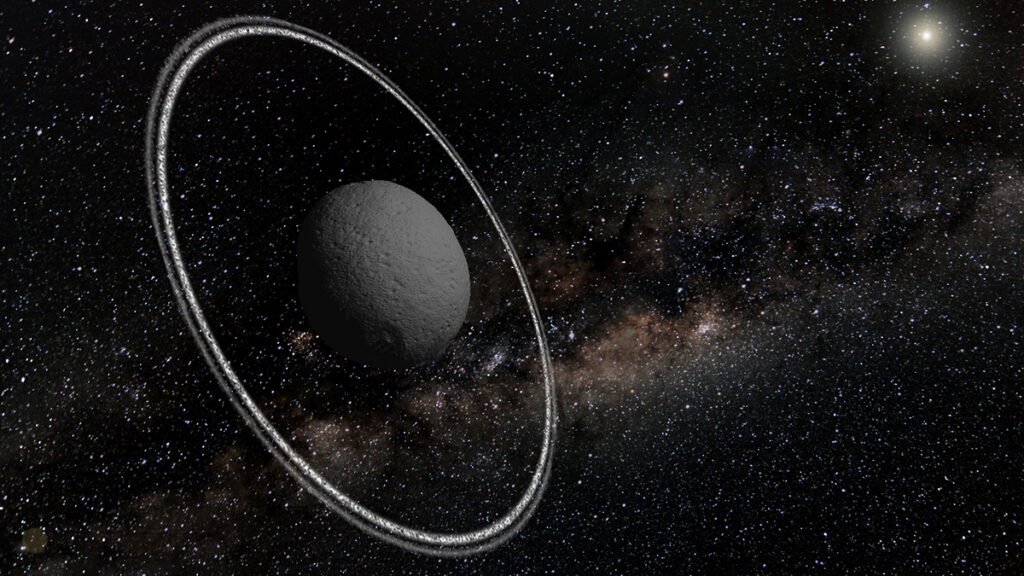
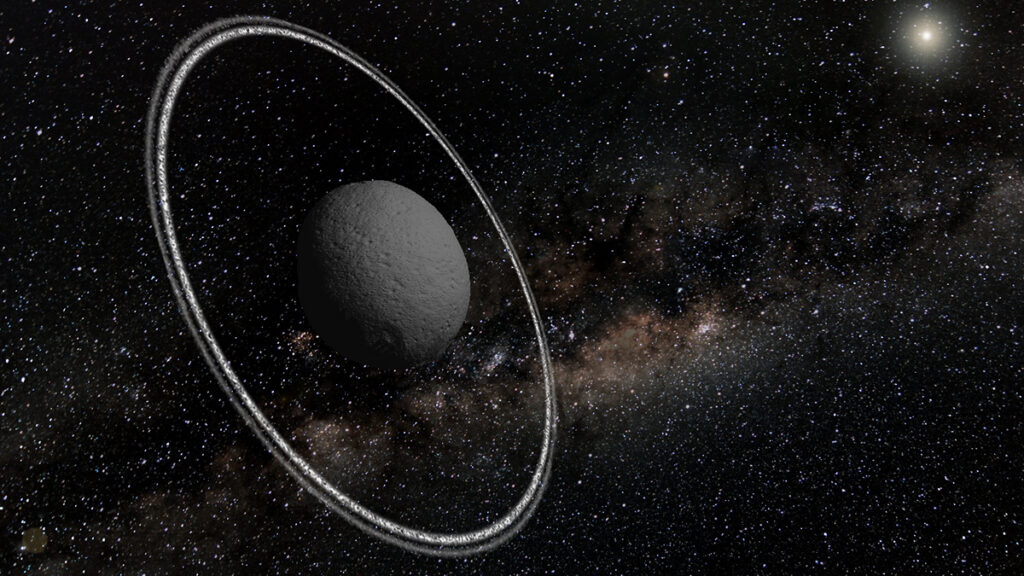
Tiny asteroid Chariklo, floating through the void between Saturn and Uranus, boasts two rings. It’s the first asteroid found to have them, and their existence took astronomers by surprise when they were spotted in 2013. Now, Chariklo’s rings are showing some unexpected and unexplained behavior.
“The opacity of the outer ring is now lower than in the previous observations, but also the opacity of the inner ring was stronger,” said Pablo Santos-Sanz, an astrophysicist at Instituto de Astrofísica de Andalucía in Granada, Spain, and lead researcher on the discovery.
When Santos-Sanz saw the results, he asked himself, “Oh, what has happened here?”
Dynamic Rings
Chariklo is a Centaur asteroid, meaning it orbits the Sun in the space between the giant planets. It’s 302 kilometers (108 miles) across, is not very spherical, and orbits about 2.3 billion kilometers (1.5 billion miles) from the Sun.
In 2013, Chariklo passed between earthbound observers and a distant star, an alignment called stellar occultation. Astronomers saw that the star’s light dimmed twice before Chariklo obscured the star and twice again after Chariklo passed by, revealing the presence of two thin rings orbiting the asteroid. That made Chariklo only the fifth solar system object, the first besides the four giant planets, discovered to have rings.
Later observations revealed that the rings are thin, sharply defined, and separated by a mere 14 kilometers (8.7 miles). Other measurements suggest they may contain water ice.

But occultations are rare, and the rings themselves are too faint to observe directly. Santos-Sanz and his colleagues decided to see whether a space-based occultation might be possible. They turned to the James Webb Space Telescope (JWST), which is orbiting Earth’s L2 Lagrange point 1.5 million kilometers (nearly a million miles) away. With meticulous precision, the researchers calculated the future positions of JWST and Chariklo and searched the Gaia mission’s database to find stars along the lines connecting them.
But the positions and trajectories of JWST, Chariklo, and every background star each have some degree of uncertainty. JWST’s orbit is the trickiest aspect, as it is nearly impossible to predict the telescope’s position more than a few months ahead of time.
“At the beginning I felt like a crazy guy proposing this.”
“If you put these three things together, it’s really very challenging to predict an occultation from James Webb…At the beginning I felt like a crazy guy proposing this,” Santos-Sanz said.
Nevertheless, after several months of searching, the researchers found one potential alignment in October 2022 in which JWST would likely pass through Chariklo’s tiny occultation “shadow.” They predicted it just a month ahead of time, secured time on the telescope, and kept refining their calculations. When the time came, the team triggered the telescope, and JWST successfully observed its first stellar occultation.
The telescope clearly detected both of Chariklo’s rings but revealed that the inner ring’s opacity increased 42% from previous observations. In contrast, the outer ring was so translucent it was barely visible.
The team published these results in Science Advances on 9 September.
Rings Might Not Be Forever
Right now, the team has no definitive answer to explain the rings’ opposing evolutions. It’s possible the inner ring particles are colliding and changing how much light they reflect while the outer ring particles are drifting away. Or Chariklo might have an unseen satellite driving the rings’ evolution, both keeping the rings in their orbits and providing extra material to the inner ring. Future stellar occultations, observed either from the ground or space, will be needed to reveal whether and why the rings are still changing.
“The existing observations of such miniature ring systems are still very sparse, compared to the vast amount of data collected of their giant-planet analogues,” said Heikki Salo, an astronomer at the University of Oulu in Finland. “Nevertheless, the dynamical processes in such ring systems around irregular small bodies are at least as challenging to understand as those governing the rings of the giant planets!”
Salo, however, thinks the evolution of Chariklo’s rings might not be so inexplicable after all.
“It’s a piece in the big puzzle that is solar system science.”
“The perturbations induced by the highly nonspherical shape of Chariklo make most orbits in its vicinity highly unstable,” said Salo, who was not involved with the new research. Chariklo’s rings orbit in a particular gravitational resonance—the ring particles orbit three times for every one rotation of Chariklo—that is known to make rings evolve. “In this sense, the Chariklo rings can be expected to resemble Saturn’s F ring, with highly time-variable structure.”
Salo added that an unseen moon around Chariklo might yet play some role, perhaps in replenishing material in the inner ring and keeping it stable over longer periods.
But for now, with the next occultation maybe 5 years away, Chariklo and the mystery of its changing rings will remain unsolved.
“It’s a piece in the big puzzle that is solar system science,” Santos-Sanz said. “In a few years we will have more pieces, and we will understand more what is really happening in Chariklo and probably in other ringed objects like Haumea, Chiron, and Quaoar.”
—Kimberly M. S. Cartier (@astrokimcartier.bsky.social), Staff Writer
Citation: Cartier, K. M. S. (2026), Chariklo’s rings are evolving, Eos, 107, https://doi.org/10.1029/2026EO260308. Published on 28 September 2026.
Text © 2026. AGU. CC BY-NC-ND 3.0
Except where otherwise noted, images are subject to copyright. Any reuse without express permission from the copyright owner is prohibited.