Editors’ Highlights are summaries of recent papers by AGU’s journal editors.
Source: Journal of Geophysical Research: Earth Surface
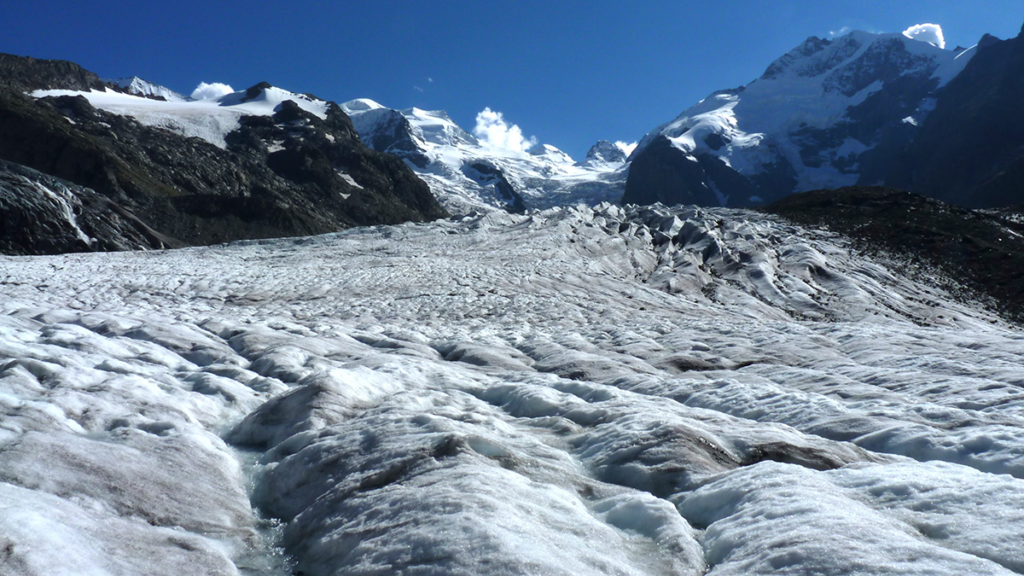
Glacier ice is a crystalline material that flows across the Earth’s surface and is often close to the pressure-melting point. The way ice deforms is therefore an interplay of many factors including the temperature, grain size, and purity of the ice. Numerical models of ice flow are based on the Glen-Nye flow law (Glen’s Law)—a simple relationship between stress and strain in ice developed by John Glen and John Nye from laboratory experiments in the 1950s. Glen’s Law derives strain (creep, or deformation flow of ice) from the applied stress raised to the power of the exponent n, multiplied by the temperature-dependent constant A. The values for these parameters are empirical, and both linear and power-law forms of Glen’s Law have been proposed, although a value of 3 is typically used for n.
Lilien et al. [2026] use a flowline model to explore the impact of the choice of value for Glen’s n on the outcome of projections of ice sheet mass change, considering different values for A and different glacier sliding laws. They found that the relationship between n and glacier mass loss is complicated and varies depending on glacier type. For dynamically controlled glaciers, increasing n increased mass loss, as ice flowed more rapidly into ablation areas. For surface mass balance-controlled glaciers, increasing n decreased mass loss, because ice flux decreased at the equilibrium line. The authors find that using a single value for Glen’s n is likely to lead to large uncertainties in projections of ice sheet change, and therefore studies of future ice sheet mass loss need to consider how the flow-law exponent varies spatially.
Citation: Lilien, D. A., Ranganathan, M., & Shapero, D. R. (2026). Effect of the flow-law exponent on ice-stream sensitivity to melt. Journal of Geophysical Research: Earth Surface,131, e2025JF008726. https://doi.org/10.1029/2025JF008726
—Ann Rowan, Editor-in-Chief, JGR: Earth Surface
Text © 2026. The authors. CC BY-NC-ND 3.0
Except where otherwise noted, images are subject to copyright. Any reuse without express permission from the copyright owner is prohibited.