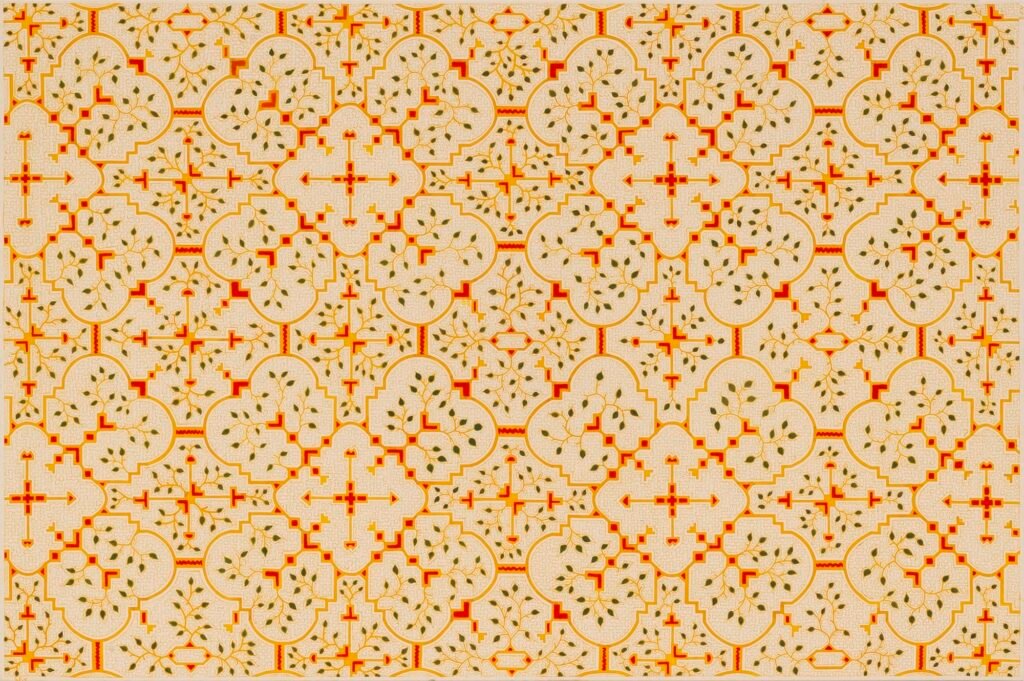

In the Peruvian Amazon, the Shipibo-Konibo people (sometimes also spelled Shipibo-Conibo) have made their home around the verdant Ucayali River basin for millennia. Their visual culture is richly informed by their belief systems and the environment in which they live, where foraged clay, wild cotton, and plants used to make pigments have sustained a steadfast artistic tradition known as Kené.
The exhibition Akinananti at White Cube illuminates the work of artist Sara Flores, whose meticulous patterns rendered with organic, handmade inks continue an ancient Indigenous tradition. The gallery says, “In the Shipibo language, ‘Akinananti’ describes work done together with love and joy—a practice and lifeway rooted in reciprocity, interconnectedness, and mutual aid, where individual well-being is inseparable from collective and environmental balance for the flourishing of life and community.”

Flores was born in the small Indigenous community of Tambomayo in 1950, where at the age of 14 she began to learn the tradition of Kené from her mother. At that time, the craft was treated with more functionality, as textiles were typically designed for use in garments.
Entwined with the aesthetic and technical aspects of the works, which incorporate handmade dyes and intricate geometric patterns, Flores’ mother instilled “the practice known to the Shipibo as joni-ati or ‘person making,’” the gallery says. “During this formative period, she recalls taking walks with her mother, who would gather ipobekené leaves and delicately press them onto her eyelids so that she ‘could better receive the designs.’”
Over time, Flores began to create standalone works, which now sometimes span several feet and are stretched in the manner of paintings. “She was 75 before she was given an exhibition at MALI, the Museo de Arte de Lima,” writes Charles Darwent in an essay accompanying Akinananti. “The snub wasn’t personal. ‘Folk art is not coming to this museum, ever,’ a curator had fumed twenty years before. Her show, Non Nete, was the first ever of the work of an Indigenous artist in the museum’s seven-decade history.”

The artist now collaborates on the pieces with her daughters, who have inherited the technical skills and philosophy of Kené. Together, they process materials sourced from the Amazon including bark, leaves, and wild berries. Evoking meditativeness in both the design and painstaking application of the media, the art form extends well beyond the physical object to encompass Shipibo-Konibo cosmology and ways of life.
Akinananti continues through August 14 in New York City. It coincides with Flores’ exhibition De otros mundos (From Other Worlds) in the Peru Pavilion at the 61st Venice Biennale, which continues through November 22 and also marks the first time an Indigenous artist has represented the nation during that event.


© Sara Flores. Photo © White Cube/Eva Herzog
Do stories and artists like this matter to you? Become a Colossal Member today and support independent arts publishing for as little as $7 per month. The article Elaborate Kené Patterns by Sara Flores Continue an Ancient Indigenous Tradition appeared first on Colossal.