A Game-Like Reality
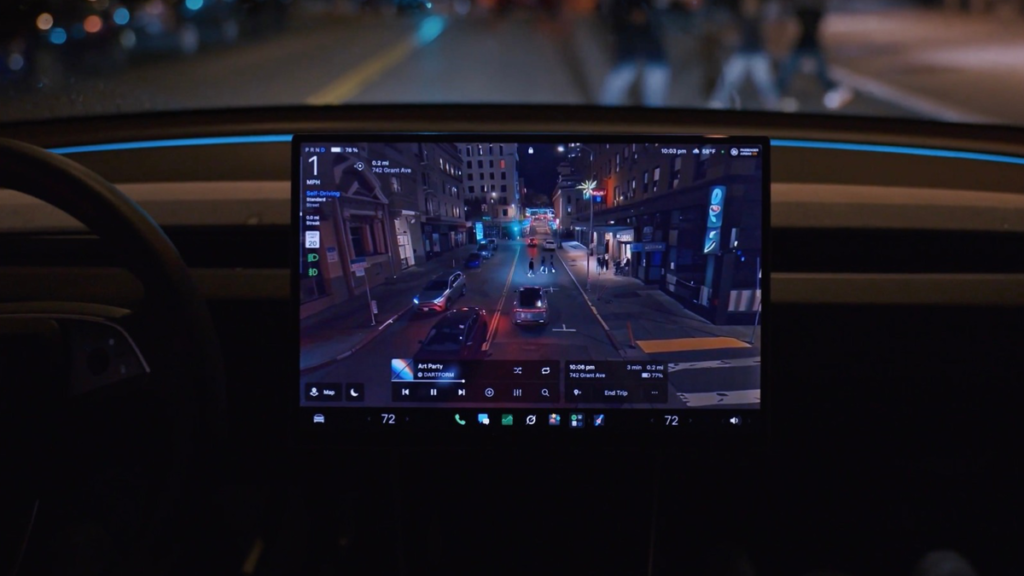
Tesla has announced Full Self-Driving (FSD) V15, and one of its biggest talking points is the Reality View, which digitally reconstructs the vehicle’s surroundings in an almost hyperrealistic way. It is a significant improvement over earlier FSD visualizations, which used predominantly dark backdrops and depicted surrounding vehicles as simplified, boxy shapes.
Tesla CEO Elon Musk likened the new Reality View to Grand Theft Auto, a gaming franchise he was previously critical of due to its violent content. With this interface, drivers can better understand what the vehicle perceives, while floating chevrons indicate upcoming turns, similar to BMW’s Augmented View navigation feature. According to Musk, it also makes navigation more intuitive by allowing occupants to select specific locations directly on the visualization. Another interesting bit is that the improved display requires less computing power than its predecessor.
It’s like GTA https://t.co/H2H9tjTStt
— Elon Musk (@elonmusk) November 21, 2026
Safety Beyond the Screen
Beyond the fancier visualization, Tesla claims that FSD V15 is 25 times better at handling safety-critical situations and nine times safer than a human driver. While the EV maker has not detailed the V15-specific methodology behind these claims, such improvements could strengthen its case for wider European approval, particularly amid scrutiny over its previous safety statistics.
The safety improvements are attributed partly to an upgraded vision encoder shared between FSD, Robotaxi, and Optimus. The company also claims that the update improves detection of potholes, animals, road debris, signs, and standing water. Musk previously confirmed that V15 would run on Tesla’s AI4 computer, also known as Hardware 4 (HW4). Older vehicles equipped with Hardware 3 could consequently miss out on the latest functionality.
Despite the improvements, FSD remains a Level 2 driver-assistance system, requiring human supervision at all times. It falls under the same classification as General Motors’ Super Cruise and Ford’s BlueCruise. Tesla offers FSD through a $99 monthly subscription in the U.S. after discontinuing the one-time purchase option earlier this year.
Tesla
A Shared Vision for the Future
Given the shared vision encoder, improvements in FSD’s visual perception could also benefit Tesla’s Robotaxi fleet, potentially making its autonomous ride-hailing service safer and more reliable. The Cybercab is already commercially operational in parts of Texas, though the two-seater robotaxi still faces federal scrutiny over its self-certification.
Over time, the AI ecosystem could become even more interconnected, especially with commercial deliveries of the Optimus humanoid robot targeted for around the end of 2027. For now, Tesla owners get an improved system with navigation reminiscent of GTA, in which the EV maker has inspired several vehicles under the fictional Coil brand.
Tesla