SAN FRANCISCO — Emory Douglas honed his craft in the trenches of political artmaking. The artist first learned the basics of commercial printing while serving a 15-month sentence at a juvenile correctional facility at the age of 13; later, he became the minister of culture for the Black Panther Party, where he designed the party’s newspaper and shaped the group’s political aesthetic. Douglas’s deep-seated understanding of the strength of printed material and critical eye toward oppressive power structures have remained key features of his work for decades.
Now, the 83-year-old artist is the subject of the survey exhibition Emory Douglas: In Our Lifetime at San Francisco’s African American Art and Culture Complex, complete with paintings, prints, and political cartoons spanning decades and issues. It makes the case that to be a contemporary artist, one must remain politically engaged, ever navigating and responding to the times they live in.
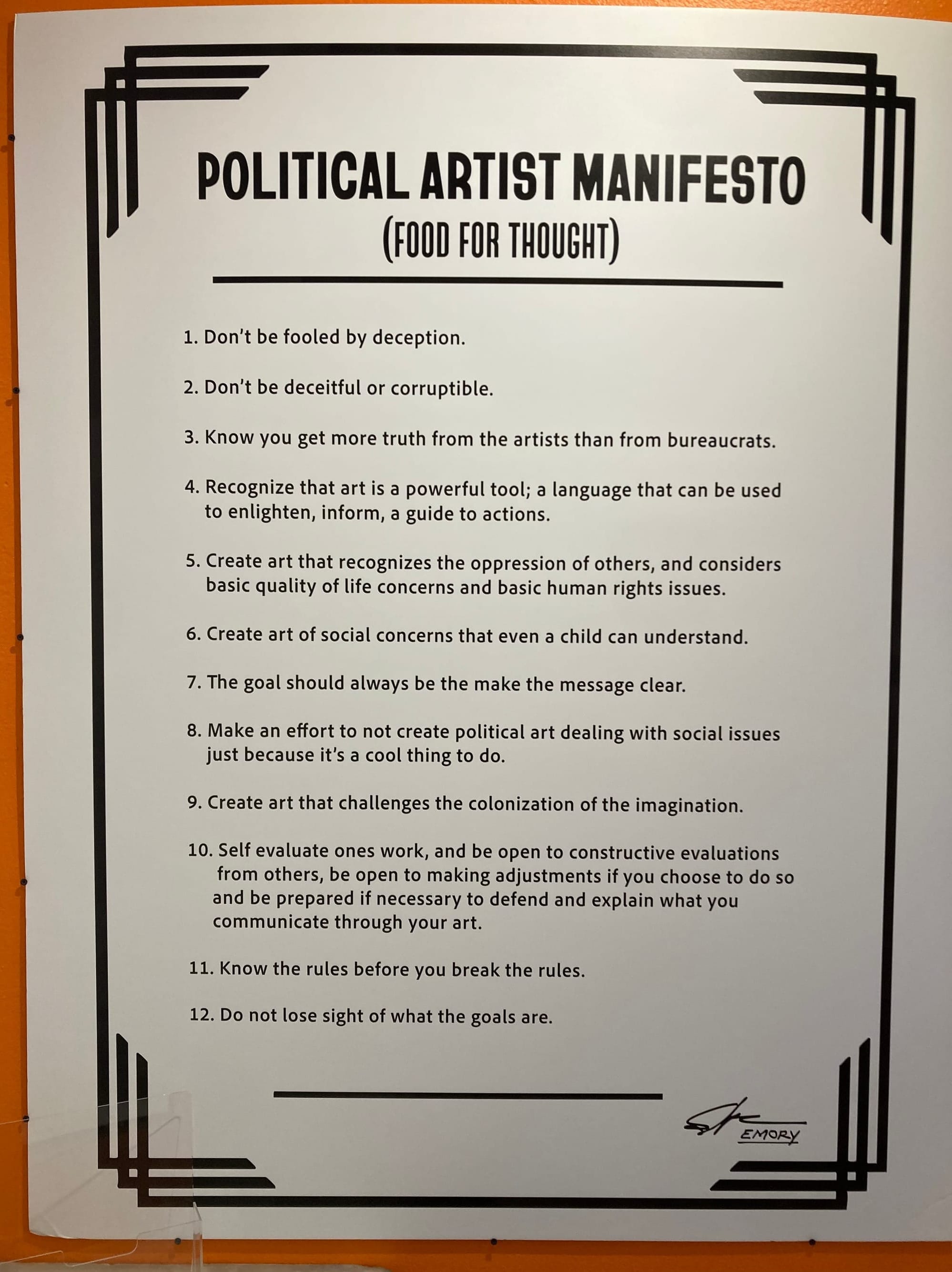
A large poster spelling out Douglas’s 12 commandments on making effective political art welcomes visitors into the exhibition. Among the bullet points in his “Political Artist Manifesto” are warnings like “Don’t be fooled by deception” and “Do not lose sight of what the goals are.” Others are more aspirational, such as “Create art that recognizes the oppression of others, and considers basic quality of life concerns and basic human rights issues,” or simply, “You get more truth from the artists than from bureaucrats.” Hung beneath the classic Black Panther Party logo of a prowling jungle cat, the list operates as a key text for the show, giving a clear sense of Douglas’s principled conceptual framework. In this day and age — and indeed, perhaps always — it is a document that more artists and arts organizations ought to read.
A large selection of Douglas’s early political cartoons and posters from the late 1960s and ’70s offer entire worldviews in a single frame, from advertisements for the Black Panther Party’s People’s Free Food Program to indictments of greedy landlords and police brutality. In “38th Puppet of the United States” (1974), Gerald Ford is controlled like a marionette by a hand emblazoned with corporate logos. “Cointelpro” (1978) shows a Spy vs. Spy-like character clutching a smoking gun while surveying wanted-poster-style mugshots of Black revolutionaries. The print is titled for the FBI counterintelligence initiative under which multiple Black revolutionaries were assassinated, including Chicago Black Panther Party Chairman Fred Hampton.
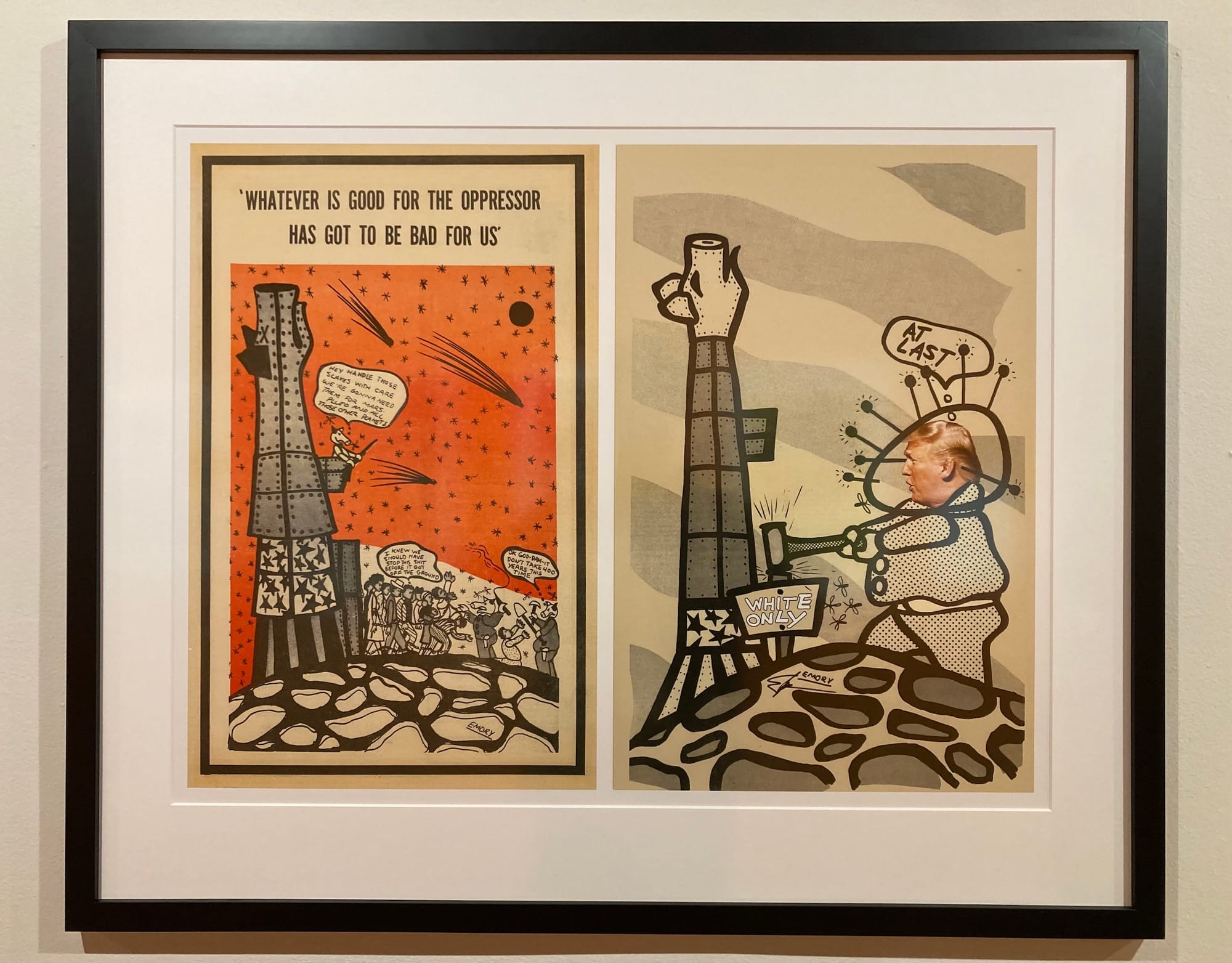
Sometimes Douglas does find humor, often at the expense of the state. “Whatever is good for the oppressor has got to be bad for us” (1968) shows humanoid pigs marching a group of Black people off of a pig-shaped rocket ship. In it, the United States’s histories of slavery and imperialism are deftly intertwined in a darkly humorous scene: One of the pigs overlooking the proceedings says, “Hey handle those slaves with care we’re gonna need them for Mars, Pluto and all the other planets.” One of the captives remarks, “I knew we should have stopped this shit before it got off the ground” — a punny reference to the rocket ship and the real-world evils it symbolizes. In an accompanying collage, “White Only” (2021), Donald Trump can be seen hammering the titular signage to the pigs’ rocket ship and saying “At last” — one of several instances in which Douglas uses old work to reflect on the present.
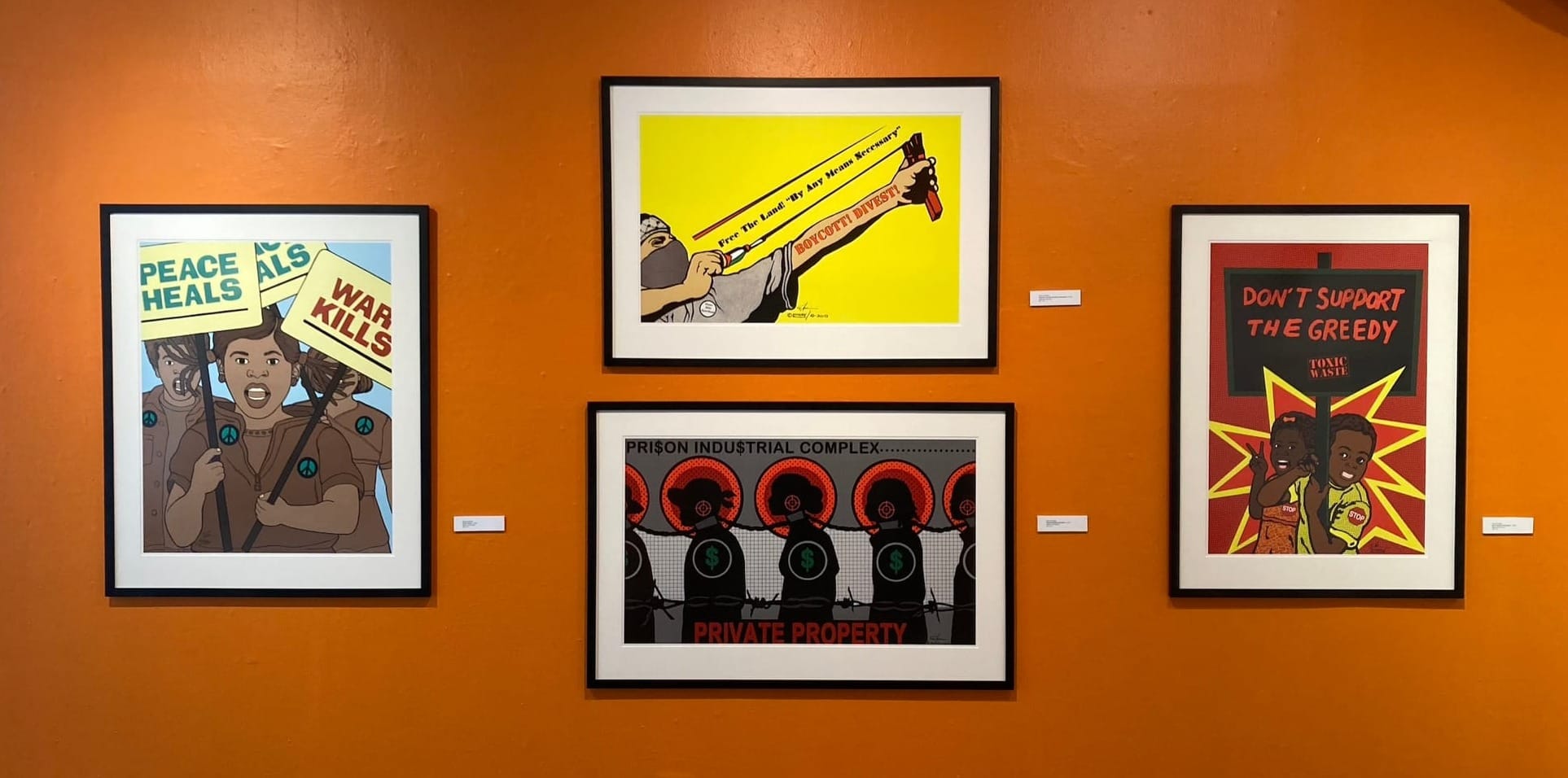
In a world inundated with AI slop, Douglas makes the best case for digital art I’ve seen in recent years. He characterizes several of his digital illustrations as “remixes,” updating key elements and motifs from older, recognizable artworks to help them maintain present-day political relevance. Douglas also takes the opportunity to incorporate statements about issues beyond the Black American experience, including the Vietnam War, violence in Haiti, and the genocide in Palestine, emphasizing the global interconnectedness and reach of solidarity movements.
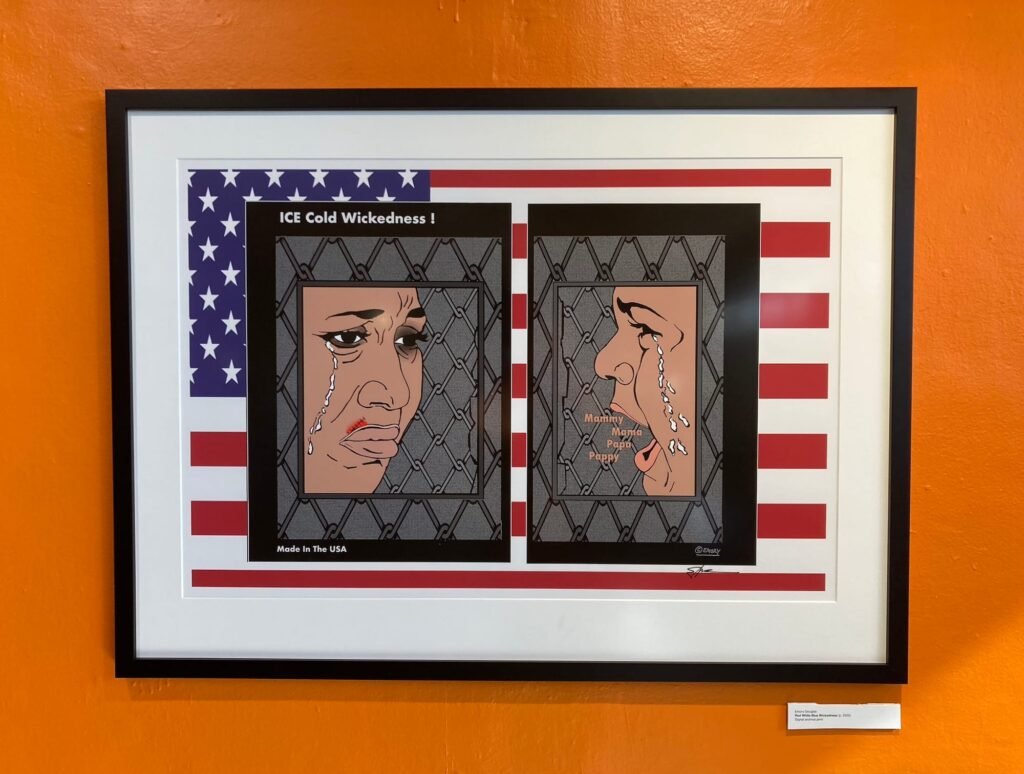
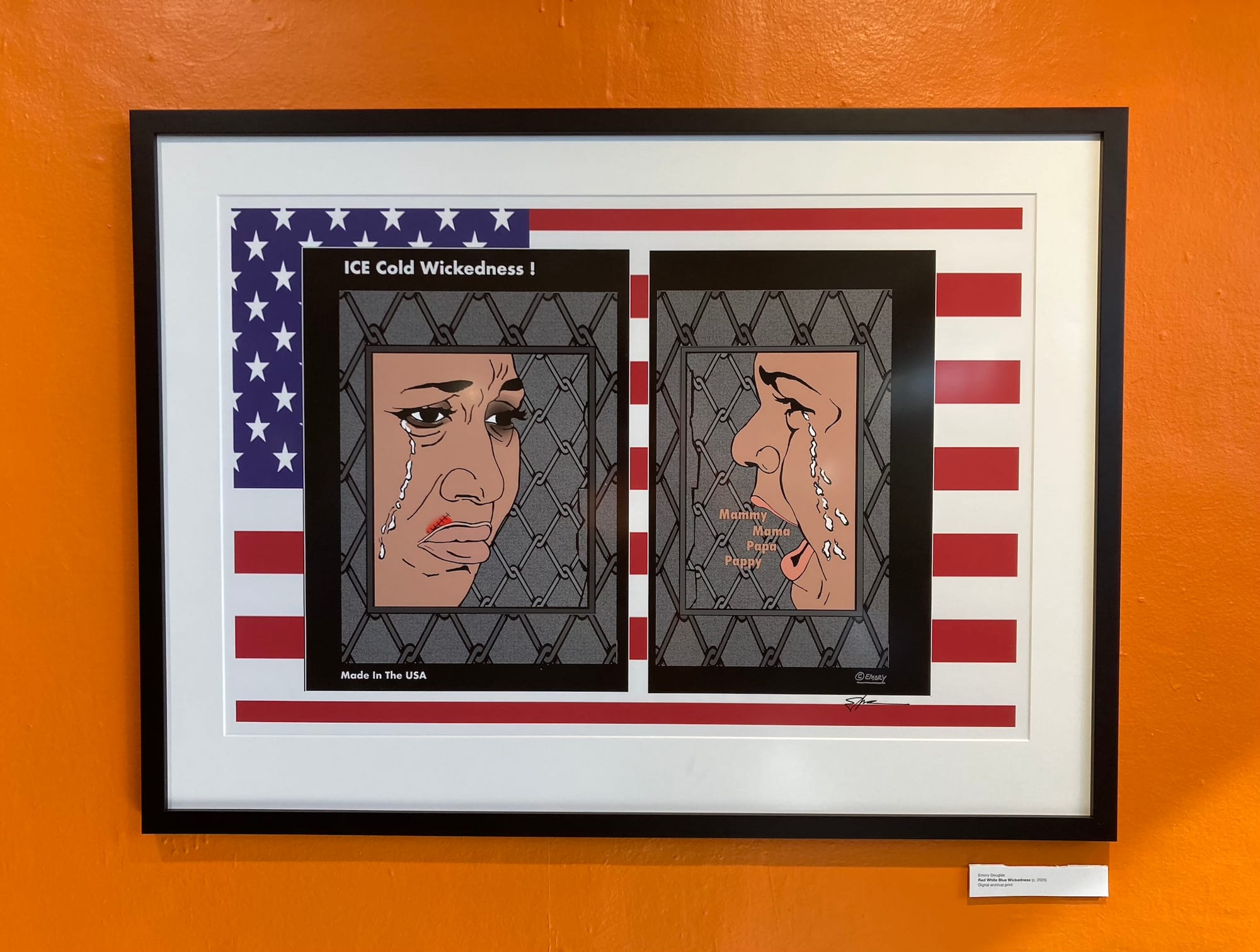
Douglas remains determined to engage with ongoing political issues and adapt to the times, while presenting his signature illustrative style in both contemporary and traditional mediums. In the digital drawing “Ethnic Cleansing / GENOCIDE” (2026), a grieving woman holds an infant swaddled in the Palestinian flag. In the acrylic painting “Free the Land” (2010), a freedom fighter swathed in a keffiyeh against a striking yellow backdrop takes aim at an unseen enemy with a slingshot, a pose reminiscent of David battling Goliath or Susan Meiselas’s 1979 photograph of Nicaraguan revolutionary Pablo Arauz tossing a molotov cocktail. In the digital illustration “Red White Blue Wickedness” (2025), two faces separated by fencing weep against the backdrop of an American flag. The phrase “ICE cold wickedness” is printed at the top of the composition, “Made in the USA” at the bottom.
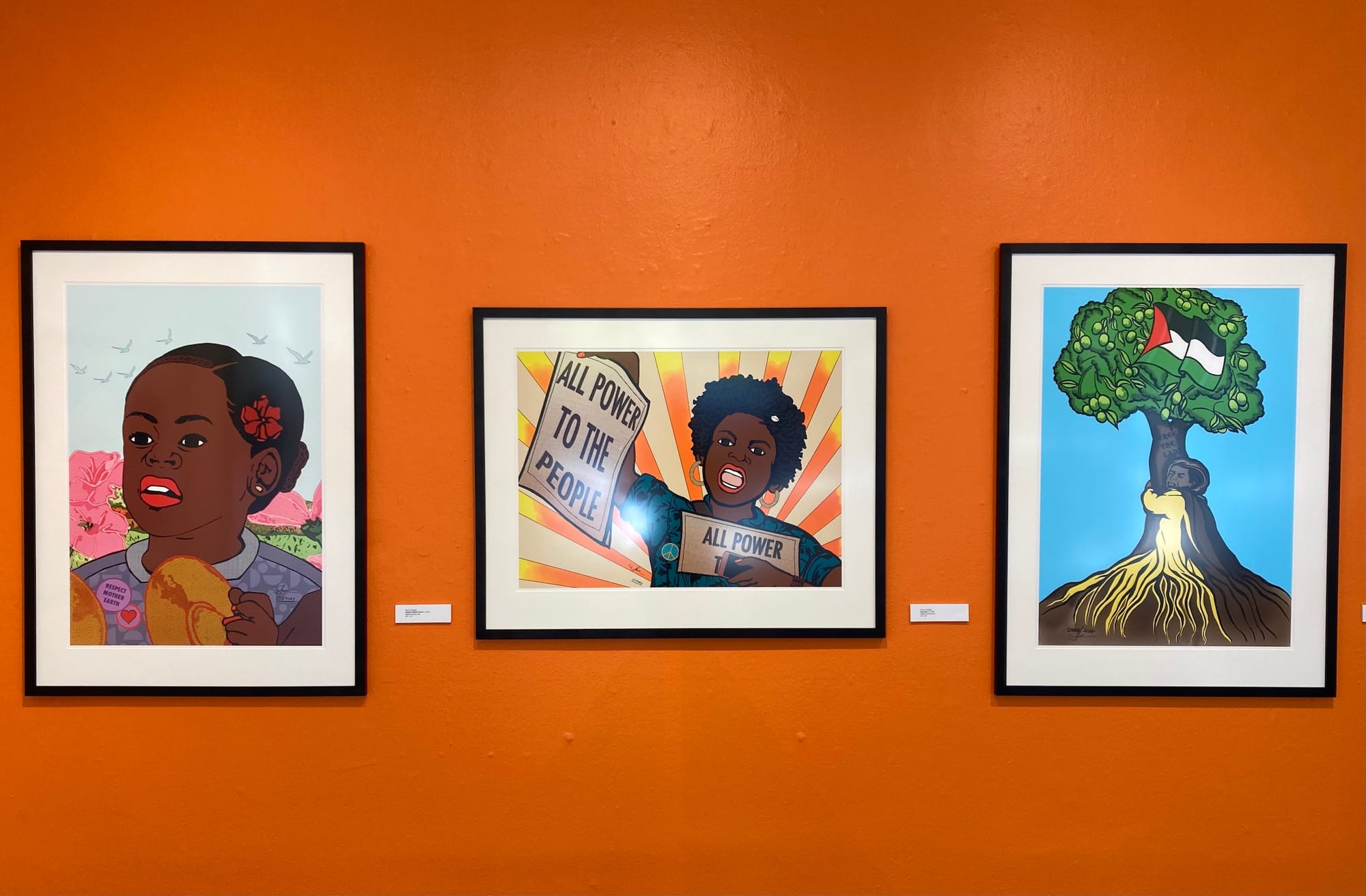
Not all of Douglas’s images of political unrest are images of strife. In several scenes, love is expressed through revolutionary community and acts of political education. In the brightly colored, graphic digital drawing “I Am We” (2018), a child wearing a Colin Kaepernick jersey and sporting a bold orange halo plays with a toy globe, while another child, smiling and raising their fist in the foreground, wears a pin that reads, “I am we.” In “Fight Sickle Cell Anemia,” a pen-and-ink infographic illustration from 1973, a parent reads to a child from a book of the same title. Family is often the site of solidarity and political education in Douglas’s work, with special attention paid to how the next generation will carry the political torch.
Throughout In Our Lifetime, Douglas takes a refreshingly uncompromising orientation toward the kind of direct messaging that frequently gets scrubbed from art in favor of palatable, salable nuance. But Douglas isn’t interested in being palatable. He’s interested in articulating his political position as clearly as possible.
In recent years, many San Francisco museums have struggled to meet the political moment head-on. In 2024, the Yerba Buena Center for the Arts closed its triennial Bay Area Now exhibition when artists altered their own work with pro-Palestinian messaging. The center has still not publicly addressed the incident, despite turnover in museum leadership. Later that same year, a group of pro-Palestine artists withdrew from the Contemporary Jewish Museum’s California Jewish Open, citing censorship of their work. The city’s larger museums, such as the de Young or the San Francisco Museum of Modern Art (SFMOMA), have continued to mount blockbuster shows without much political — or artistic — merit, making a case for only one side of the equation: the bottom line.
In 2021, Douglas’s text-based mural “Reparations” was installed at SFMOMA. While the work felt like a significant gesture on the museum’s part at the time, it’s hard not to see it as a platitude given the institution’s uneven track record on engaging with the current political moment. The small-scale vinyl of the piece included in In Our Lifetime, situated in the context of the African American Art and Culture Complex and Douglas’s other work, packs a stronger punch. Too many museums and arts organizations today seem to conveniently forget that, in Douglas’s words, “culture is a weapon.”
Both SOMArts and the African American Art and Culture Complex, two of San Francisco’s city-funded cultural organizations, have mounted explicitly political exhibitions, highlighting work by Palestinian and pro-Palestine artists. Their shows are proof that during moments of political upheaval, maintaining financial freedom from corporate donors — whose politics inform the programming of the institutions they fund — pays off. During the current period of censorship at cultural institutions across the country, smaller, locally funded organizations are often better positioned than their major institutional counterparts to mount politically engaged shows. It’s a mode of hyperlocal politics in art and activism that other institutions ought to emulate — and one that Douglas is no stranger to. He helped create it.
Emory Douglas: In Our Lifetime continues at the African American Art and Culture Complex (762 Fulton Street, San Francisco, California) through October 2026. The exhibition was organized by Rio Yañez and Rosalind McGary.