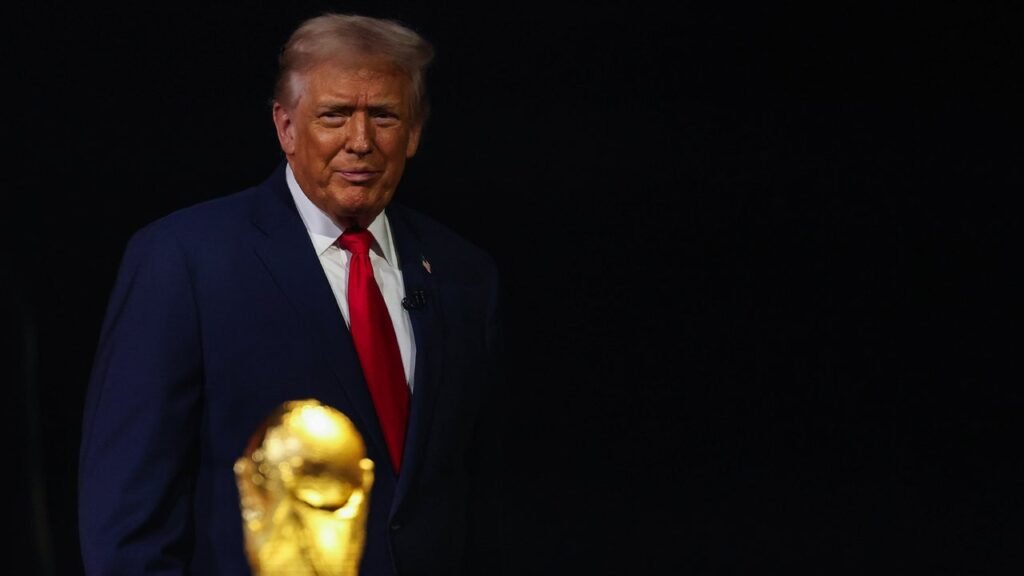
As Fourth of July barbecues buzzed with breathless chatter about this year’s maximally absorbing World Cup, little did anyone know President Trump and FIFA were about to stage a master class in public corruption.
The next day, FIFA took the unprecedented step of reversing a controversial one-game suspension for a U.S. player, after Trump personally lobbied the organization’s president, Gianni Infantino, on his behalf.
This is why we can’t have nice things.
It was as if Trump heard about U.S. citizens coming together to enjoy some politics-free fun amid a brutal heatwave and a chaotic start to summer, and felt left out or slighted in some way.
No matter his motivation, though, Trump ultimately succeeded in doing to the World Cup what he does to everything else he touches: making it all about him.
A questionable call from the ref
It started last Wednesday when Folarin Balogun, the frequent-scoring striker for the U.S. Men’s National Team (USMNT), incurred a controversial referee call during a game against Bosnia and Herzegovina. Around the middle of the second half, Balogun was chasing a loose ball when he came into contact with the Bosnia defender Tarik Muharemović. As the two approached the ball at the same time, Balogun’s foot apparently slammed down on Muharemović’s ankle.
Was it just an innocent accident? At first, the referee seemed to think so. Raphael Claus did not initially call a foul or declare a penalty, but instead waved the players to play on. Only when a video assistant referee watched a slow-motion replay did Claus give Balogun a red card denoting “serious foul play” for the clash. Balogun was ejected from the game and automatically suspended for the U.S. team’s next match.
Doubts swirled around the call, adding drama to a tournament already rife with it. Fans, commentators, and former players suggested Balogun wasn’t maliciously trying to hurt his opponent but merely competing for the ball. Perhaps it was a foul, they allowed, but not one deserving of the sport’s harshest penalty.
The purported injustice of the call quickly sparked conversations about whether any mechanism might exist to appeal or overturn the call.
Somehow, Trump seemed to interpret this idea as a personal challenge.
A questionable call from the president
In the grand tradition of Trump’s previous shakedowns, reports emerged on Sunday that the president personally contacted Infantino to ask for a review of the incident. Soon after, FIFA made its big announcement. Rather than force Balogun to serve the automatic suspension, the organization invoked a little-used provision of its disciplinary code that suspended Balogun’s ban, allowing him to play in the game against Belgium.
For the governing body behind the world’s premier sporting event to overturn such a call at the behest of a political leader would be scandalous no matter the circumstances. That this particular leader happens to be Trump only turbocharges the scandal, considering his relationship with the FIFA president.
In the run-up to this year’s U.S.-hosted World Cup, Infantino had been falling all over himself to cultivate a close relationship with Trump. He argued that being tight with Trump was “absolutely crucial” to the tournament’s success, since the federal government controls security, visas, logistics, and other critical factors. Beyond attending Trump’s inauguration and publicly praising him at every chance, Infantino consummated the courtship by awarding Trump the inaugural “FIFA Peace Prize” last year, after Trump felt he’d been snubbed by the Nobel committee.
Given this context, Trump’s lobbying of Infantino to interfere on a referee call in favor of the U.S. team cheapens the World Cup. It lends the proceedings the inescapable aura of one long mutual back-scratch session between Infantino and Trump.
Arguing over a bad call from a ref can be a fun part of sports fandom, even if the call goes against one’s favorite team. Arguing over whatever it is Trump just did at any given time is such an inexorable fixture of modern life, it often seems Americans do little else.
Until FIFA’s ruling on Sunday, the World Cup had been a pleasant reprieve for many from anything having to do with the U.S. president.
Perhaps that’s exactly why he felt the need to get involved.
The protagonist of reality
Had FIFA independently overturned the call without any presidential persuasion, many would have still speculated Infantino was doing it just to appease Trump.
But that might have been too ambiguous for the president’s tastes.
When he posted online about his happiness with the outcome and then, on Monday, acknowledged his efforts, Trump pulled the entire World Cup into his gravitational orbit. The tournament has now become politicized, with anyone who agrees with FIFA’s call having to account for whether they also agree with how the call came about. The MAGA faithful could boast that the World Cup’s red cards are no match for the Trump Card, using AI slop videos to make the point, while the leader of the Democratic minority in the House, Hakeem Jeffries, tried to find a nonpartisan way to celebrate the U.S.’s improved odds in the game against Belgium.
This isn’t the first time Trump inserted himself into a public narrative that already commanded enormous attention, and dominated it. Professional and college football championships become about him whenever team members have to decide whether to visit the White House. During hurricanes, wildfires, and other disasters, Trump often emphasizes his administration’s response and his personal involvement. He complained about the 2024 Oscars during the 2024 Oscars, prompting the host, Jimmy Kimmel, to read Trump’s social posts on air. And more recently, he turned America’s 250th anniversary into a celebration of himself.
With his World Cup-hogging episode, Trump remains secure in his role as the protagonist of reality.
Now that the USMNT has lost to Belgium and is out of the tournament, it might be for the best that the team won’t go any further in competition with an asterisk following it around—a hard pill to swallow for its fans.
Trump may have got the whole world talking about him once more, but he did so only by scoring an own goal against the U.S.