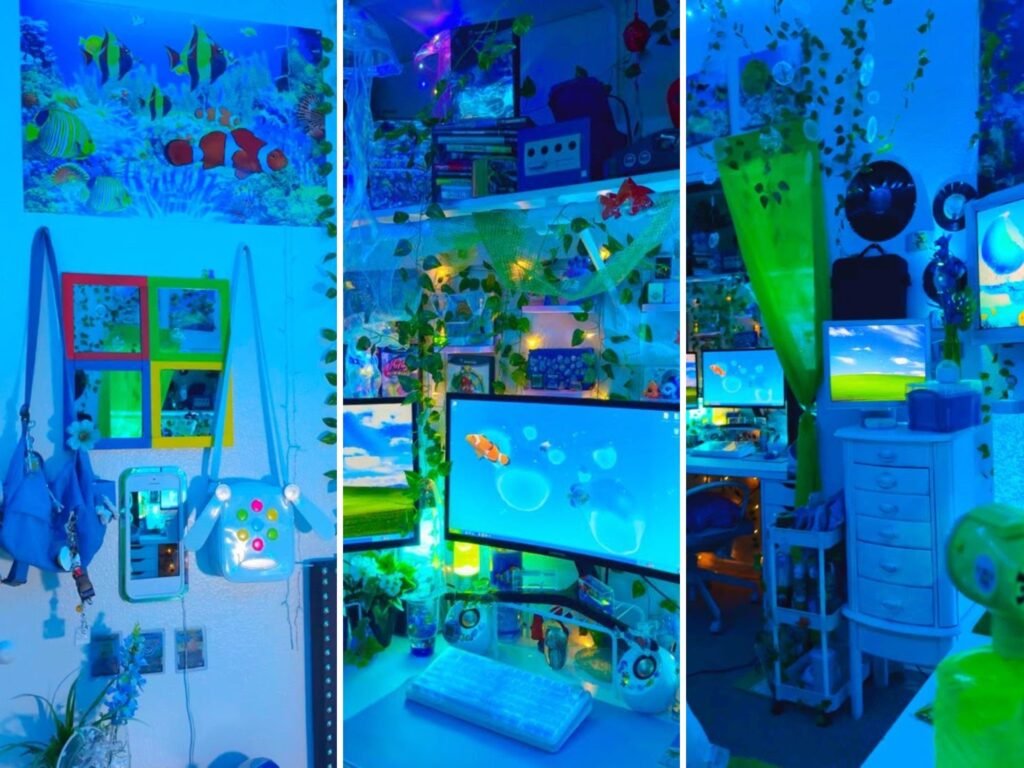
Sammy Conti/@bwuubbles on Instagram and TikTok
- Frutiger Aero, a Gen Z favorite, combines early internet nostalgia with a utopian tech vision.
- Fans say the aesthetic represents a “future that was promised” by tech but never arrived.
- Some recent tech releases have hinted at a Frutiger Aero revival.
Looking at 22-year-old Sammy Conti’s room is like looking into a fishbowl.
Shades of blue fill the space, interspersed with neon green and the occasional pop of orange or yellow. Vines, bubbles, and jellyfish hang from the ceiling. Moving lamps are everywhere: lava lamps, bubble lamps, aquarium lamps with roving tropical fish. Then there are objects that feel out of place: a purple Game Boy Advance, Nintendo 64 cartridges, Wii and PlayStation game cases hung like art on a gallery wall, and a DIY mirror in the shape of an old Microsoft Windows logo.
The confluence of nature and old-school tech isn’t random. It’s Frutiger Aero, an aesthetic inspired by the early internet, embraced by Gen Zers who say it represents a future that was promised but never arrived — one where technology is a source of inspiration and fuel for creativity, coexisting with nature and helping us ascend to our highest selves.
“You grow up thinking the world is going to be this green utopia where we coexist with nature and have technology and it helps us,” Conti told Business Insider. “Then as I started getting older, things became very sleek and modernist, very gray.”
For Conti, whose Frutiger Aero content has earned her more than 700,000 followers across Instagram and TikTok, the aesthetic represents a promise tech abandoned. “We could have lived in that future,” she said. “It could have been taken care of responsibly in a way that doesn’t take people’s jobs, doesn’t pollute the environment, but it’s not.”
A corporate tech aesthetic gets a glow-up
A fervent online community has formed around the term after it first gained traction in 2023, according to Google Trends data. There’s an active Discord and Subreddit, plus millions of views for #frutigeraero on TikTok.
Sofi Xian, a researcher and founding member of an online community called the Consumer Aesthetics Research Institute, coined the term Frutiger Aero in 2017 to describe a corporate tech aesthetic prevalent from the mid-2000s through the early 2010s. Some defining characteristics included glossy surfaces, glass or transparent materials, and macro photos of grass. “Frutiger” refers to a specific typeface, while “Aero” was Microsoft’s name for the interface design of its Windows Vista operating system, which came out in 2006.
“Nobody at the time really thought it was cool,” Xian said of the design style. “It was a corporate product. It was sold to us.”
Kevin Lee/Getty Images
The recent embrace of Frutiger Aero remains somewhat of a mystery to Xian, who says the term has blossomed well beyond what she first documented. Her book on the style, “Archaeology of a Promised Future,” is set to come out in November.
The modern version of the aesthetic still incorporates some of the classic elements, and then some. “Bliss,” the iconic photo of rolling green hills beneath a bright blue sky with clouds — the default wallpaper on Windows XP upon its release in 2001 — remains an almost sacred image to Frutiger fans. Conti recently made a pilgrimage to the area in Sonoma County, California, and called it “just as beautiful as it is in the photos.”
The future that never showed
“The future that was promised” is a central theme in the world of Frutiger Aero and is frequently invoked alongside images of clean, glistening skyscrapers set against grassy fields.
“It’s really a vision of technology that is quite different to what we have,” Maria Gemma Brown, a cultural studies researcher at the University of Queensland, told Business Insider.
Many young people now see technology as bland, lifeless, addictive, or even sinister. AI is increasingly associated with war, mass surveillance, and environmental degradation. Data centers, one of the most controversial physical manifestations of modern tech, face fierce opposition over environmental concerns.
Richy Srirachanikorn, a Ph.D. candidate at Concordia University, has interviewed more than 30 people in the Frutiger Aero community. He said it’s about nostalgia for a feeling more than about the specific objects or design that inspired it.
“Whatever this aesthetic was as a kid, it made me optimistic, not about the future, but about the present,” he said was how the people he interviewed described it.
That could help explain why it’s especially appealing to Gen Z, a generation rife with concerns about environmental, technological, and financial doom. Srirachanikorn said he found Frutiger Aero is used almost as a “coping mechanism” and the associated online communities as places to take “respite from the uncertainties of the world.”
Getty Images
Lovers of Frutiger Aero are also rejecting a broader design shift toward minimalism and neutral colors. In consumer tech, translucent clamshell laptops and bright pink MP3 players have given way to sleek, uniformly gray designs, as if they’re explicitly meant to disappear into the background of our lives.
“I feel like products had almost a personality. Which color you picked or what design you picked was a loud extension of you,” Conti said, adding that now it feels like everything merely wants to “fit in.”
The old-school tech may also represent a level of agency that feels unattainable now, Srirachanikorn said. In the early 2000s, consumer tech companies may have embraced bright colors and images of nature to make their products more appealing as they still needed us to buy in. Today, their products are almost impossible to escape.
Hope for a new bloom
Austin Horey, founder of the New York-based brand Unjust Jewelry, makes a range of products inspired by Frutiger Aero and similar strains of nostalgia. He’s sold over 10,000 bottles of a Frutiger Aero-inspired fragrance — oceanic, clean, soapy — that comes in a box that, when opened, plays an original Frutiger Aero-inspired song.
Horey said not only is there a huge appetite for Frutiger Aero content and products, but that major tech companies seem to be taking notice. His work has been embraced by an icon of the Frutiger Aero movement: Microsoft. When he released a Windows XP bracelet featuring the classic application icons from the operating system, the company partnered with him to make a necklace as well.
Fans of Frutiger Aero celebrate every time Big Tech makes a move they think signals a return to the aesthetic, like Xbox introducing a new glossy neon-green logo and the release of the budget-friendly Apple MacBook Neo, which comes in a bright yellow-green. Apple’s introduction of the Liquid Glass design last year also set off the Frutiger Aero antennae. Microsoft even posted a TikTok suggesting the design was reminiscent of Windows Vista.
Sammy Conti
Conti said the colorful MacBook Neo was the most Frutiger Aero product a tech company had released in years. While she’s been disappointed in modern tech, the underlying vibe of Frutiger Aero is one of optimism, and she still sees the ideas behind it as something to strive for, “especially as Gen Z moves into these positions of power as we get older.”
“I think it’s important not to forget what it still could be,” she said.