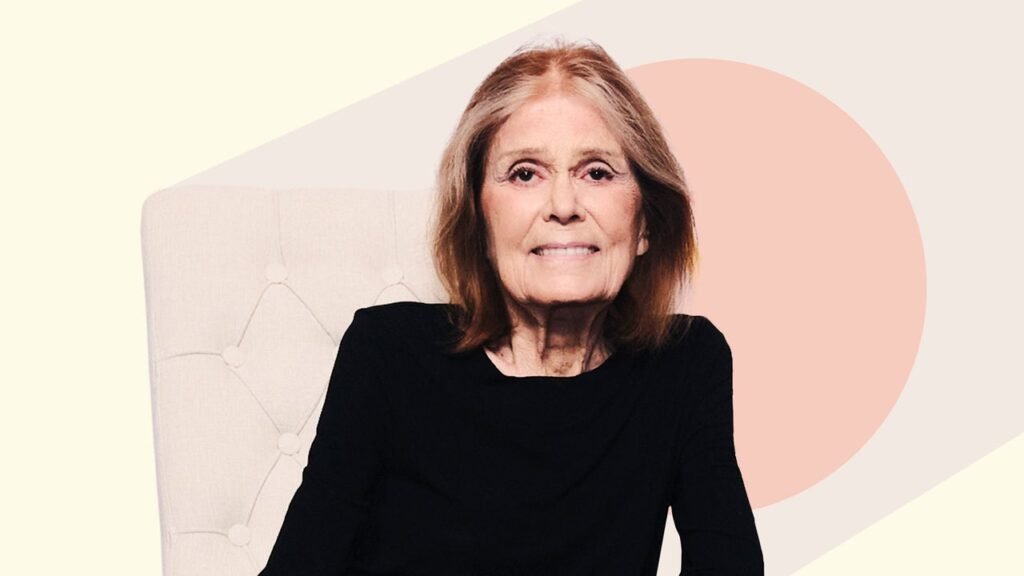
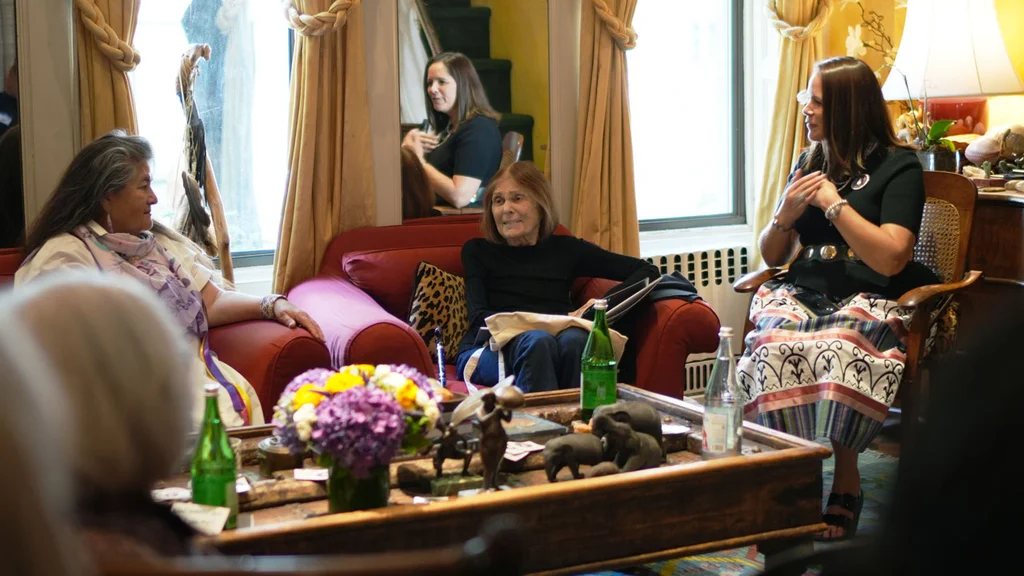
Gloria Steinem is ensconced in a plush red armchair in her living room. On her right is Louise McDonald Herne, a Mohawk Bear Clan Mother, dressed in white linen with burgundy and purple ribbons. On her left is Michelle Schenandoah from the Oneida Nation Wolf Clan, creator of a show on PBS discussing rematriation: the process of centering Indigenous women’s voices and philosophies into daily life.
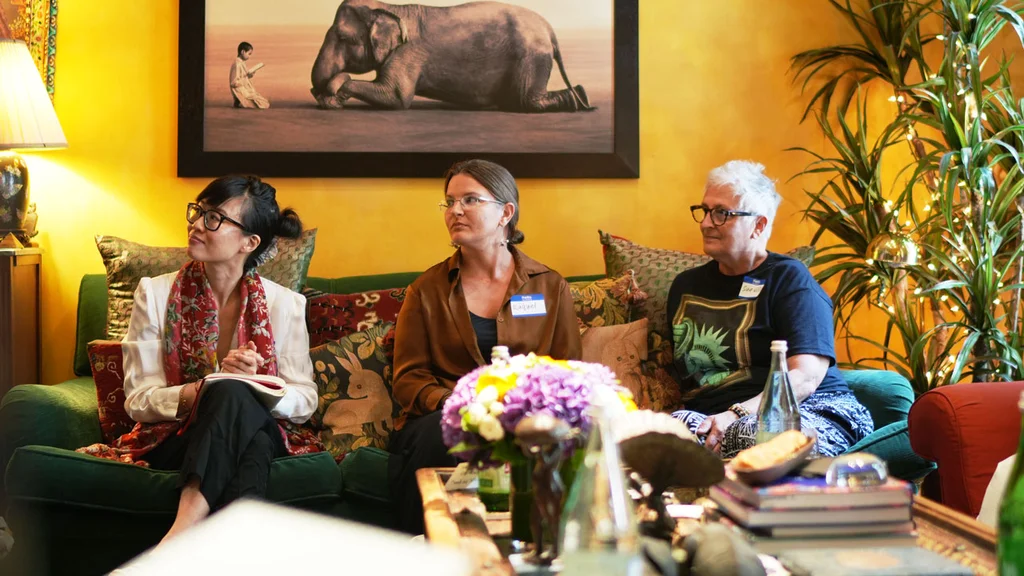
On this Monday afternoon, Steinem’s living room is filled with 20 or so people: a diplomat from the Netherlands, a publisher, an impact investor, Emmy nominee and comedian Baratunde Thurston, as well as members of the Haudenosaunee (also known as the Iroquois) Confederacy.
Steinem, 92, is the founder of Ms. magazine, who rose to prominence as a social justice activist and key figure in the second-wave feminist movement of the 1960s and ’70s, especially for her clear-eyed writing, including the classic “If Men Could Menstruate.” She has been hosting gatherings in her home for decades. Recent discussions explored the topics of AI and sexual desire.
This month’s topic is the Haudenosaunee’s system of governance, which includes practices such as involving women in leadership, centering the natural world in decision-making, and thinking seven generations into the future. Many of the Haudenosaunee’s practices—such as separation of power, checks and balances, and impeachment—served as a template for America’s democracy. However, the Founding Fathers didn’t adopt other practices—such as giving women equal power.
In a year filled with news about women leaving the workforce and AI gobbling up entry-level jobs while slowly destroying our planet, envisioning a better way to move forward is difficult—yet clearly necessary.
One woman, the investor, comments that there was a study where people were asked to paint the future. Their paintings were dystopian. Yet, when asked to envision a better future, most people couldn’t. She notes the Haudenosaunee principles offer a template for what “better” could look like.
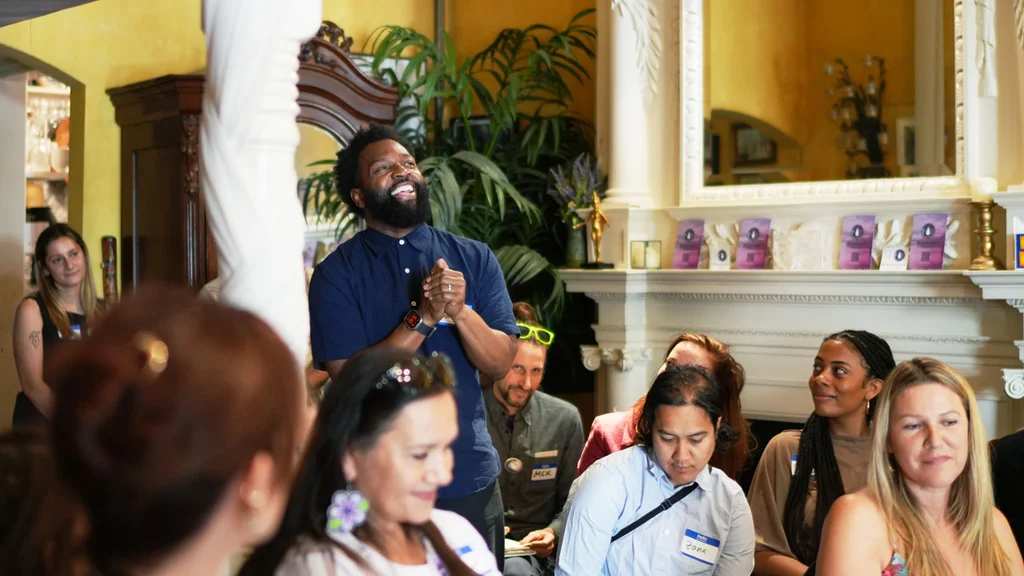
During the conversation, no one takes out their phone except to snap photos. Instead, the group nibbles on cinnamon sugar doughnut holes and talks about how each of us can create a future where we go back to our roots, to a country where women had an equal voice in leadership.
Afterward, Fast Company sat down with Steinem to take stock of how far women have come in the last six decades—and how they can keep making progress. [This conversation was edited for clarity.]
How do you feel about the state of where women are today? Have we made progress since the ’60s and ’70s?
Well, I think we probably have made progress in reproductive freedom. We probably have more control over whether we have children, or many children, and with whom. It’s not true for everybody, but I think in a general way it’s probably true. We’ve also become more accustomed to women in leadership roles, and men caring for their own children.
In a global, political way, this country is still behind. We’ve never had a female president, which many other countries have. We have arguably one of the worst presidents we’ve ever had. I lived through Nixon and Reagan, which wasn’t easy, but Trump is definitely worse. He doesn’t have leadership qualities that help us get along with each other across differences and that make us more considerate of the environment.
How do you feel about how much progress businesses have made since you started fighting the good fight for women? Currently, 11% of the Fortune 500 CEOs are women—and this is an increase from less than 1% in 2000.
It’s a difficult question. On the one hand, I think we should be on strike against a lot of businesses. And on the other hand, we want to transform business so that it is more democratic and inclusive and better for the environment. And of course, we need to be present in order to do that.
I can’t believe businesses allowed Trump to become president. I don’t know how to make corporations feel more responsible for who’s in the White House, and not just for the tax policy that they may be interested in.
We’re seeing a record number of women in leadership exit the workforce because they say they’re burnt out, and they have to choose between caregiving and their jobs. What do you make of that?
I think there’s some resentment of female power, and because of that, there’s probably an idea that we have more power than we really do—that it’s somehow not natural for women to have power.
Meanwhile, the invisible problem is that women are still accepting the idea that they take care of children more than men do. Men are fathers, too. If we’re to have a democracy, truly, we need to have democratic families. That means that both women and men can be active outside the home, and both women and men are equally responsible for children.
If men love their children and if they want children, then taking care of equal care of those children is crucial.
We need to make sure that businesses have parental leave, not just maternity leave, so that fathers can be home. We need to look at employment patterns to make sure that the decision-making, especially at the top, such as the board of directors, is divided between males and females, and is racially diverse.
What does it take to create these changes?
I believe in movements. I don’t think anything happens automatically. As long as we are living in a culture in which the guy who parks your car makes more money than the woman who takes care of children, it will seem that cars are more important to us than our children—which isn’t true.
We need a movement among the employees in corporate America, among the stockholders who demand not just profit but also changed social policies. We’re missing the social power of the civil rights movement, the feminist movement, the gay and lesbian movement, the environmental movement, and we need those powers back.
There are ways that we have power and that we can make change.
How do we do that?
Well, having meetings like this one in our living rooms, making neighborhood demands, urban demands, country demands. Social justice movements have different kinds of sources, but overall it’s people who, instead of saying “why?,” say “why not?”—and just do it.
A movement is just composed of people moving. It means that you invite 10 other people, or however many other people who share the same desire or problem, to meet and plot what steps could create change. It’s not magic; it’s just logic.
Speaking of creating change, a few years ago, companies were talking about the importance of diversity. Now we’re seeing DEI efforts rolled back and women exiting the workforce. How do you make sense of where we are now compared to where we were a few years ago?
There was a time of—perhaps an artificial time of—liberalization during World War II, because the men were in the military and the women were taking roles that they probably would not otherwise have done. But we shouldn’t need to go to war in order for that to happen.
The pattern of change is usually a forward push, and then a few steps back while that [change is] assimilated, and then another forward push, and so on. Now, there’s probably much less discrimination against females in the labor force and people of color in the labor force than there was when I, as an old person, was growing up. We are moving forward, but slowly.
What advice actually do you have for people who are struggling with this moment of two steps back before one step forward?
I would say find a couple of other people who share the way you feel, because we need each other. Together, you’ll figure out an interesting and even fun way to make change. Meetings like today in the living room are important.
Just don’t be alone. We’re communal animals. There’s a reason why solitary confinement is the worst punishment everywhere. So, make sure you meet frequently with people who share the same hopes and dreams. That’s crucial.