Josh Lefkowitz/Getty Images
- General Motors tells Business Insider it’s trying to cut the time to develop a new model to two years.
- Automakers are trying to make cars faster amid tariffs, EV stumbles, and competition from China.
- GM shared some tools it’s using to virtually test cars before building prototypes.
General Motors wants to find its “uh oh” moments earlier.
For years, automakers have built physical prototypes to learn how a car behaves on the road, cools passengers down, burns through energy, or even crashes. Those builds can be expensive and time-consuming.
In an interview with Business Insider, GM’s chief product officer, Sterling Anderson, and executive director of virtual integration engineering, Jason Fischer, said the automaker is using AI, simulation, and decades of engineering data to move more of that discovery work into the virtual world.
GM — which runs brands including Chevrolet, Cadillac, and GMC — is targeting a two-year vehicle development process. That’s down from the standard four- to six-year vehicle development cycle.
“Physical properties are really becoming confirmation builds,” Fischer, a 28-year GM veteran, said, rather than “the first time we’ve discovered something that we’ve missed.”
The push comes as the auto industry is facing several headwinds at once. Chinese automakers are launching new, lower-cost vehicles at a rapid clip. America’s EV appetite has not met initial expectations, forcing automakers to write down billions of dollars in production investments. And federal emissions rules, tariffs, and consumer incentives for vehicle sales have swung back and forth between presidential administrations.
Those pressures are forcing automakers to rethink how long they can afford to spend developing new vehicles. Executives at Nissan and Hyundai have previously told Business Insider that they are trying to cut down the time it takes to bring cars to market.
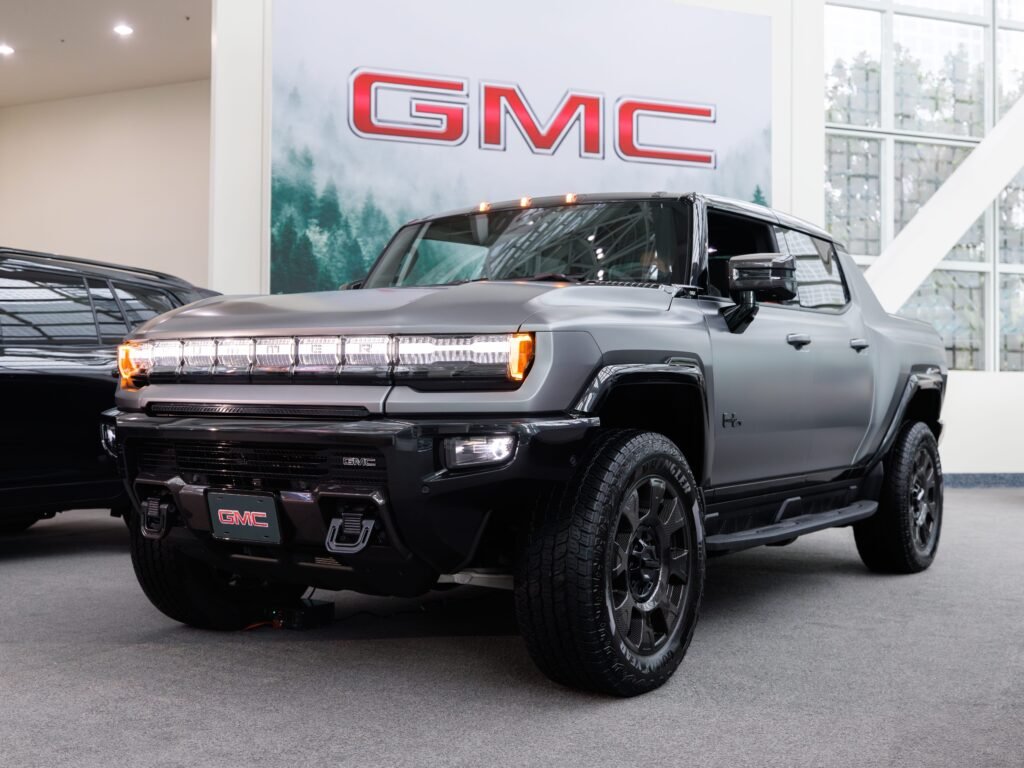
Now, GM tells Business Insider it’s confident it can meet its timeline goal because it’s done it before: The GMC Hummer EV took them 20 months to move from concept to production.
“We want that to be the norm, not an exception,” Anderson, a former Tesla and Aurora Innovation executive, said. “The team did a number of Herculean things to make that happen. These tools are making it possible for our entire product development organization to do the same thing without the heroics for every vehicle we build.”
GM is testing the car before it exists
General Motors
GM’s faster-development push is powered by a mix of bespoke virtual tools and AI models trained on or informed by the automaker’s own engineering data.
Fischer said GM rarely uses an “exact off-the-shelf tool.” Instead, the company works with software suppliers to customize tools for its own vehicle programs and has also built some of the technology internally.
“We have a lot of IP ownership on some of the techniques that we’ve developed,” Fischer said.
GM declined to specify how much it budgets for AI usage by product designers or engineers. Instead, the company said it’s focused less on token volume and more on whether AI solves real business problems.
In one demo, GM showed a Cadillac Lyriq running a cone avoidance maneuver — a common safety test run by Consumer Reports — with several engineering and design teams brought into “a single virtual environment,” Fischer said.
That lets GM test how hardware and software behave together earlier — and under more weather conditions. Fischer said engineers can rerun the tests in different road conditions, including ice, snow, and rain.
The same approach applies to less flashy parts of the car, too. Fischer said GM can use co-simulation to model airflow, refrigerant behavior, cabin comfort, range, energy efficiency, and fuel economy together. Work that might have taken months can now happen in “hours or days,” he said.
The models even suggested different designs for a bracket in the Corvette’s rear hood. Fischer said it was developed using topology optimization and turned out to be 30% stiffer, 20% lighter, and about 95% more durable than the original design.
GM then added the Corvette symbol in the middle.
General Motors
GM has spoken with Business Insider before about using AI in design, including tools that help turn sketches into animations and monitor its supply chains.
This latest push goes into the belly of a car’s development process: validating how the vehicle handles, cools, crashes, and integrates hardware and software before GM spends more time and money proving it with a physical build.
“The winners of this industry are those who iterate like next-gen software companies,” Anderson said.