Want more housing market stories from Lance Lambert’s ResiClub in your inbox? Subscribe to the ResiClub newsletter.
The spring 2022 housing market was one of the most competitive periods on record. In many housing markets, homes went pending within days of hitting the market as buyers rushed to lock in mortgages before rates moved higher.
Four years later, the landscape looks very different.
According to Zillow data, the typical U.S. home listed for sale in May 2026 went pending after roughly 18 days—three times longer than the 6-day national median recorded in May 2022.
Median days to pending offers a timely glimpse into the supply-demand equilibrium of local housing markets. Because homes typically go pending weeks before they close, the metric often captures shifts in market conditions sooner than closed-sales data.
If homes begin taking longer to go pending, it can signal that buyers are gaining leverage. Conversely, falling days to pending may indicate a market that’s tightening.
The maps below show just how dramatically conditions have shifted across the country.
LEFT: Median days to pending in May 2022
RIGHT: Median days to pending in May 2026
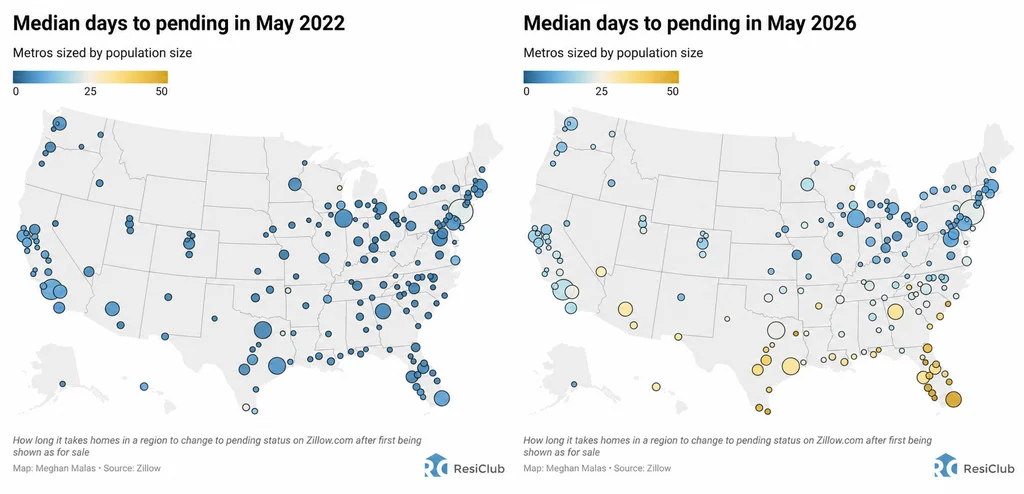
While homes are generally taking longer to sell almost everywhere, the slowdown has been far more pronounced across many parts of the Sun Belt.
Large portions of Florida, Texas, and the Southeast have seen median days to pending rise sharply since the pandemic-era housing boom, reflecting a market where inventory has increased and buyers have gained leverage.
By contrast, many markets across the Northeast and Midwest remain relatively tight. In numerous metros across Pennsylvania, Ohio, Illinois, Wisconsin, and upstate New York, homes are still going pending in less than a week.
Among the nation’s 250 largest housing markets, the 10 metros with the longest median times to pending in May 2026 were:
- McAllen, TX: 79 days
- Laredo, TX: 75 days
- Naples, FL: 74 days
- Cape Coral, FL: 66 days
- Punta Gorda, FL: 66 days
- Brownsville, TX: 65 days
- Panama City, FL: 59 days
- Houma, LA: 58 days
- Port St. Lucie, FL: 54 days
- Ocala, FL: 54 days
Meanwhile, the 10 metros with the shortest median times to pending in May 2026 were:
- Springfield, IL: 4 days
- Kansas City, MO: 5 days
- Columbus, OH: 5 days
- Lancaster, PA: 5 days
- Anchorage, AK: 5 days
- Grand Rapids, MI: 6 days
- Hartford, CT: 6 days
- Richmond, VA: 6 days
- Cincinnati, OH: 6 days
- St. Louis, MO: 6 days
Other housing markets that also had a median days to pending of 6 days in May 2026 included: Dayton, OH; Syracuse, NY; York, PA; Reading, PA; Manchester, NH; Peoria, IL; Ann Arbor, MI; Erie, PA; and Topeka, KS.
The regional divide becomes even clearer when comparing today’s market to May 2022.
Many of the Sun Belt metros that were among the hottest housing markets during the pandemic boom have seen some of the biggest increases in selling times.
In Miami, the median home went pending in just 10 days in May 2022; by May 2026, that figure had climbed to 52 days. Tampa rose from 5 days to 34 days, Jacksonville increased from 5 days to 43 days, and Austin went from 11 days to 41 days. Similar slowdowns have occurred across other parts of Florida, Texas, and the Southeast.
By contrast, many Northeast and Midwest markets have remained relatively tight. Chicago went from 6 days to 8 days, Philadelphia from 7 days to 9 days, Boston from 6 days to 8 days, and Cincinnati from 3 days to 6 days over the same period.
Buyers in many markets now have considerably more negotiating power than they did during the pandemic-era frenzy. Homes are taking longer to attract offers, giving buyers more time to compare listings, negotiate pricing, and request concessions.
At the same time, many Northeast and Midwest markets continue to face limited inventory, helping keep selling times relatively short despite elevated mortgage rates.
In other words, while the national housing market has cooled considerably from its 2022 peak, local conditions remain highly regional. The markets where homes are sitting the longest today are largely concentrated in parts of the Sun Belt, while many markets in the Northeast and Midwest still resemble a seller’s market.