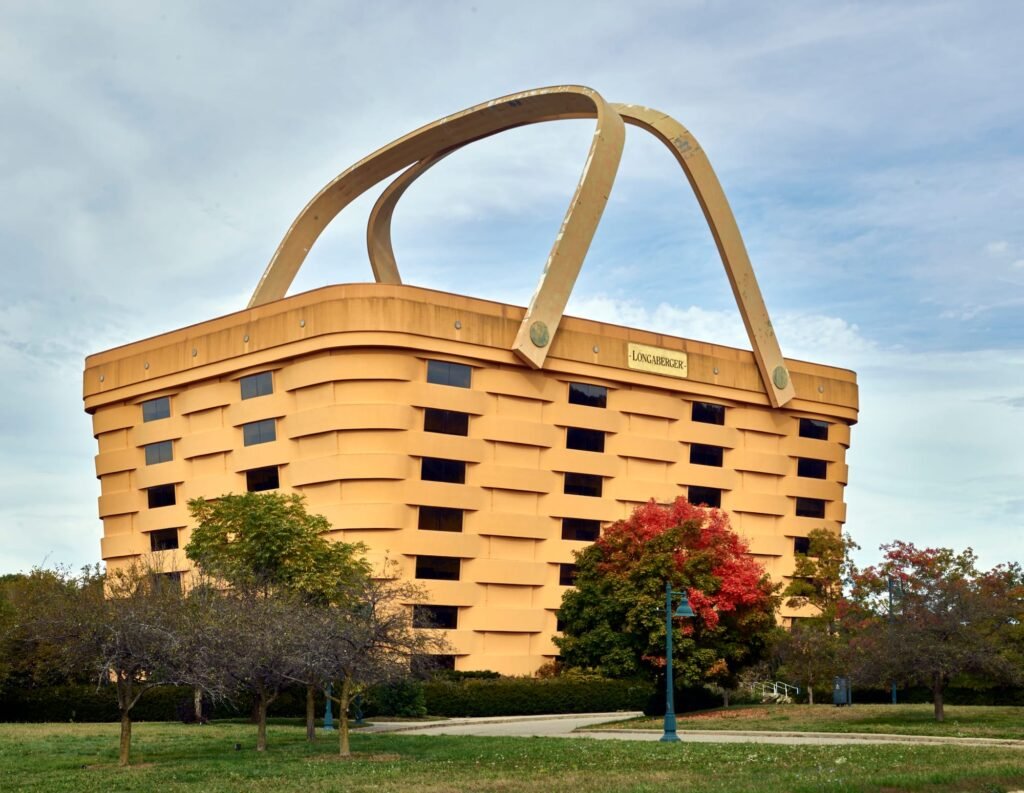
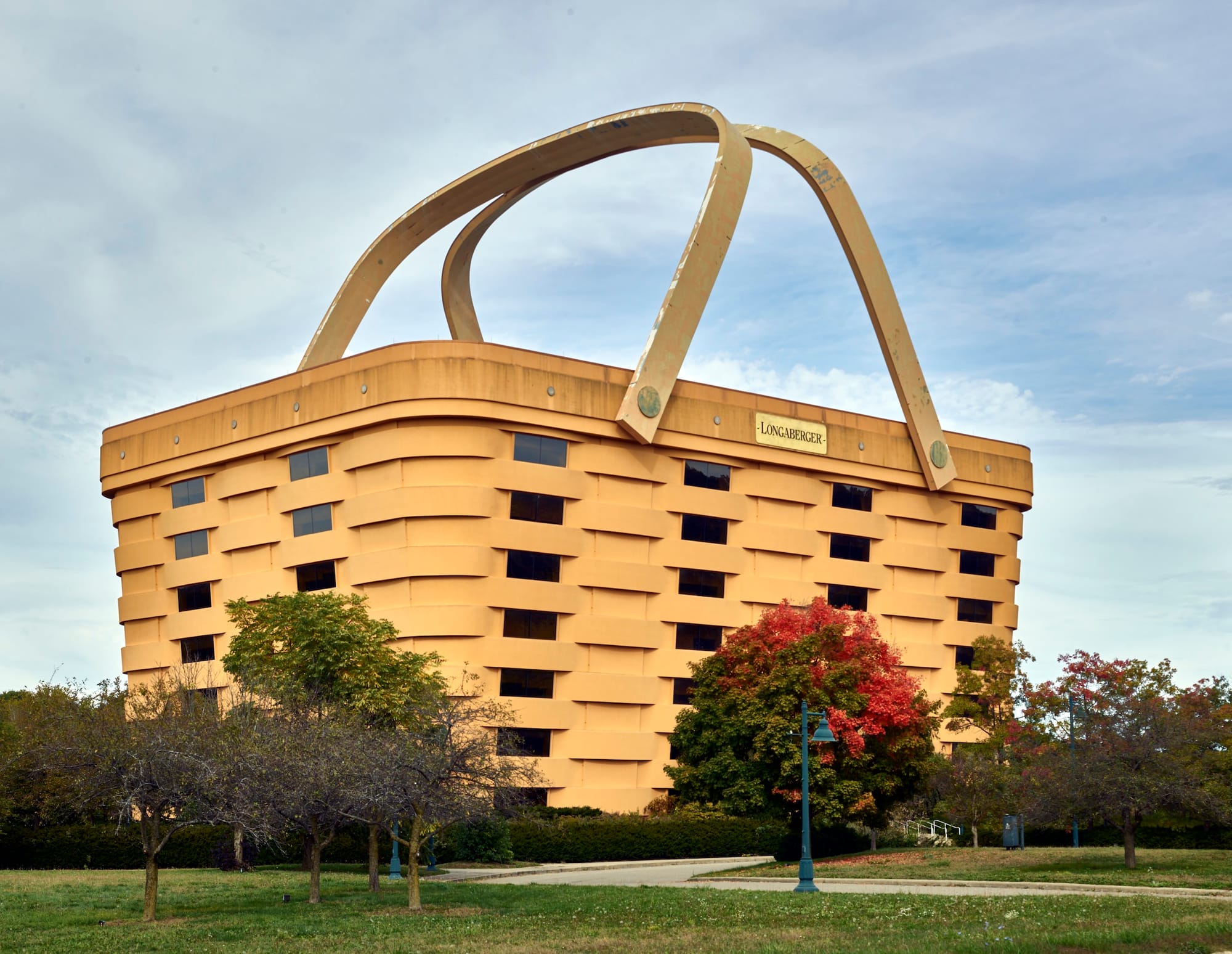
The Longaberger Company was once a billion-dollar basket-weaving empire, employing over 8,000 people at its peak. Its headquarters in Newark, Ohio, was built in 1997 in the shape of a giant basket, complete with two enormous handles arching over a glass atrium ceiling. But after declining sales, the company filed for bankruptcy in 2018. The iconic Basket Building, which has sat empty for years, is now for sale.
Ryan Miller, a photographer who worked at Longaberger in 2014, witnessed the company’s descent into financial instability. “After countless late and missed payments, I learned they were struggling to pay many of their contractors, myself included,” Miller told me. “That glass ceiling? Well, it turns out that the handles would gather moisture and ice pretty frequently in the winter and when it broke free, it had only one place to come crashing down. Eventually, they didn’t even bother to get it repaired, and I vaguely remember some tarp and tape holding it together during my final days there.”
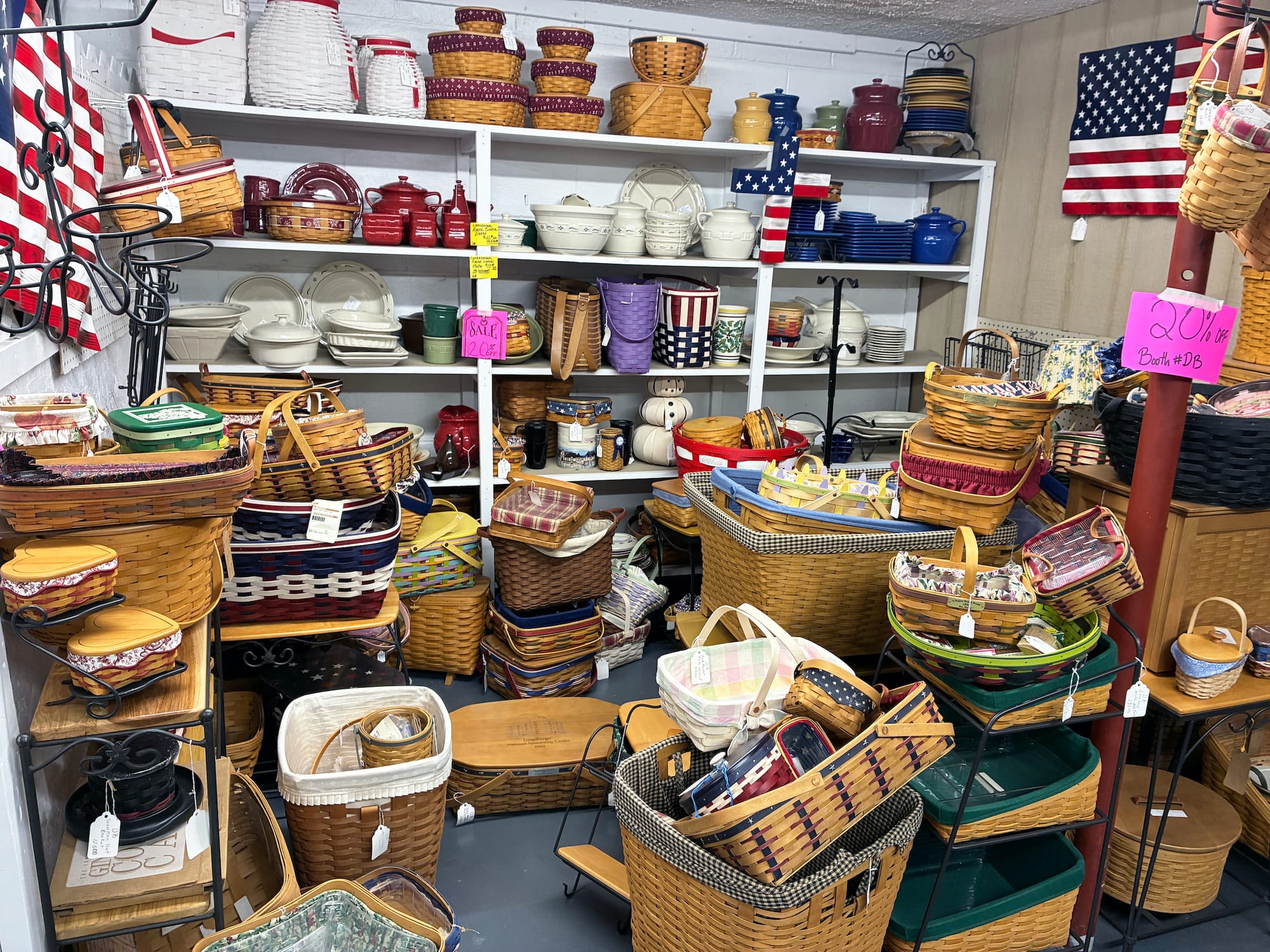
Dave Longaberger founded the company in Dresden, Ohio, in 1973, inspired by his father’s 40-year career in the basket-manufacturing business. The quality of their handmade Maplewood baskets was undeniable: They were produced with milled wooden weavers, fabricated in long strips that interlace with the spokes. When I was growing up, these baskets sat in almost every room of my house. They sometimes came complete with a vacuum-formed plastic protector, marked by the indelible indentation of the over-under weaving structure.
Collected by countless women who bought them from a multi-level marketing network of over 70,000 sales representatives, Longaberger baskets introduced a new culture of basketry to America — an invented and mythologized material culture of settlement. (Conspicuously absent from the company’s family lore is how the Longabergers came to arrive in Ohio.)
One small Longaberger basket in my possession was released in 1992, in celebration of the 500th anniversary of Christopher Columbus setting foot on what we now call the Bahamas. The basket is shaped like a small, round vessel with a rectangular metal tag that reads, “Longaberger DISCOVERY BASKET 1492-1992.” This “Discovery Basket” perhaps best encapsulates what Longaberger was truly selling: an American mythology and identity. A classic bootstraps story, but with a twist.
The Longaberger trick was to sell the very thing the company had abandoned: the family that quit making baskets built an empire on the aura of having made them. A craft lineage became a sales network, and the baskets became souvenirs of a practice that no longer existed at the top.
Baskets often represent the intrinsic relationship between land and people; they demonstrate how we manipulate the world around us to make meaning and utility. The problem, then, with Longaberger baskets is that the meaning that these vessels hold is limited to their worth as cultural relics of a withering American empire. While Longaberger baskets inarguably left their mark, they refuse the knowledge of ancestral land imbued in basket traditions such as Gullah Geechee sweetgrass baskets or Cherokee rivercane baskets.
Good craft is antithetical to capitalism. Good craft cannot survive in a system that alienates labor. As Erin Miller, director of Weaving at Berea College, told me, “all objects tell a story, whether they are handmade with care for a family member or a t-shirt from Walmart.”
Berea College, a tuition-free work college in Kentucky’s Appalachian foothills, has run a continuous weaving program for over a century. It is just a few hours south of Dresden, but a world away from the Longaberger model of production. Miller reflected on the lineage of objects crafted at the college, where craft survives because no one is extracting a fortune from it.
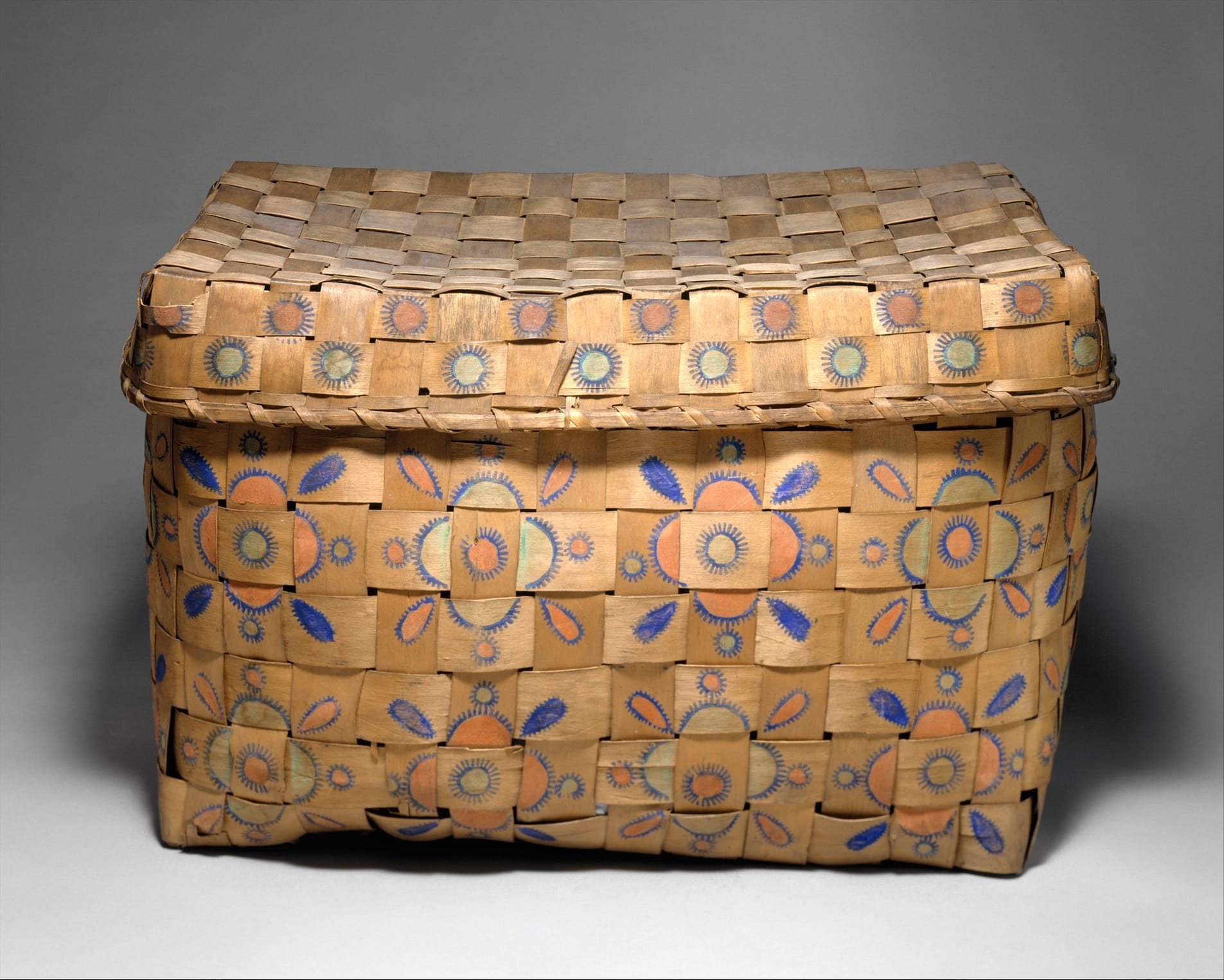
“The end product at Berea tells a story of education in Appalachia. When I was learning to sew, I had envisioned a world in which I would eventually be able to make everything: spin the thread, make the buttons, weave the cloth,” Miller said. “As I grew older, I realized that that vision was unrealistic. At Berea, we dye only special projects ourselves. We still rely on a supply chain, sourcing materials from all over. The reason that our objects are Appalachian is because they’re made by students in Appalachia.”
My mother will gift her baskets to me eventually, but they first found their way to her through the marketplace, through uneven wealth distribution, and through a markedly Victorian sensibility of collecting the natural world, and by extension, the people who steward it.
The bitter truth is that we have inherited a culture that places the sacred in the tangible. We find value in commodity. We are incentivized to remember our kin not through cultural practice, through song, stories, or craft — but through buying, selling, and collecting. Our cultural heritage, with the help of companies like Longaberger, is flattened into the opaque construction of whiteness. Not German, like the family company’s ancestors, but American.
I will remember my mother through my Longaberger basket collection, which is capable of outlasting my life and continuing long into a shared American future, whose inheritance is still being contested. The headquarters, meanwhile, sits empty in Newark with a for-sale sign, the biggest basket the family ever made and the only one nobody wants. The small ones persist because their burden is lighter: They only have to hold a memory, not a myth.