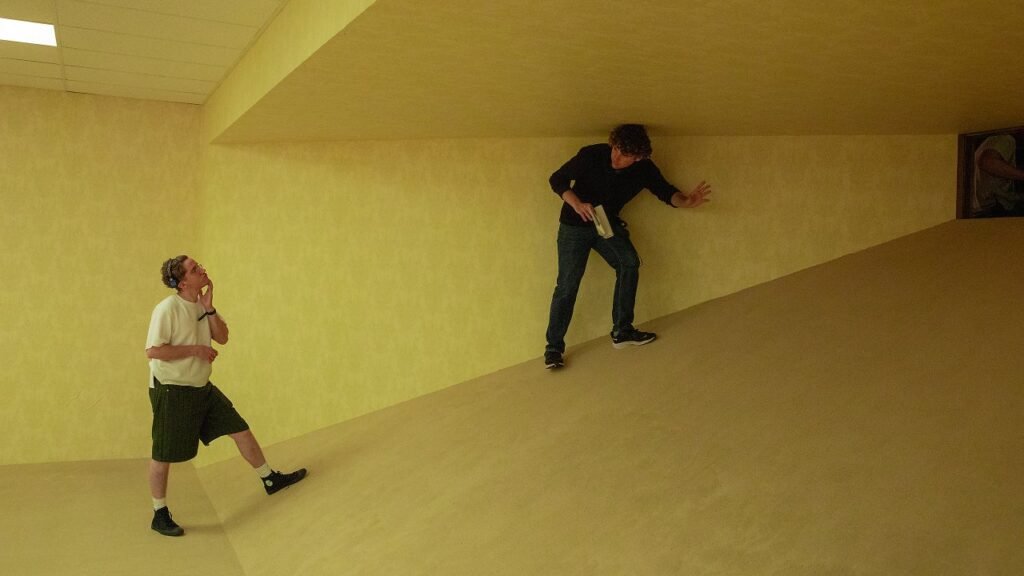
There’s a place that you’ve never actually set foot in, but your subconscious recognizes it. It’s a maze of hallways full of yellowed wallpaper, dingy cream carpet, and fluorescent lights—an amalgamation of all the in-between, liminal spaces that you’ve ever briefly occupied. Just looking at an image of it triggers a sense of déjà vu for some forgotten childhood doctor’s office, playdate, or store. This is the Backrooms, and it’s the playground where A24’s new surreal horror film takes place.
The Backrooms, which debuts on May 29, was directed by 20-year-old Kane Parsons, A24’s youngest-ever director. Parsons discovered the concept of the Backrooms as a middle schooler by trawling through sub-Reddits, fan forums, and wiki posts. Since then, he’s essentially created a Backrooms canon through a series of videos on his YouTube channel, building his own rich Backrooms lore that’s amassed such a fervent fan base that it’s getting its own mainstream movie spinoff.
The adaptation fleshes out a small narrative snippet from the overarching Backrooms story that Parsons has already crafted on YouTube. It takes place in 1993, following a furniture store owner (played by Chiwetel Ejiofor) who discovers a portal to the Backrooms in his warehouse’s basement and is ultimately followed into the unknowable space by his psychiatrist (played by Renate Reinsve).
In order to transport viewers into this world alongside its characters, Parsons gave his production design team a daunting imperative: turn the internet’s most iconic liminal space into a physical film set.
A beginners guide to the Backrooms
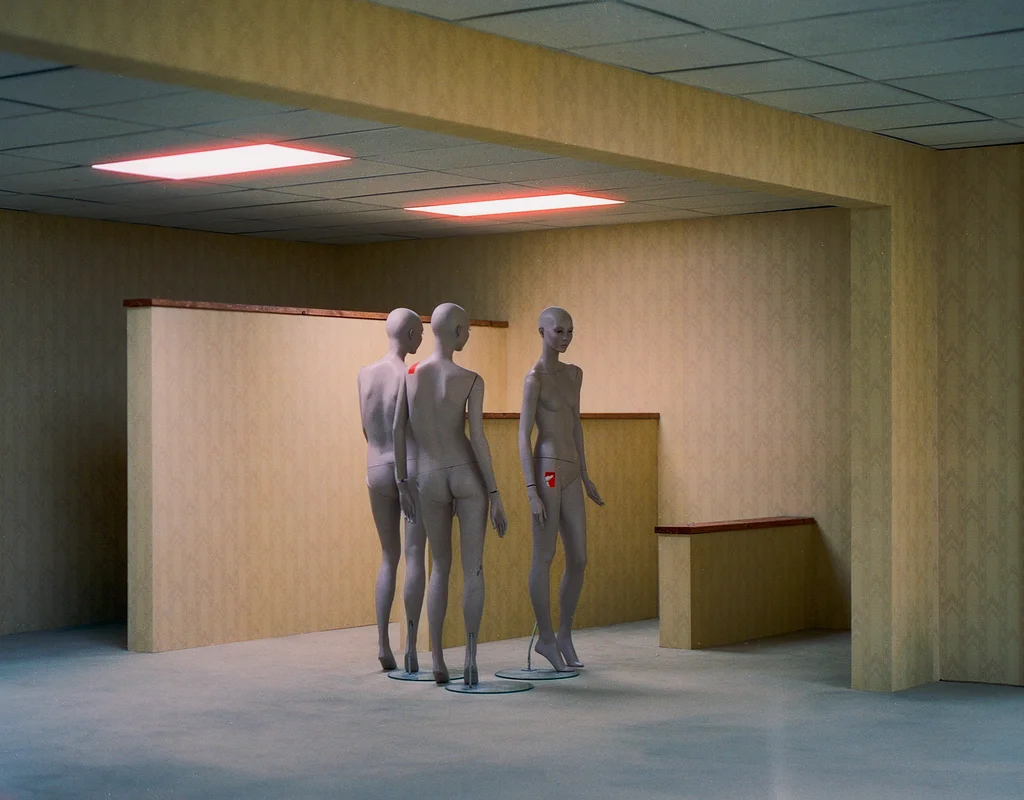
The first known reference to the Backrooms traces back to a 2010s post on 4chan. It shows a series of empty rooms filled with yellow wallpaper, close ceilings, and fluorescent office lights.
One comment on the post, which has come to define the essence of the Backrooms, reads, “If you’re not careful and you no-clip out of reality in the wrong places” (video game slang for glitching from one place to another) “you’ll end up in the Backrooms, where it’s nothing but the stink of old moist carpet, the madness of mono-yellow, the endless background noise of fluorescent lights at maximum hum-buzz, and approximately six hundred million miles of randomly segmented empty rooms to be trapped in.”
This post took on a life of its own, spawning user-written stories, its own wiki, graphics, and countless theories. But the concept truly solidified when Parsons, then 16, published his first YouTube video about the the Backrooms in 2022. The video, titled “The Backrooms (Found Footage)” has more than 78 million views and is the first in a 16-part series. Over time, the videos reveal that a mysterious corporation called the Async Research Institute is responsible for spawning the Backrooms in an apparent effort to deal with overpopulation and create an infinite storage space, though its exact motivations and operations remain shrouded in mystery.
Each new installment, which Parsons scripts, sound engineers, and designs himself on the visual effects (VFX) platform Blender, has millions of views and a legion of fans ready to dissect every frame (see the multiple hours-long videos on the topic) for information about how the Backrooms came to be.
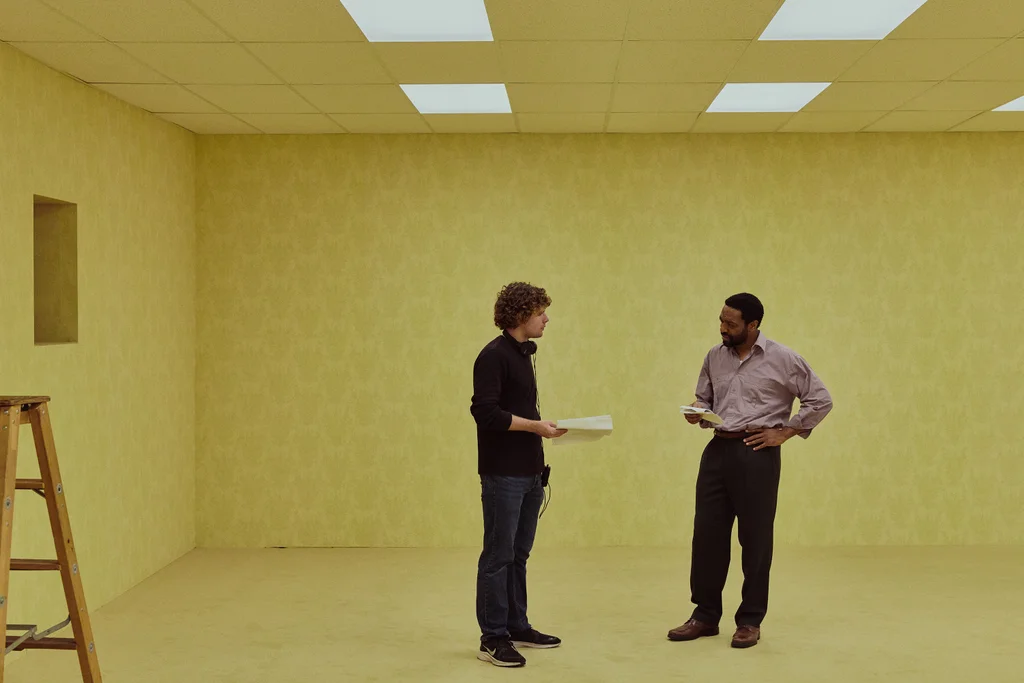
Parsons’s new A24 movie will be one of the biggest new installments of lore yet. It will also be the first time that the Backrooms have been constructed in real life. To capture the space’s unsettling ambience, the production designer Danny Vermette built a giant physical set for the actors to interact with. Then he combined the footage with digital shots created primarily in Blender in postproduction.
Fast Company sat down with Vermette—whose other credits include horror films like Osgood Perkins’s Longlegs and The Monkey—to discuss how he brought the Backrooms to life. It involved extensive research, dozens of wallpaper samples, and some very musty props.
This interview has been edited and condensed for clarity.
Fast Company: How much did you know about the Backrooms before this project?
Danny Vermette: I was aware of liminal space and that there was a trend happening. I’ve always been a fan of awkward design with this surreal quality, but I had no idea how in depth it went. It was an eye-opening experience.
I’ve watched about five hour-long videos explaining the Backrooms, but I feel like I’ve barely scratched the surface of the lore. What did your research process look like?
It’s funny because I actually ended up watching some of the wrong videos. It wasn’t Kane’s stuff; it was just other content creators’ work on the Backrooms. I was like, “Oh, this is pretty cool.” It wasn’t until a day later that it really resonated, and I was thinking about it a lot. This is way before we knew we were going to do the movie. It was very preliminary.
Finally I found Kane’s stuff and watched quite a bit of it before having our first chat, and it became very apparent that this was his world. The way that he speaks to it so eloquently—and he hates the word “lore,” but I’m going to say it—it has a tangible sequence and feel, and it’s an entity with rules and boundaries.
When I eventually got the original script, there were elements that just didn’t fit within that lore, and he made it apparent that they were going to need to change. My first pass at the idea of what and how this film would work was wrong. The Backrooms doesn’t change in front of your face. It’s not ever-morphing. It’s this repetitive space that is limitless.
Kane clearly has a very specific vision. What was your first step to executing that?
I said, “Tell me what’s your dream scenario. What do you want to build practically?” So Kane spent a couple of weeks building everything in Blender, and when he sent the file over to me, it crashed my computer. It was, like, 100,000 square feet.
I was like, “Well, we’re working with a budget here. We’ve got X amount of square footage that is tangible space for us to build in. We’re going to have to be very particular on what we build practically and what we move to VFX.” It was a matter of figuring out what levels he wanted to create and how far into the Backrooms we wanted to go. How much do we want to show practically to enable our talent to interact with?
That was me looking at a lot of his work in the YouTube series and finding the stuff that really interests me and chatting back and forth about that. Then we created a plan from there.
I think I read that the set was about 30,000 square feet—is that right?
We were maybe just slightly under 30,000. It was 37,000 square feet of wallpaper and 29,000 square feet of carpeting.
That’s one part I was curious about. Obviously those classic yellow Backrooms are so recognizable to fans. What did your process look like to hunt down materials that could replicate the feeling of that space?
The wallpaper was huge. It was something where I was like, “Okay, we need to dial this in.” There were two things on my mind: It was the sheer volume and it was right around the time when the tariff threat showed up.
We’re in Vancouver, and a lot of our main producers are in the U.S., so we couldn’t afford to bring that stuff up. We had to source it locally and we ended up finding someone like five blocks from the office. He was a new company and he was just like, “Yeah, we can do it. I’m down to try.”
We ended up doing 30 to 40 renditions of the wallpaper to get the tonality and the print and the scale right. We had to make sure that the backing versus the print didn’t have too much contrast. We ended up doing tons of samples and tons of variations, putting them together with our carpet, putting them together with the lights just to make sure that it was recognizable for the fan base.
There’s a contentious debate online about what’s the true yellow, and everyone has their own opinion and you have to take in so many factors. The lighting is one, but you’re adding a cinematic camera and actors and real tangible furniture in there, which changes the tone of everything. We developed a recipe where it would hopefully translate into something that was very close to a Blender image.
To that point, another key ingredient is the lighting and making that look as eerie and liminal as it does in Blender. Were there strategies that you had to develop to get that perfect?
With the drop ceiling that is predominant throughout the sets, you would normally use a trougher that sits on an overhead grid with fluorescent bulbs. We quickly realized that that wasn’t going to work for quality of light and other factors, so we kind of had to invent our own strategy.
We ended up having to use film lights and suspend them quite high above the lens of our drop ceiling, and actually create basically a mask to control the light. If the lights were too close, we saw the bulbs. If they were too far away, there wouldn’t be enough light. It was a really fine balance to get the light quality.
So how did you decide which pieces to make practically and which to make digitally?
A big part was we wanted to add interesting elements and verticality to the sets that pushed our actors out of their comfort zones. That meant introducing sets on 15- and 20-foot risers. In the scenes where they’re going down tunnels, those tunnels are practical. We built those on 20-foot stilts.
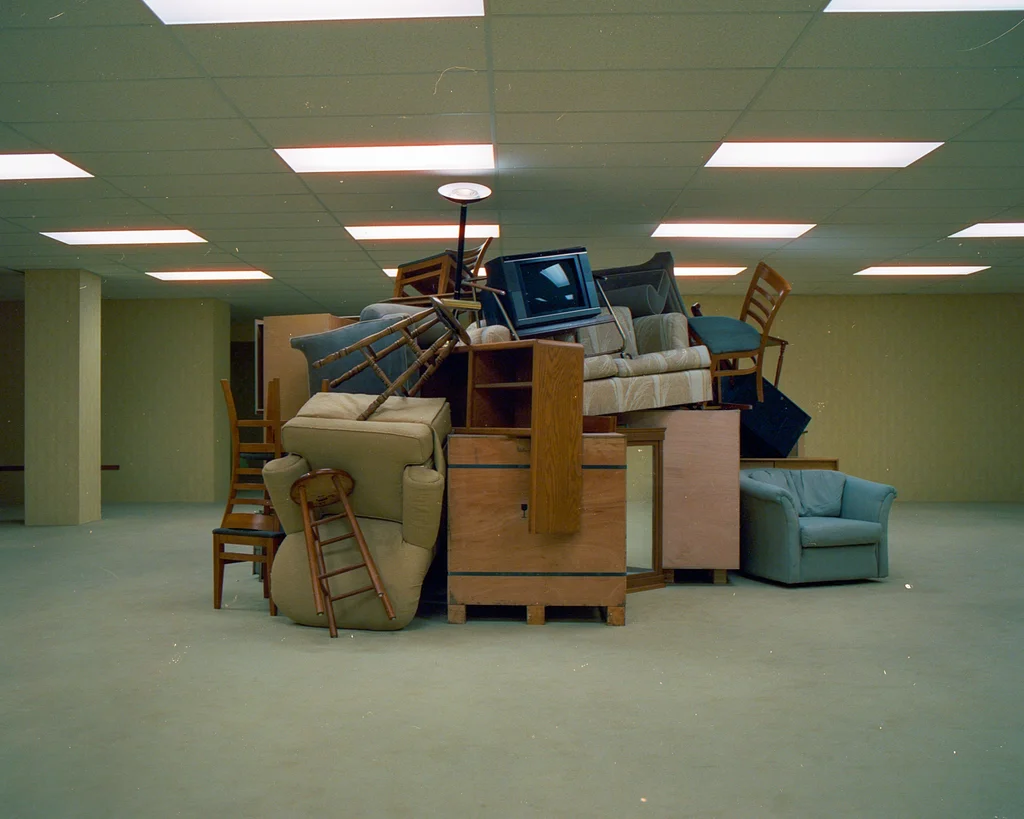
An interesting tidbit is, [in one scene], we needed piles of clothing as set dressing. We ended up getting these massive containers of clothing, but apparently they had been left out in the rain. When we went to dress the set, they were all musty and they just reeked.
I mean, it did look like it smelled terrible down there!
Yeah, talk about method! When we did the crew screening here, the whole crew just howled because we spent days in there and it was not pleasant.