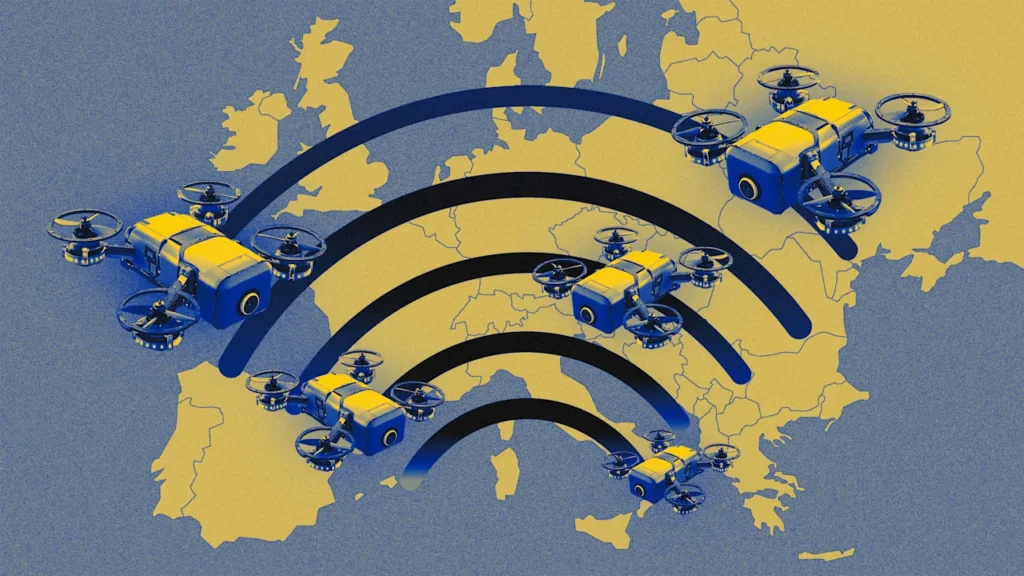
Germany’s SPRIND, the Federal Agency for Disruptive Innovation, and Sweden’s Vinnova, the country’s innovation agency, are two bodies that traditionally haven’t worked hand in hand. But the challenges the world currently faces have brought the two public innovation agencies together to back teams from across Europe building systems that can defend airports, nuclear plants, and civilian sites from hostile drones.
One team, led by Martin Saska, a robotics professor at Czech Technical University in Prague, is among those being backed by the agencies to develop anti-drone technology. Beyond supporting a single company, the partnership offers Europe a way to stand firm amid shifting alliances elsewhere.
Mario Draghi’s report on European competitiveness made clear that the continent was falling behind in the speed and scale at which radical ideas reach the market. The SPRIND-Vinnova partnership, formalized last year, is a deliberate effort to change that.
“We need to have a fundamentally different way of funding innovation if we want to see different results,” says Jano Costard, head of challenges at SPRIND. “If we as SPRIND would have just copied what everybody else did, then what would be our added value?”
Both agencies are modeled on DARPA, the U.S. defense agency credited with creating and later popularizing the internet and GPS, but with the military framing stripped away.
SPRIND, founded in 2019 and operational from 2020, was given unusual legal latitude in how it spends money, including a 2023 act of parliament in Germany that allowed it to take equity stakes in startups, something most German public bodies cannot do. Vinnova, more than 20 years older, has operated with a similar playbook for years. Sweden, with a population of just 10 million, produced more than 500 IPOs in the past decade, more than Germany, France, Spain, and the Netherlands combined.
“Europe as a whole needs to invest more in radical breakthrough innovation, and we also need to figure out ways of really supporting the journey to scale,” says Darja Isaksson, director general of Vinnova. The aim, she adds, is to “make it easy for private sector VC to spot that and to crowd in.”
The choice of drones for the agencies’ first joint initiative is no accident. Beyond the integral role drones are playing in Middle Eastern conflicts, repeated drone sightings over European airports in late 2025 have rattled governments. There is also growing anxiety about the role of Russian- and Chinese-made hardware in critical infrastructure, making anti-drone technology a key focus for European police forces and militaries. The challenge is that Europe’s drone sector remains highly fragmented. Costard argues that without coordinated demand across member states, no startup can build a viable business in the space. “If every police force that would like to buy drone interceptors posts different requirements, that’s a nightmare for any small startup,” he says.
For founders like Saska, whose company EAGLE.ONE builds drones that hunt other drones, the agencies’ support has made a tangible difference. Winning a SPRIND challenge round in 2024, he says, “got a lot of leads, and this helped us really get into the German market.” Saska argues that Europe needs sovereign drone capability for deeper security reasons: police forces and some armies across the continent still rely on consumer drones from Chinese manufacturer DJI.
Bringing together two countries’ innovation agencies helps pool expertise and accelerate the pace at which solutions can emerge. “Iteration speed is a superpower,” says Costard, borrowing a line from OpenAI co-founder Greg Brockman. “If these young teams rely on the funding that we provide, the slower we are, the slower they are.”
Success tends to breed success, and the model is beginning to spread. The Netherlands has announced a SPRIND-style agency of its own, and the European Innovation Council has been tasked with piloting challenge-driven funding. Sweden is also exploring an expanded version of what Vinnova already does, while the European Commission renegotiates its next research framework with Draghi’s recommendations on the table.
“Our mission is to solve the grand challenges of our time,” says Costard. “They’re typically not unsolved because nobody has thought about them—it’s typically because they’re very hard to solve.”