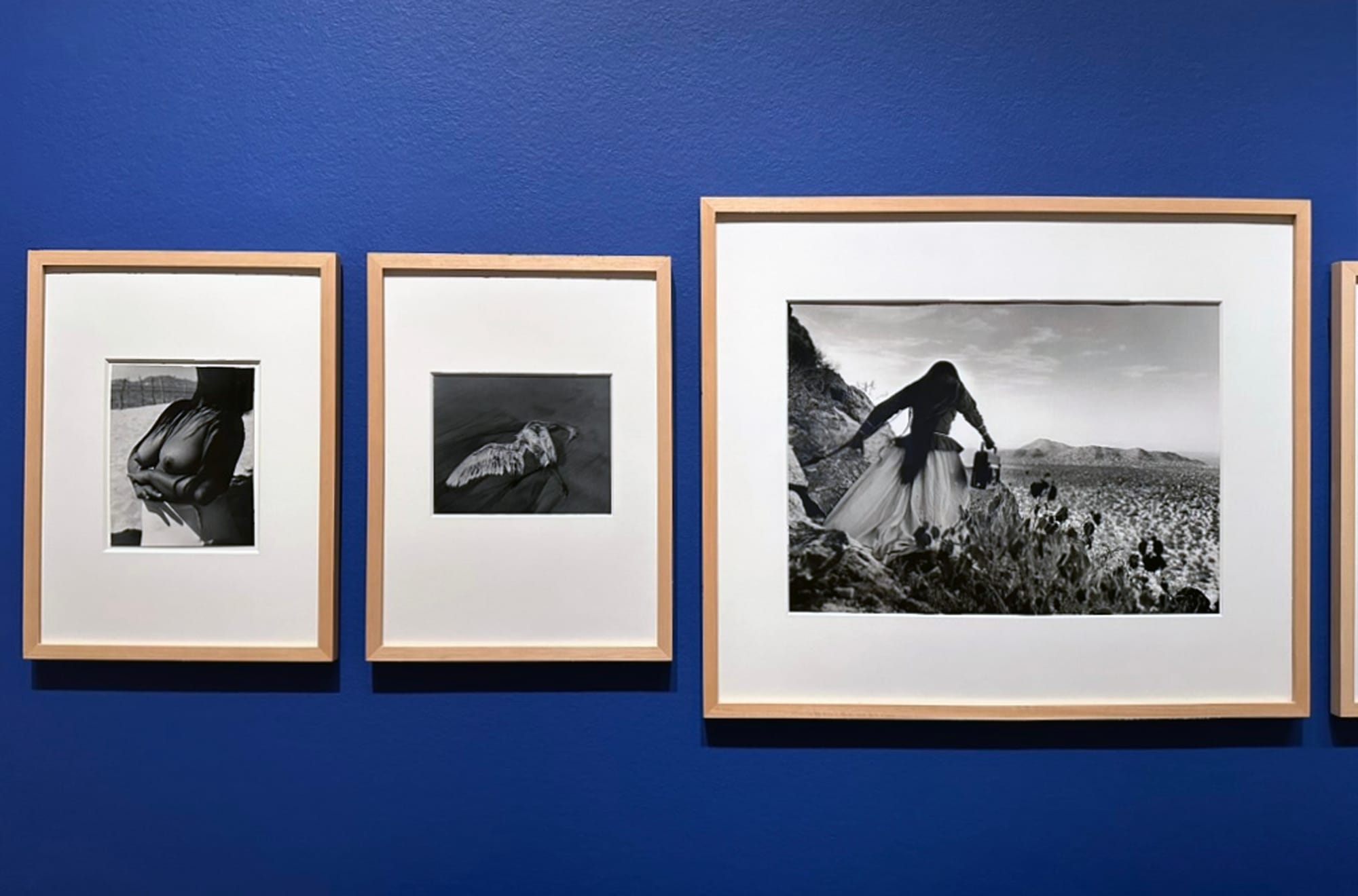
LOS ANGELES — In “Tríptico de los martirios” (1950), the late photographer Lola Álvarez Bravo patiently renders her subject anonymous, capturing a tree’s shadow crawling toward her subject’s bare chest with exquisite timing. In Graciela Iturbide’s “Mujer ángel” (1979), meanwhile, a woman with a veil, long white skirt, and portable stereo traverses a field of flowers to encounter a spotty desert. Almost cinematic in their presentation, both works demonstrate a keen attention to light and form as well as an emotional sensitivity to their subjects, demonstrating the way modernist approaches to photography shifted the visual culture of Mexico in the 20th century.
The work of both artists is prominently featured in Instante/revelación: Moments in Mexican Photography at the Getty Center in Los Angeles, which brings together the work of 13 Mexican photographers from the late 1920s to the mid-2010s to trace the arc from post-Revolution nation-building to contemporary life through photography.
The exhibition takes its name from a book published by the late Nobel Prize-winning Mexican writer Octavio Paz entitled Instante y revelación (Instant and Revelation, 1982). In it, Paz pairs his poetry with photographs by Manuel Álvarez Bravo, whose work he encountered in the Mexican literary magazine Contemporáneos (Contemporaries). This relationship between language and visual art informs the exhibition’s framework, allowing for poetic groupings. In this way, artists and intellectuals, including Frida Kahlo, Diego Rivera, and David Alfaro Siqueiros, are shown alongside landscapes, botanical species, and scenes from everyday life.