Bloomberg/Getty Images
- Wildfires are raging across Canada, and the smoke is being pushed southward.
- The air quality began decreasing on Wednesday and continued into Thursday.
- Here’s a guide to understanding the Air Quality Index (AQI), a metric used to assess air quality.
As more than 800 wildfires burn across Canada, including dozens of out-of-control fires in western Ontario, the resulting smoke has worsened air quality in various parts of the United States, including the Great Lakes, the Midwest, and the Northeast.
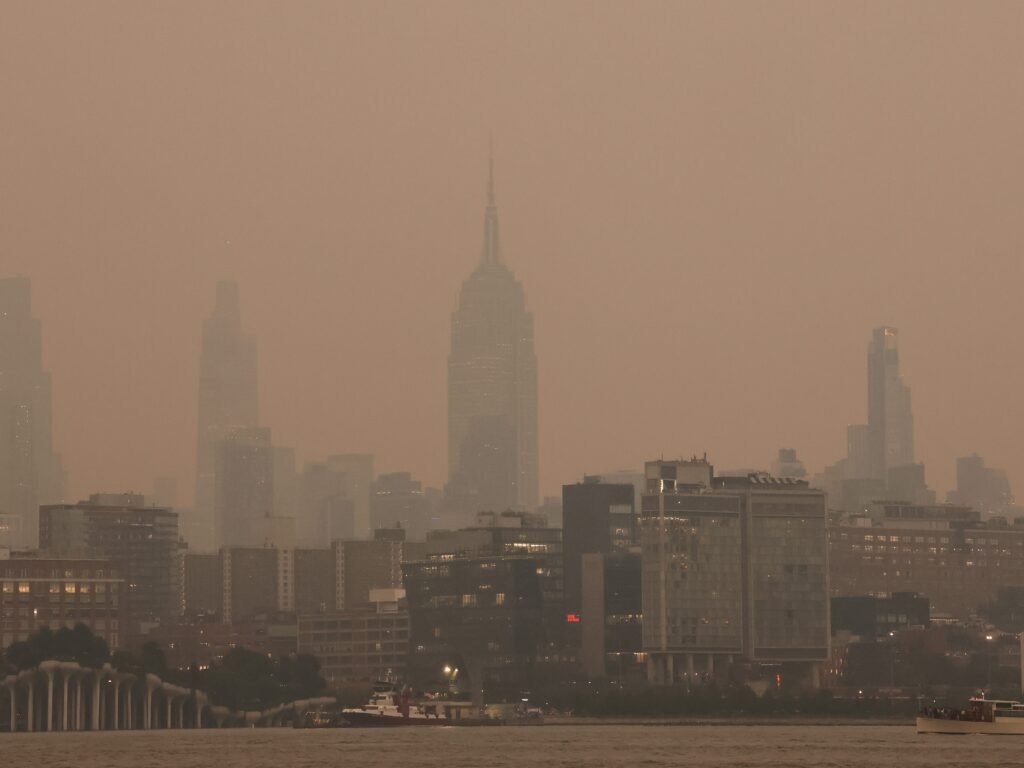
Unsettling images of orange skies in New York City on Wednesday and Thursday raised widespread concern and confusion about the risks posed by poor air quality.
To determine the quality of the air, the Environmental Protection Agency (EPA) uses the Air Quality Index, or AQI. The scale spans from 0 to 500. A higher AQI value signifies a higher level of air pollution and a greater health risk.
NYCEM, the city’s emergency management agency, forecast an AQI of 200 in New York City on Thursday. In areas like Detroit, it reached as high as 754 on Thursday morning, according to air-quality tracker IQAir. (Official EPA guidance classifies any AQI above 300 as hazardous, but in cases like wildfires or other extreme situations, IQAir’s scale can climb past 500.)
Poor air quality can cause a litany of symptoms, including coughing, wheezing, stinging eyes, headaches, chest pain, runny nose, and more. It can also cause chronic inflammation.
Here’s a comprehensive guide to the AQI scale, including what the numbers mean and how you can protect yourself from harmful air pollutants during a wildfire.
0-50: Good
According to AirNow, a website and app run by the EPA, an air-quality index of 50 or below signifies satisfactory air quality.
Air of this quality poses minimal to no risk to humans. It is highly unlikely that individuals who inhale air that falls at this point in the AQI will experience health issues as a consequence.
51-100: Moderate
Air that falls between 51-100 on the AQI is deemed “acceptable” by the EPA. Individuals who are particularly sensitive to air pollution may be at risk when inhaling air of this quality.
According to the EPA, people with heart or lung disease, people with diabetes, older adults, and children are groups generally more sensitive to air pollutants.
101-150: Unhealthy for sensitive groups
Members of sensitive groups may experience health effects, while the general public is less likely to be affected.
151-200: Unhealthy
The general population is more likely to experience health issues, and sensitive groups are at risk of serious health concerns.
201-300: Very unhealthy
The high risk of health concerns extends to the general public at this AQI level.
301-500: Hazardous
Everyone who inhales air with an AQI between 301 and 500 is likely to be affected by poor air quality.
Bloomberg/Bloomberg/Getty Images
How can I protect myself from air pollutants?
As Business Insider previously reported, there are ways to protect yourself when the air quality is particularly poor. These include staying inside and closing your windows. Certain indoor activities should also be avoided, such as burning candles or fires, which increase indoor pollution, and vacuuming, which may kick up fine particles that have come inside the home.
If you must go outside, wearing an N95 mask can help filter the air you inhale.
“If you have to exert yourself, exert yourself less. Hydrate more,” Dr. Leonardo Trasande, who studies environmental health at New York University, told The Associated Press.
Elana Klein contributed to a prior version of this story.