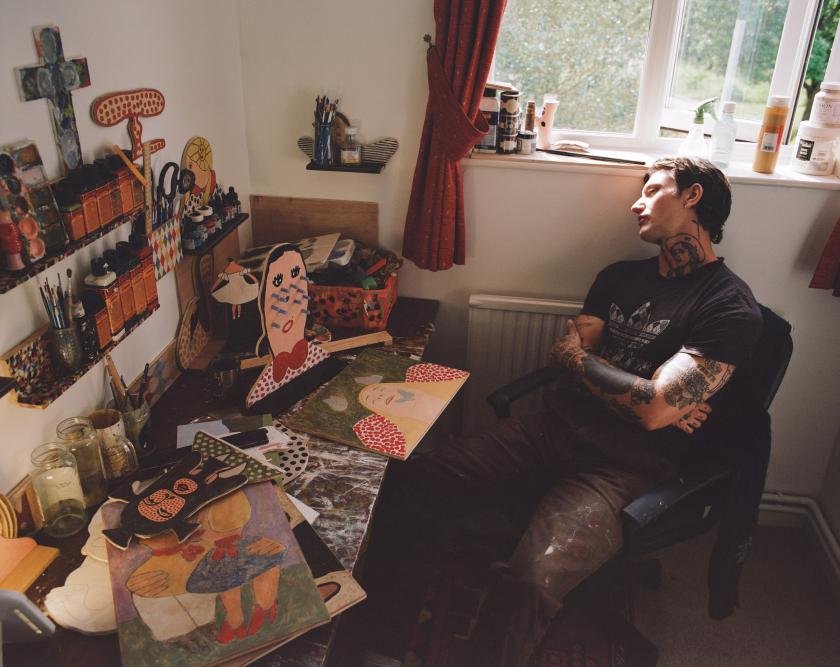
Working from his home in South Norfolk, the artist creates symbolic, folk-like paintings shaped by tattoo culture and a lifelong tendency to see connections everywhere.
Joseph Carway didn’t grow up with art. There was no sketchbook on the kitchen table, no trips to galleries, no teacher who spotted something in him early. What there was, from as far back as he can remember, was a brain that couldn’t stop grouping things, noticing patterns, pulling at the threads that seemed to connect one aesthetic thing to another. “I used my brain’s unconscious pattern recognition to understand the world,” he says, “for better or worse”.
Joseph – born in Lowestoft, Suffolk, in 1997 and now working from his home in the South Norfolk countryside – makes art that operates like his mind. It’s instinctive, symbol-driven, full of stories, and frequently very funny. His artworks live on wooden panels he builds himself, made with enamel paints in colours that veer between carnival brightness and the kind of earthy, sun-bleached muted tones you’d find on a fairground sign left out in three seasons of British weather. Other subjects include figures with elongated heads, dancers, flowers, fruit and bodies in states of ambiguous reverie. There is a quality to them that feels ancient and immediate, like folk art filtered through a very particular, very wry, modern aesthetic.
Joseph first tattooed himself at 13, using supplies ordered from eBay and hidden in his wardrobe. By 15, he was tattooing friends in bedrooms and sheds, then by his early 20s, an apprenticeship with his “tattooing idol” Wink Evans at Wildflower Tattoo had given his practice serious form – and left a deep imprint on how he thinks about image-making. “From my background in tattooing, I have been surrounded by strong symbols and the idea of the timeless,” he explains. “Bolstering the idea of simple conveyance for maximum emotional effect.” The solid line you see throughout his paintings – you know the one; that firm, defining black outline that only needs to be filled in, child-like and rigid – is the tattoo artist talking.
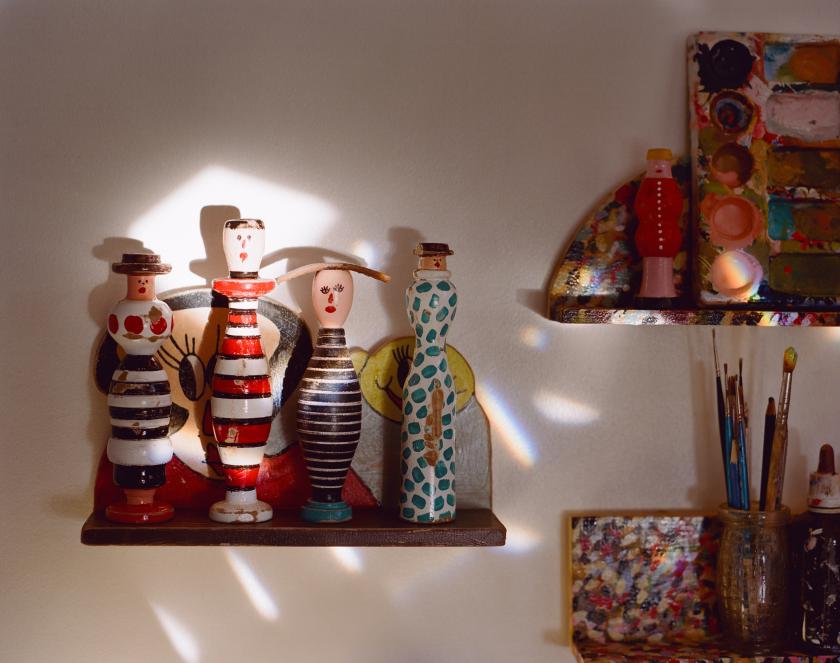
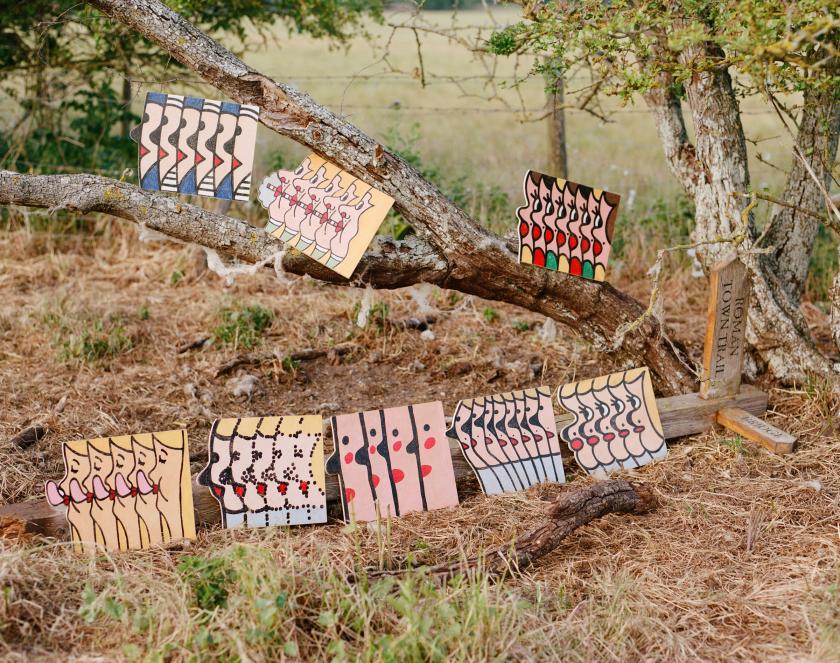
He began making his wooden paintings and objects seriously just a year ago, though he’d been circling the approach for years. When it clicked, it really clicked. He was invited to Fort Worth, Texas, for his first solo show with Giant Runt Gallery, and has since joined Galerie Urbane in Dallas.
When making one of his pieces, Joseph’s process starts with drawing and planning until he has “just enough structure” that he won’t feel lost. Then, enamel paint takes over, and he’ll work from an enlarged doodle from a notebook, from a photograph he’s pushed and pulled in different directions, or sometimes he’ll build a sculpture with “little to no plan at all”. He’s impatient, he admits. Staring at a blank canvas is not for him. He also deliberately damages his work, distressing the surface to mimic ageing, inviting texture and mistakes, the way a ceramicist lets the kiln do its thing. The resulting pieces look like they’ve been around a lot longer than they have.
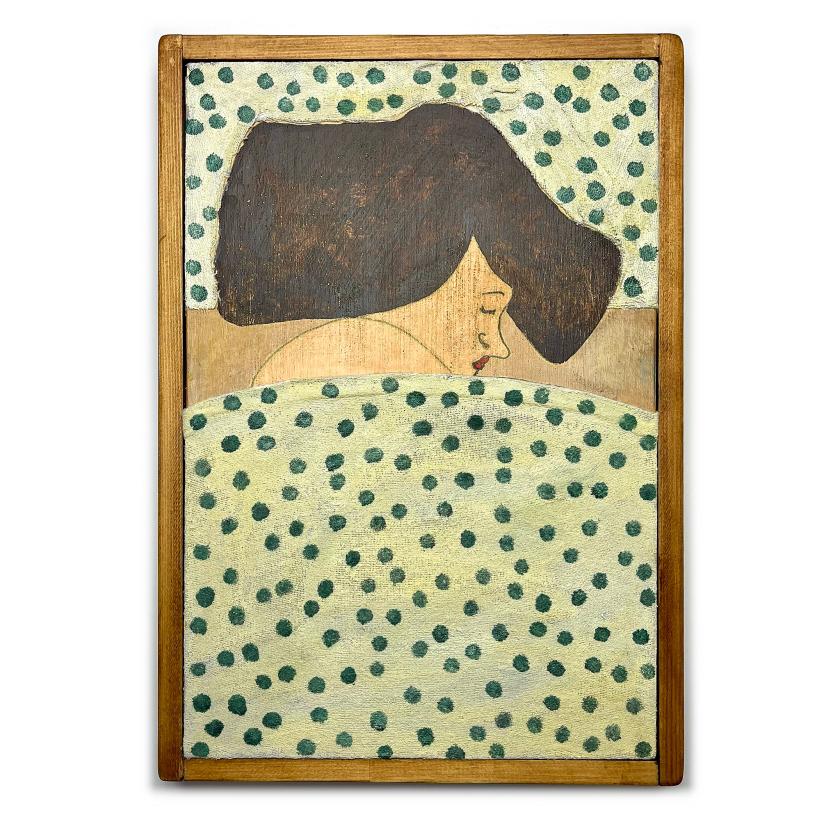
Two recent works give a good feel for where his head is at. Sleeping Spiral Dreamer features a woman in bed, eyes closed, mid-dream or trance, with a cartoonish thought bubble spiralling above her and a comically elongated head that has absolutely no interest in anatomical accuracy. “Imagine if she were real,” Carway says, “imagine her having this weird phenomenological experience in bed – why is there actually a bed sheet on her?” The bed sheet is actually made of fabric, layered directly onto the panel as a three-dimensional element, an addition whose justification is essentially: why not. The palette is muted, brownish, quieter than much of his earlier work – he’s testing subtlety, seeing how already-muted colours become further mottled when distressed and dirtied. The whole thing is 30 × 20 cm, roughly A4. “The idea that it can fit in an office printer is both homely and hilarious,” he says.
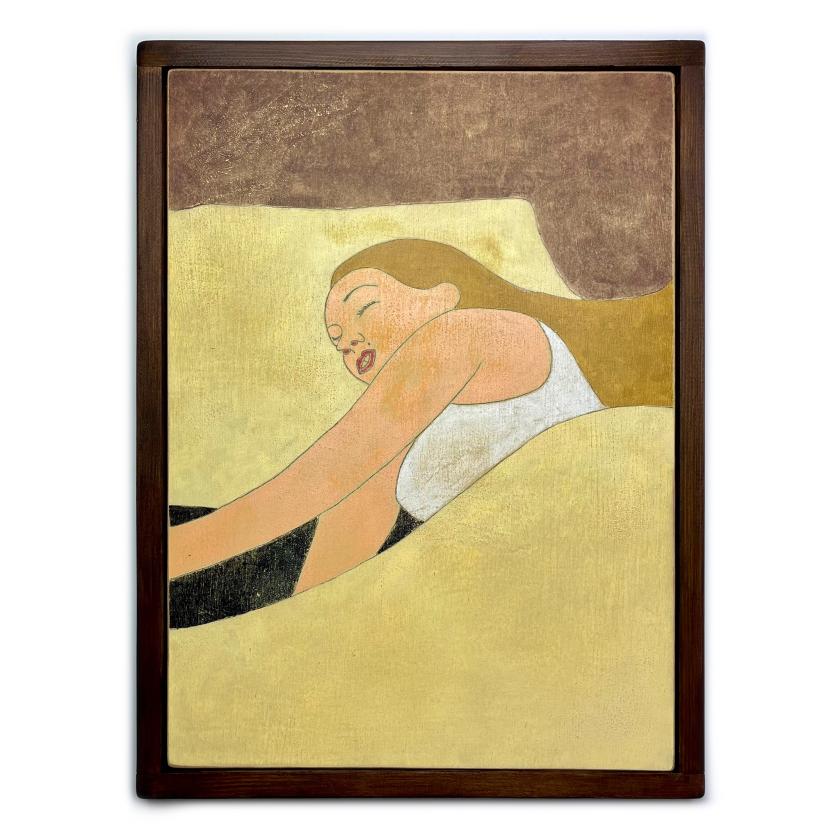
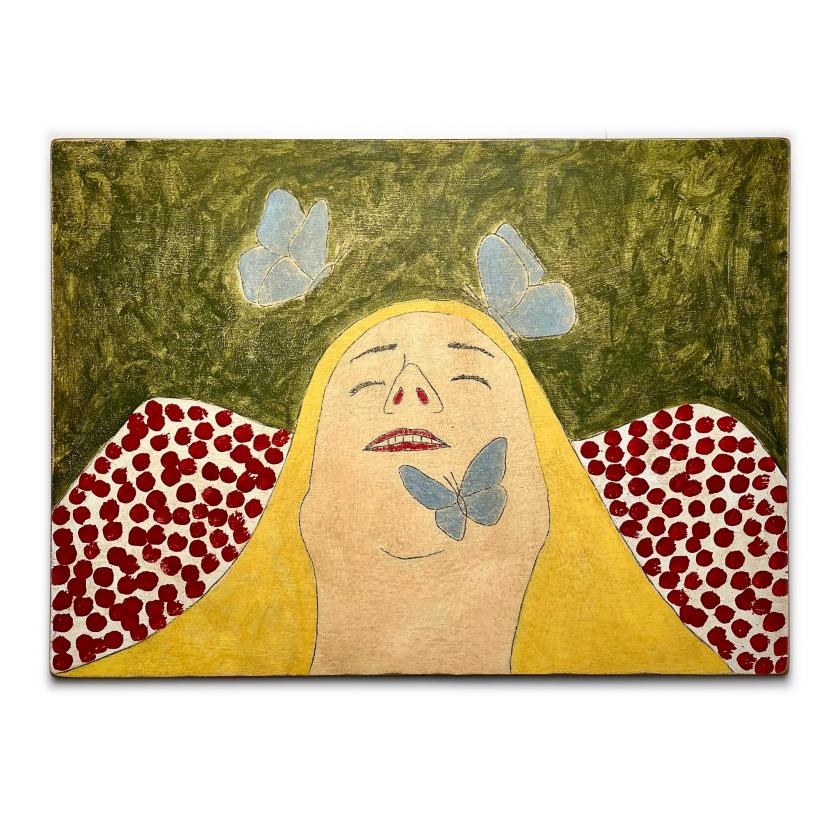
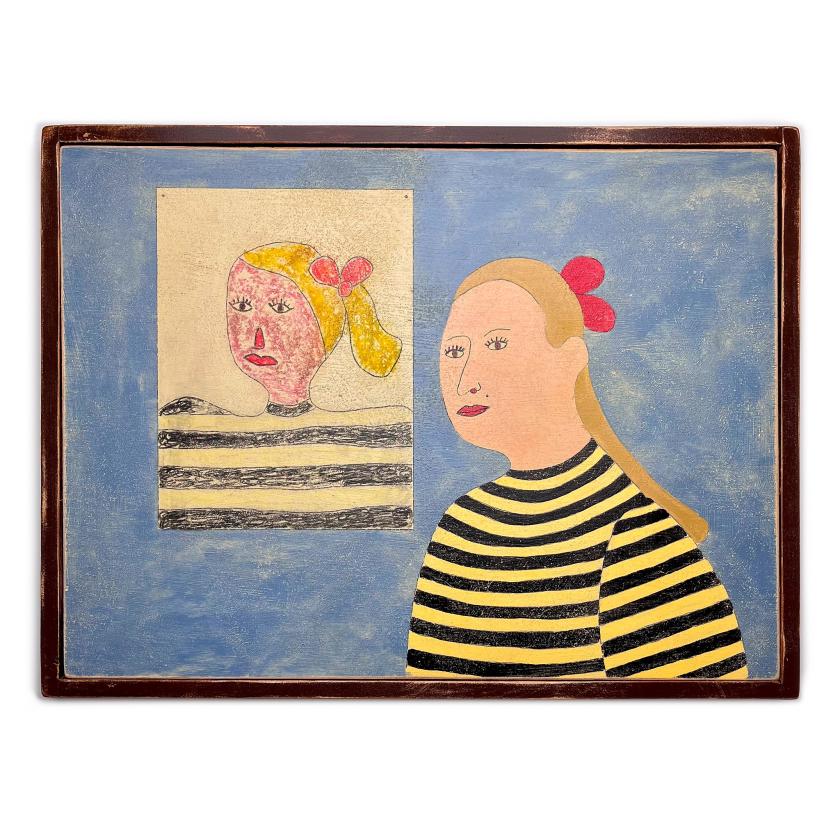
Dancers on Stage, made in oil rather than his usual enamel, has a looser energy to it. The unpredictability of oil mixing introduces a pleasing chaos into his normally more controlled process. There are two figures, rendered in heavy black lines that feel more structural than his usual fine graphite work, against a background of thick, impasto colour. It’s small at 40x30cm, and he loves it for that. Growing up in cramped spaces, he never had the confidence to paint big. “Every time I make something I like, I am both honouring, rectifying and vindicating this version of myself,” he says. “It’s nostalgic and cathartic.”
What does he hope people feel when they gaze at his work? Warmth, confusion and the cosmic absurdity of being alive. “I hope people think it’s a bit stupid and jovial,” he says. A group show is on the horizon – alongside, he notes with excitement, some “old and interesting art” and “truly incredible artists both past and present”. He’ll keep painting daily and impulsively, making his own frames, exploring what he calls “the collective unconscious and silliness in the most beautiful ways I know how”. We’ve kept the smiley face at the end of that sentence because it suits him perfectly.