
Grant Mainland had a tough day at the office earlier this week. A lawyer representing the prediction markets platform Kalshi, Mainland appeared before the Massachusetts Supreme Judicial Court on May 4 with an unenviable task: persuading the justices that a company that has literally advertised itself as the “first app for legal sports betting in all 50 states” is not, technically speaking, offering people the opportunity to bet on sports.
Mainland was hoping to get the court to overturn a lower state court injunction that blocked Kalshi from offering its “markets” related to sports within the commonwealth’s borders. Thanks primarily to these sports markets, which accounted for nearly 90% of its revenue in 2025, Kalshi has hit $1.5 billion in annualized revenue.
It’s a growth story that investors are clearly buying: Kalshi recently announced it raised a $1 billion Series F, catapulting the company to a $22 billion valuation—double what it was worth just six months ago.
For the uninitiated, Kalshi allows users to make money by correctly predicting the yes-or-no outcomes of real-world events. Users are able to buy and sell contracts at prices that range from 1 cent to 99 cents, which roughly approximate the market’s sense of the percentage chance that an outcome will occur. When that market “resolves” (i.e., the event either happens or doesn’t), those who hold shares in the winning position are paid out at $1 per share. If, for example, my beloved Seattle Seahawks return to the Super Bowl next year, anyone who bought in at 14 cents per share—the price as of this writing—will enjoy a nice payday.
If this sounds to you like futures betting by another name, you’re not alone. In January, a lower court judge found that Kalshi, by allowing users to buy and sell “event contracts” on everything from final scores to player props, was functionally operating in Massachusetts as an unlicensed sportsbook. There is “no question,” Judge Christopher Barry-Smith wrote, that requiring Kalshi to follow the same laws as every other sportsbook—and putting it on ice in the meantime—would serve “both public health and safety, and the Commonwealth’s financial interest.”
Mainland’s primary arguments in Commonwealth of Massachusetts v. KalshiEX LLC are the same arguments Kalshi always makes when pressed about the sports side of its business: that as an exchange regulated by the federal Commodity Futures Trading Commission, Kalshi is not subject to state regulation. It also contends that its products are not “bets,” but “swaps,” a type of derivative contract that companies have long used to hedge against financial risk.
Things did not go smoothly for Mainland when he made this case before Massachusetts’s highest court. He was quickly interrupted by Justice Gabrielle Wolohojian: “If we just zoomed up one level, ‘event contracts’ would not be conceptually incompatible with what we would historically understand to be a bet or wager.”
When Mainland asserted that buying and selling contracts on Kalshi is “completely different” from laying a wager with a sportsbook, Justice Scott Kafker sounded baffled: “Completely different? For someone who wants to bet on a game, this is a way of betting on a game, right?”
Mainland tried to forge ahead, but Kafker could not conceal his skepticism. “I understand you can distinguish it,” he said to Mainland. “But if I want to bet on this stuff, I can do it this way, too.” At one point, Kafker characterized Mainland as “swimming upstream here,” which, as a lawyer, is not what you want to hear a judge say about your legal argument.
The oral argument in Commonwealth v. KalshiEX is part of a national trend in which states, at last aware that prediction markets are depriving them of tax revenue and opening up de facto sports betting to people who might still be in high school, are trying to reassert themselves a bit. These legal fights pit states against billion-dollar companies and a Trump administration with a vested interest in ensuring prediction markets’ continued profitability.
Massachusetts is one of many states that have sued Kalshi in recent months for alleged violations of state gambling laws. On April 3, Nevada regulators celebrated when a state court judge issued an injunction banning the company from offering sports contracts, which he described as “indistinguishable” from placing a bet, in the state.
Others have been even more aggressive, creative, or both in their enforcement efforts. Arizona’s attorney general filed criminal charges against Kalshi, accusing it of running an illegal gambling business. Lawmakers in Utah passed a law to ban prop bets, which is a little odd, given that the state already prohibits gambling (in fact, it’s part of the state constitution). In a February op-ed in Deseret, though, Utah’s attorney general implied strongly that the ban on prop bets specifically targets prediction markets like Kalshi, and that he would use it to go after those companies as soon as the governor signs off.
The principal challenge these attacks face is that Kalshi, which during football season does 90% of its volume on sports contracts, has invested lots of time and money preparing to fend them off. In January 2025, shortly after Donald Trump’s inauguration, the company announced that the president’s eldest son, Don Jr., had joined the company as a strategic adviser. A few months later, he took a similar position at Polymarket.
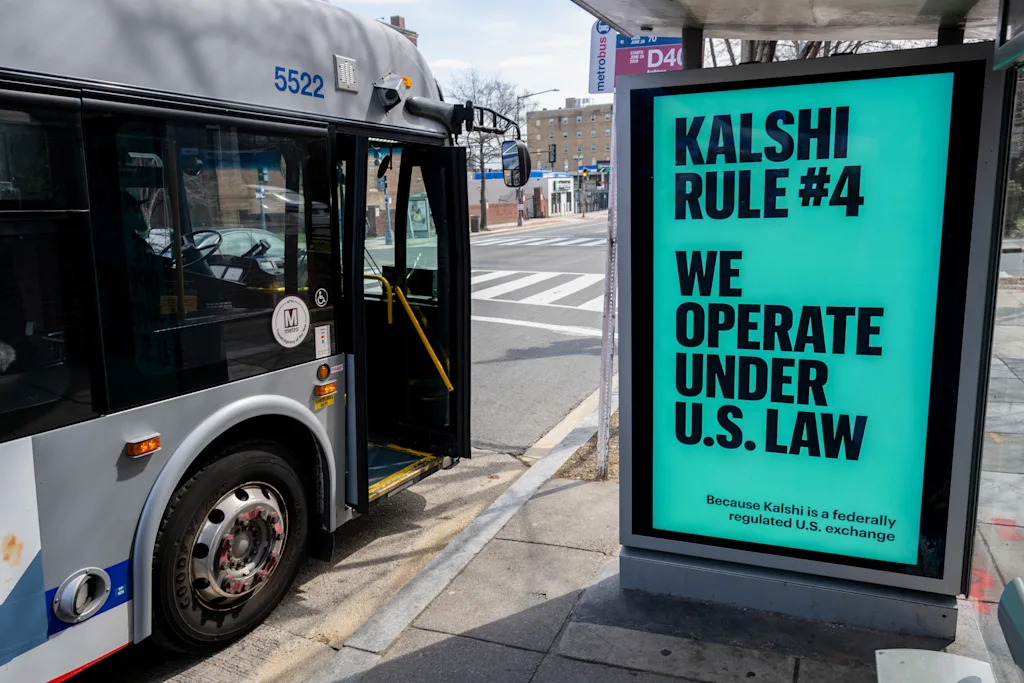
Earlier this year, Kalshi blanketed downtown Washington, D.C., in splashy mint-green ads assuring commuters that the platform is safe and legitimate. The tone of the campaign is unmistakably urgent, in the “doth protest too much” sense of the word; as Fast Company’s Joe Berkowitz pointed out, if you are a business that still feels compelled to make crystal clear that you “operate under U.S. law,” that’s a sign that the PR department has a lot of work to do.
Fortunately for Kalshi, the Trump administration has not required much persuasion. Although the president has occasionally criticized prediction markets, his media company is working on launching its own prediction market for users of his social media platform, Truth Social.
In a wild coincidence, CFTC Chair Michael Selig, whom Trump nominated in October 2025, has aggressively defended his jurisdiction over prediction markets—so much so that critics have described him as less a “normal regulator” than a “cheerleader for the industry.” During the Biden administration, the CFTC proposed a rule that would have banned event contracts related to politics and sports; shortly after taking office, Selig withdrew it.
At least some judges have come down on Selig’s and Kalshi’s side: In early April, a federal appeals court found that the federal Commodity Exchange Act indeed preempts state gambling laws, allowing Kalshi to operate in New Jersey over the objections of state officials. On X, Selig applauded the court for its “decision to uphold federal law.” This week, a federal district court judge ended Arizona’s criminal prosecution of Kalshi, which he said would create an “inconsistent regulatory patchwork that Congress intended to avoid.”
Other courts, however, have remained leery: In April, a three-judge panel of the 9th Circuit Court of Appeals sounded reluctant to intervene on Kalshi’s behalf in its dispute with Nevada regulators; one judge, Bridget Shelton Bade, remarked that based on Kalshi ads that she encounters “almost every day” on her phone, “it seems like they are advertising this as sports betting.”
During oral argument in Maryland’s litigation against Kalshi this week, a 4th Circuit judge invoked the classic farm animal analogy: “If it quacks, you know, it’s a duck, right?” Judge Roger Gregory said.
What state gaming regulators are really after here, of course, is tax revenue; of the billions of dollars in sports-related volume that Kalshi does each year, states do not collect any of it. But there is also a growing body of evidence that sports event contracts inflict real-world harms on the users whom regulators are supposed to protect—harms that anyone familiar with this country’s sports betting boom will recognize.
In just about every meaningful way, Kalshi operates like a conventional sportsbook: It is available on smartphones, for example, and nudges winners riding a dopamine high to play again. Yet Kalshi is not subject to state laws that prohibit sportsbooks from taking bets from people under 21, and that require sportsbooks to take specific steps to discourage problem gambling and prevent insider betting.
In Massachusetts (like in most states) sportsbooks like DraftKings and FanDuel must participate in a system that allows users to voluntarily exclude themselves from licensed betting platforms in the state. But Kalshi is not licensed, which means that a Massachusetts resident who is struggling with compulsive gambling, and who opts into the system in an effort to stop, will be as free as ever to open up the Kalshi app and place another bet.
A recent Wall Street Journal analysis sheds some light on just a few consequences of a status quo in which functionally identical prediction markets can operate in parallel with state-licensed sportsbooks. Although prediction markets pitch themselves as a way to make easy money, in reality a tiny fraction of sophisticated professionals take home most of the winnings.
Meanwhile, ordinary people are losing eye-popping amounts of money on, for example, whether A$AP Rocky says the word rapper during a Tonight Show interview with Jimmy Fallon. The evaporation of your life savings is not any less devastating if you lose it on a contract purchased on a federally regulated exchange, instead of a bet placed at a state-regulated sportsbook.
The basic question that lawmakers and courts are grappling with right now is less legal than it is philosophical: whether to classify Kalshi’s business based on how the company organizes itself, or on how it appears to consumers and works in the real world. To date, Kalshi has been mostly able to maintain its position of privilege in the regulatory landscape.
But as oral argument in the Massachusetts case suggests, for an increasing number of people in positions of power, the distinction between money-line wagers and event contracts is no longer meaningful, to the extent that it ever was in the first place.