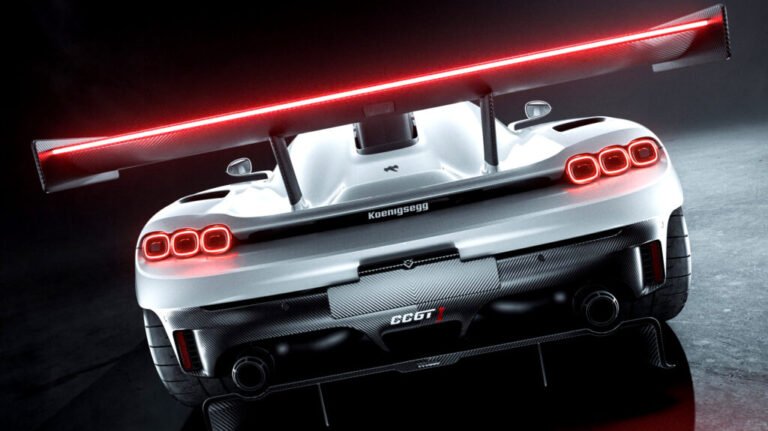
Last year, we got the Koenigsegg Sadair’s Spear, hailed as the Swedish marque’s most track-focused hypercar (or megacar, if you adopt founder Christian von Koenigsegg’s terminology), and it quickly started breaking records, even when hamstrung by noise limits. But now, Koenigsegg has revealed the CCGT1, a CC850-based tribute to the painful but promising early days of the Koenigsegg story, and it’s an intentional step backward.
See, Christian von Koenigsegg always wanted to send a car he had built into the crucible of motorsport, specifically late-1990s FIA GT1 racing, and he dreamed up something that would meet the rules precisely; something on the cutting edge of the class. But just as the highly promising CCGT racecar was crossing its development finish line, the rules changed, and the project came to a heartbreaking end, with only one prototype ever being constructed. Fortunately, Christian made lemonade, as that same CC8S-based racecar would inform the more extreme CCR, giving the fledgling brand more credibility when it briefly held the title of the world’s fastest car, and paving the way for all the megacars that have come since. Thus, it’s worth celebrating, especially since the one-off CCGT is now preparing to race in the GT1 historic class, finally fulfilling its destiny.
Koenigsegg CCGT1: A CC850, But Much Wilder
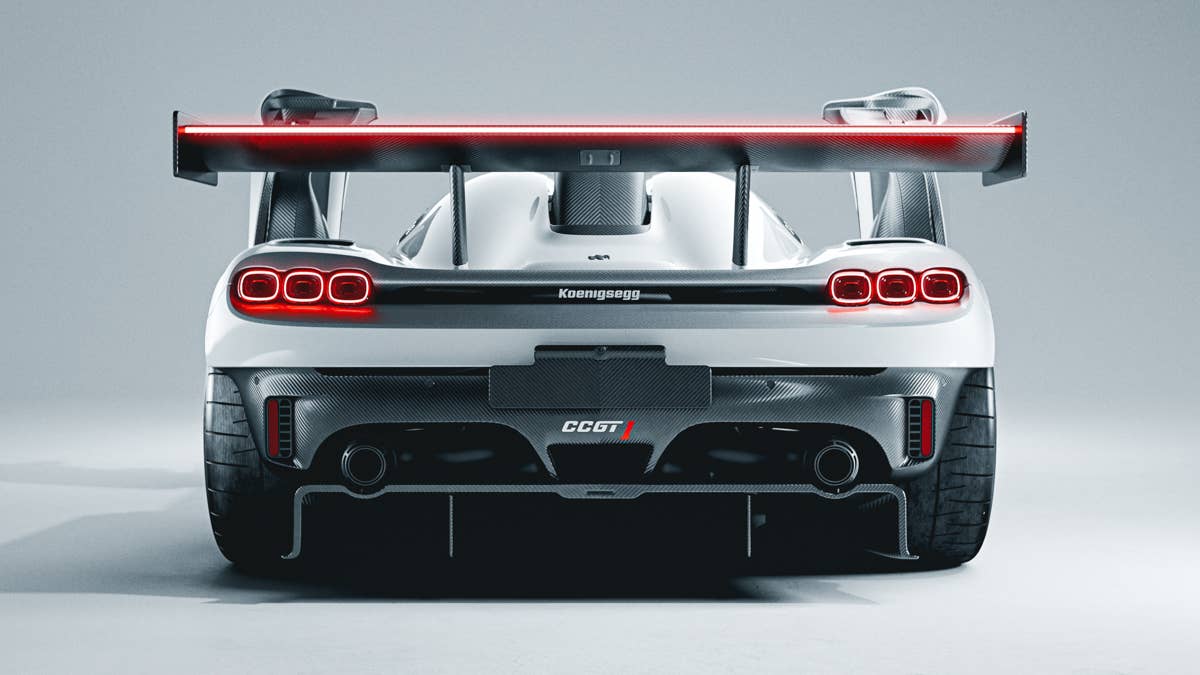
It’s always a marvel how Koenigsegg pushes the boundaries of engineering and technology, despite being a relatively small underdog, but a focus on pure performance shaped by a motorsport-inspired vision surely helps encourage innovation. And although the CCGT1 is an homage to the past, it’s still more than just a CC850 with a wing and some extra NACA ducts. Thanks to an active wing with 30 degrees of automatic adjustment, at 155 mph, the CCGT1 generates 1,763 pounds of downforce, which Koenigsegg says places it between the Jesko Attack and Sadair’s Spear for peak downforce. Balancing this huge wing are a sizable front splitter and active underbody flaps, as well as a model-specific diffuser. There’s also a new roof scoop, but it’s not just a ram air intake. Along with the engine, this feeds a bigger oil cooler and a cooling system for the dampers, encouraging prolonged track sessions. A new take on the Aircore hollow carbon fiber wheels is also here, including in a retro three-spoke design (seen in the video embedded below). Another retro touch comes in the form of LED indicators for fuel and oil pressure, since twin quick fuel fillers can no longer be used due to emissions regulations.
The familiar 5.0-liter twin-turbo V8 reappears, producing 1,262 horsepower on pump gas and 1,578 hp on E85, delivered to the rear wheels through a new Light Speed Transmission-based gearbox called Koenigsegg Sequential Shift, which adds a clutch for takeoff and combines with ignition cuts for clutchless shifts. It sounds like a more brutal way of interacting with the vehicle, but that’s the idea, as the CCGT had a similar system. Alternatively, the Engage Shift System seen on the CC850, which can act as a six-speed gated manual, a paddle-shift, or a fully automatic transmission, is available. But save some cash if you like your performance made more extreme. For the first time, Koenigsegg is offering a track package, adding slick rubber, a carbon fiber roll cage (which can be removed for road use), racing seats, air jacks, data logging systems, a race-grade fire-suppression system, six-point harnesses for HANS-compatible seats, a second set of wheels with track tires, a track-only exhaust, more extreme brakes and suspension, and extra aero. With this, Koenigsegg says the CCGT1 is transformed “into the fastest-lapping Koenigsegg ever.” Expect to see the automaker prove that claim very soon.
Koenigsegg CCGT1 Interior: Analog Excellence
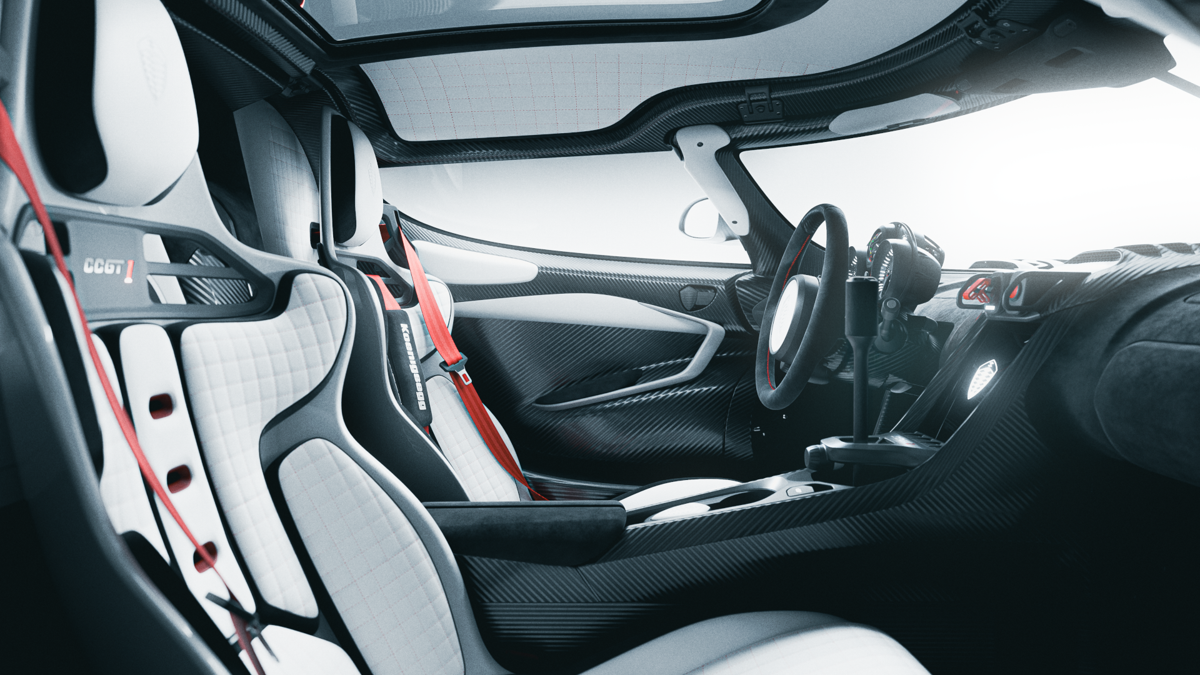
There are few things as cool as a toggle switch, and Koenigsegg knows it. While hypercars have become obscenely luxurious with swathes of hand-stitched leather, the CCGT1 proves that a minimalistic approach that favors tactility over appearance is more dramatic in its uniqueness. You flip up a red cage, revealing the toggle switch that lets you prime the fuel pumps. Flick it, and your finger can glide over to the red ignition button, letting the V8 bark into life. In the center, a tall shifter lever puts gears close at hand, and ahead of you is something intricate enough for Pagani and technical enough for Rimac; there’s a new Chronocluster with an analog G-force meter in the center and multi-function gauges on either side. Beneath you are carbon fiber seats with a six-point harness as standard for the driver, with the passenger only benefiting through the track pack.
Of course, Koenigsegg is still a company for the ultra-wealthy, and first impressions matter. Thus, all this has been wrapped up in a new Ghost Fibre finish, which revisits the company’s earlier “white carbon fiber,” with what it calls a crystal-white aramid/carbon matrix. Koenigsegg says the new finish helps insulate sound, is extremely tough, and weighs less than traditional carbon fiber. So how much does the CCGT1 cost, borderline kitsch brake light and all? Well, that’s not only a mystery, but also irrelevant, because all 70 units set for production were sold out long before these images hit the internet.