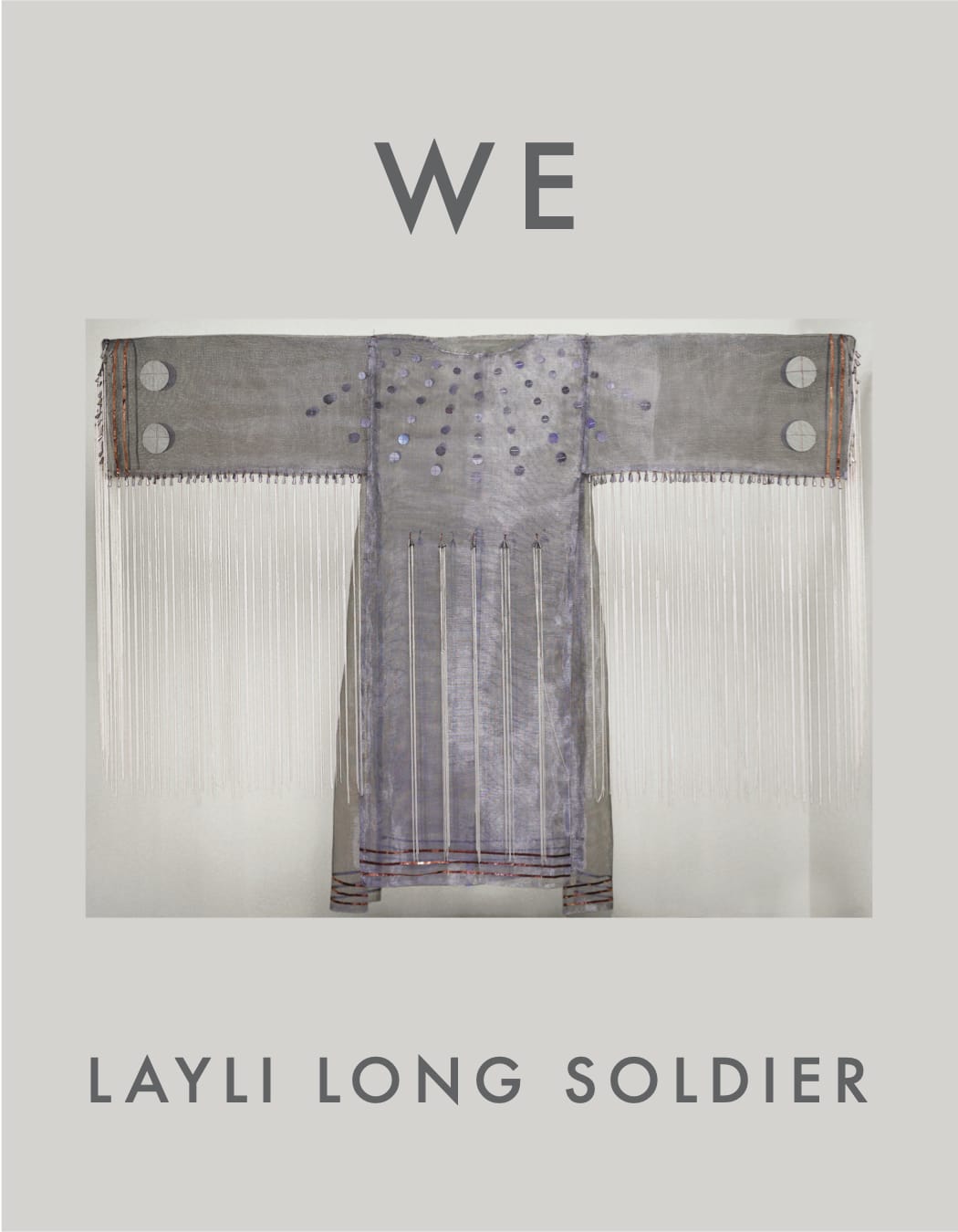
Reading Layli Long Soldier’s newest publication, We (Graywolf Press, 2026), is a visual experience. She leads us across the page through poetry and storytelling, but her work is far more than ideas, statements, and wordplay. Even when just text on the page, it is both literature and visual art. Through this bridge, it creates deep connections to our innermost experiences — at times validating our own humanity, or providing a window into another’s. Fittingly, the title has two meanings: the English “we” and the Lakota “wé,” meaning “blood,” a shared lineage and life source.
Layli and I first met while we were both attending the Institute of American Indian Arts in Santa Fe, New Mexico. As fellow Lakota in the Southwest, art students, and mothers, we bonded quickly. Our now-grown children played together when they were toddlers. We have continued to support and cheer one another on throughout the past 20 years as friends and colleagues. I am thrilled to have been able to spend dedicated time with her new book. Readers will recognize the strength and unique literary style Layli demonstrated in her 2017 poetry collection Whereas, while experiencing the excitement and joy of new terrain offered in this moving body of exploratory and expansive work.
We (Wé) is life-affirming, motivating, a call to action, an instigator of deep critical thinking; it binds together our history and our present. It is advocacy and truth-telling, education, and inquiry, all through a lens of lived experience, compassion, and love. It is an artistic expression led by Lakota values and philosophy and, through this, connects to humanity at large. Our conversation has been edited and condensed for clarity.
Dyani White Hawk: You utilize text placement, formatting, omission, symbols, color, rhythm, pauses, reader choices, and instructional language to paint rich visuals in each section of this book. There are essays and short stories, photographs, and visual art scattered throughout. You are a poet, and you are an artist. Can you please speak to the process of how you find form for a work? Do you see the shape in advance? The color? Do the words come first, and reveal their shape?
Layli Long Soldier: First of all, thank you so much, Dyani, for such a beautiful introduction to my work. And I, too, identify so deeply with your work. I think a lot about process. And in your work, I recognize the time, meticulous detail, the math, the planning, the patience, and likewise, the sensitivity to color, shape, and underlying meaning and philosophy that you put into your pieces.
Some of the forms for my poems are really demanding. They require tight use of space, down to the centimeter, at times, e.g., the poems in A Line Through Grief or Obligations. Even when the form requires every last bit of patience, believe it or not, my friends and relatives who do beadwork or detailed sculptural pieces inspire me. I think to myself, if they can sit and patiently pick up one bead at a time with a needle, then I can practice that kind of attention as well! So I keep going.
Sometimes the form in my poems does come first. I’ll wake up in the morning and I can see a shape. It feels almost as if a shape is waving hello, inviting me. So I go to my laptop with a general idea of what I want the poem to look like. And this, then, becomes the first constraint. I begin building the poem from there.
But sometimes, it’s the language that comes first. Perhaps I’m thinking about an experience, a memory, or a person, and this is where I begin. I enter the quiet mental excavation for words to translate a feeling or idea onto the page. Once the language feels right, I’ll begin the next stage of trial and error to find the right form. There have been some poems that take months or years to complete because of this process. Yet it’s so rewarding once I do find the right form, because suddenly the poem gets traction and starts to move. I can feel it in my body, it’s as if the poem says, “Thank you!”
DWH: I also really appreciate the kind, gentle, strong yet nurturing way you very intentionally lead readers through a work with commands, reminders, and encouragement. You work to ensure that they remember to hear, see, and feel what is being offered. Do you feel this is related to who you are as a Lakota artist? As a woman? As an Indigenous artist?
LLS: I’m not really sure why I do this in my writing, except it is my nature. In some ways, I consider the reader a guest. Isn’t it funny that “stanza” means room? So you could say that as I invite guests into a poem, I am guiding them through the rooms of a kind of home that I’ve built.
Also, over the years, I’ve developed an awareness that there are many ways — techniques or approaches — to help a reader feel comfortable enough to stay with me, even when I’m diving into difficult subject matter. Sometimes, I press hard. For example, in my essay “Through the Pupil of Instinct” [in We], I share painful first-hand accounts from survivors of the Wounded Knee Massacre. Yet, the essay moves multi-directionally, shifting from Wounded Knee to my child’s day at school to a drive through Minneapolis with my poet friend, Heid Erdrich. These shifts allow the reader time and breath to endure the moments of intensity. I want to say what I need to say, I want to “go there” when it comes to harm, violence, or injustice, but I also want readers to be able to sustain the energy it takes to go there with me.