From the Cool Cat Teacher Blog by Vicki Davis
Subscribe to the 10 Minute Teacher Podcast anywhere you listen to podcasts.
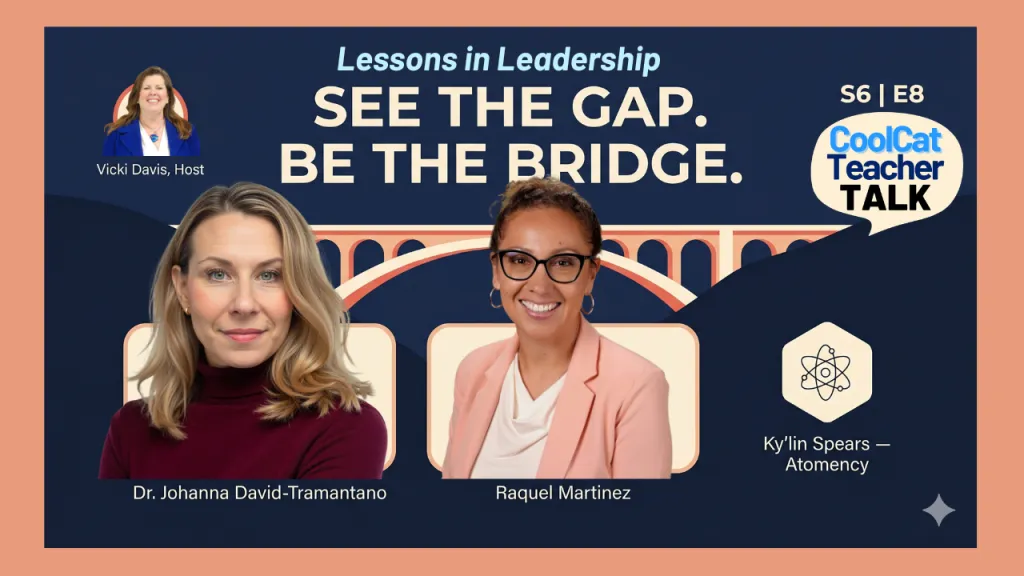
Leadership is fascinating. What does it take to be a leader? To inspire leadership? To decide that instead of complaining about a problem, we will figure out how to fix it? In today’s show we’re going to learn about that.
First, we’re going to talk to a 16-year-old from Maryland who transferred into the school and did not have access to the resources he needed to learn chemistry. He then proceeded to write a website called Atomency that is free and doesn’t collect any data, and that his district is looking to adopt as well. He built a bridge by literally building a website with the functionality his class needed. That is leadership — the kind of leadership that will help today’s students succeed.
Second, we have the gaps that Dr. Johanna David-Tramantano identified between what students know in high school and what they need to be successful in their first year of college. These gaps are real, and sometimes they are things like being able to set an alarm and get up — or other gaps that are not knowledge gaps but perhaps could be classified as behavior gaps. So when her own child struggled, Johanna documented it, began researching, and wrote a book to help bridge those gaps. So as you look at your students and see what they are missing, you can build the bridge too.
Then, finally, we have many leadership lessons from this next guest. But first, I have to apologize. I’ve had so many things going on in the past few years with my family that I actually misplaced this incredible interview with then-incoming NASSP president Raquel Martinez. But this is the perfect show to air her interview, because of how well she points to not only how she became a leader, but also how she believes principals need to support one another. She bridges the gap with her leadership, and I think all of us will leave inspired — not only by her story of becoming a leader, but by how she’s inspiring others to lead as well.
This is what we talk about here on Cool Cat Teacher. We talk about real stories with real people who are making a difference in today’s schools. As a teacher, I can assure anyone who is not in education that of my 24 years, these past few have been the toughest — not only for personal reasons, but for some quite interesting dynamics, perhaps caused by a change in parenting or even in the algorithmic programming of social media and video games. Whatever the reason, we need to hear real classroom stories and inspiration more than ever. I hope this episode of Cool Cat Teacher Talk will inspire you to see the gap and build the bridge. Enjoy!
Listen to the Show
Full Transcript
Click to read the full transcript
This transcript was generated using AI and has been reviewed by humans for accuracy. Minor errors or artifacts may remain.
Vicki Davis (00:00): Welcome back, remarkable educators. Today we’re talking about helping lead our students to a brighter future. Every student, every stage, helping students grow up and make a difference.
Announcer (00:16): Ever wondered how remarkable teaching happens? Find out right now at Cool Cat Teacher Talk with award-winning teacher Vicki Davis. Get insights from top educators, tech tips, and inspiration to elevate your teaching leadership.
Vicki Davis (00:30): Leadership. We want to help students grow to become adults full of purpose, happy, healthy, full of promise. Today we want to talk about leadership, but perhaps it isn’t what you think.
Vicki Davis (00:42): First, we’ll talk about a student who found a gap in what his school offered in chemistry. And then he created an app for his school to use that his district is looking to adopt. That is leadership, finding what needs to be done and doing it. But then we’ll talk about the gaps between high school and college readiness and what the research says and about how to bridge that gap. Some teachers and students and administrators and parents will hear this.
Vicki Davis (01:11): And I hope you’ll be inspired to step in and lead in your area to help the students at your school be ready to move from school into the world as successful adults. And then we have an interview I recorded with Raquel Martinez, who is the president of NASSP. And she will talk about leadership and how you can grow capability in others through what you talk about the most. Pat Williams, in his book, 21 Great Leaders, says.
Vicki Davis (01:40): People who don’t understand how to serve do not understand how to lead. We want to lead our students to become the kind of people who see needs and meet them. And we want to be those servant leaders too. So let me tell you a story about Richard Car Gaum. He was still a senior in high school when World War II was declared, so he signed up. And in 1953, after two years serving in the Suez Canal Zone in Egypt.
Vicki Davis (02:10): He made the long, slow journey home to England. By train through Malta, Sicily, Naples, and along the way, he had to bathe in the sea, sleep outside, live on scraps of food and water from public taps. And because of the way he looked and the way he acted, he said he was made to feel unwelcome. It was on that journey that he learned that the greatest deprivation is not hunger or cold, it’s the lack of human company. So as he traveled, he came upon a place called the Little House of Divine Providence. It was founded to care for the lonely and destitute. And it set him to thinking about how the poor, the old, and the unwanted were treated back in Britain. At a Billy Graham rally, Richard Cargom decided to dedicate his life to serving others. First he became a home helper to the elderly and used part of his own money To buy a house in East London. In 1955, he invited his first two residents to come and live with him. And that household became the Abbeyfield Society in 1956. And by 1963, it had grown to over a hundred homes across the UK. Now in 2026, the Society has over 400 houses in seven countries with more than 7,500 residents. What one man saw as a need And tried to meet has grown into an organization that earned him the Pride of Britain Lifetime Achievement Award in 2005.
Vicki Davis (03:39): I tell you this story because we want to inspire students to have initiative, to see a need and move towards it.
Vicki Davis (03:54): Richard Cargom was just a teenager when he started noticing people being left out. Our first guest today is 16. His name is Ky’lin Spears, and he didn’t have to cross Europe to find a need. He found it in his own chemistry class in Maryland. His school didn’t have the lab equipment. Assignments kept getting pushed back. The simulator they did have was old and clunky, and most of us at sixteen, we would have shrugged shoulders and waited for the adults to sort it out or Maybe we just would have complained. Well, Ky’lin had been teaching himself to code off YouTube since he was nine. So he built the tool his school didn’t have. It’s free. It runs in any browser. It collects no student data. And his district is looking at adopting it. That’s leadership, seeing what needs to be done and doing it. Now one quick note before we listen. Ky’lin is 16, so we have his parents permission to share his story. You’ll hear his voice if you’re watching on video, but you won’t see his face.
Vicki Davis (04:52): And that’s on purpose. And that’s just fine with us. Let’s listen.
Announcer (04:58): Cool Cat Teacher Talk with award-winning teacher Vicki Davis.
Vicki Davis (05:02): Today we have different interview. We’re talking with Ky’lin Spears, a 16 year old student from Suitland, Maryland, who built a professional chemistry simulation platform called Atomency he built it from scratch because his school did not have lab equipment. Atomency is free, works in any browser, requires no login, collects no student data, and works offline. And now his school district is looking at adopting it. Now we’re working to feature student voices, but when we do this, because of the wide distribution of Cool Cat Teacher Talk and 10 Minute Teacher, If you’re watching on video, you will not see Ky’lin’s image and that is just fine with us. But I did want to let you know I think it’s a great representation of the sorts of things that students are doing these days. So Ky’lin, tell me the story. The moment you realized your school didn’t have what you needed to learn chemistry.
Vicki Davis (06:00): And what was that like and how did you work to solve the problem?
Ky’lin Spears (06:01): I transferred to Maryland from Arizona, and I had just moved out here. I went to my chemistry class, and there were a lot of moments where we got our dates to do an assignment pushed back because we didn’t have the chemical tools and lab equipment that we needed to do that. We had to use an old, outdated PhET simulator that wasn’t really the greatest. I just decided.
Ky’lin Spears (06:27): I could probably make a tool similar to these that’s more modern, more useful, and we won’t have our dates for assignments pushed back because of the lack of lab equipment.
Vicki Davis (06:35): Okay, so tell us a little bit about how you built it. throw it at us. You know, did you code? Did you use AI to help you code? How did you do it? And then how did you get it up on the net?
Ky’lin Spears (06:44): I coded it completely from scratch with no AI I knew that I didn’t want to have to pay for a server so I made it serverless with html CSS and JavaScript and it’s a web app So it can be downloaded as well
Vicki Davis (06:57): Wow, so had you already had some courses or are you completely self-taught with all this?
Ky’lin Spears (06:58): I’ve been teaching myself how to program with YouTube for a couple of years now since about when I was nine or ten years old.
Vicki Davis (07:09): wow. I started coding when I was pretty young, just like you, except it was not quite as difficult as it is now to code. most students would just say, OK, this is just the way it is. But I really want to get at the trigger of what made you think I’m going to build something. I’m not going to settle for this because I want to.
Ky’lin Spears (07:10): what made me build something like that is because I seen how outdated the tools were that we were using at my school. And I also seen a lot of students in my classroom struggling to use the tool, asking me for help and things like that. And I just knew that the school needed better and that I could provide better
Vicki Davis (07:49): where did you start? What was the first simulation or activity you put in Atomency? And did you share it with your teacher?
Ky’lin Spears (07:57): Yes, the first thing that I built with this was a simple periodic table. I had all of the elements attributes like the molecular weight and everything like that listed for each and every element. I went and showed my chemistry teacher the periodic table. I added like a simple molecular builder where you can add, H to two hydrogen atoms and one oxygen atom and get H2O. And I showed him that and He seemed to like it. I kept building it and he encouraged me to continue building it.
Vicki Davis (08:25): So when you shared it with your classmates, did they feel like it made chemistry easier?
Ky’lin Spears (08:26): I’ve shared it with a few classmates and they were really impressed. They thought that it was easier to use than tools that we had before. a lot of people just encouraged me to keep going. So I kept building and building until eventually it is where it is now.
Vicki Davis (08:42): to get this interview set up because you’re so busy. You’re running track, you’re going to school. Ky’lin, what keeps you going when it gets hard? Like, why would you do this as a side hobby?
Ky’lin Spears (08:43): I like programming chemistry and together I just, love the project. I love the task. I love improving it. I just like the progression of building the tool and it doesn’t really feel like a task to me. It feels like something that I love to do.
Vicki Davis (09:05): Okay, so what was the hardest part of this whole process? Did you have a moment where you almost gave up?
Ky’lin Spears (09:10): building the molecular builder. It was very hard. There’s a lot of different calculations and equations of rules that go into molecules how they bond, all things like that. It broke maybe over 50 times. but I eventually fixed it
Vicki Davis (09:11): So you made Atomency completely free with no login and no data collection. So why was that so important to you?
Ky’lin Spears (09:36): I had to make sure that there was no data collection because I know that schools have extra processes that they have to go through in order for tools to be passed when they do collect and handle students’ because that is private information and it’s hard to get a tool approved when you are collecting the students’ data. And I also made sure to make it free for all of my classmates to use so that they can use it on their assignments, use it to help them understand chemistry because I know
Vicki Davis (09:37): Yeah.
Ky’lin Spears (10:04): A lot of people in my area and in my school don’t necessarily have the resources and money to be paying for an expensive chemistry tool for one class.
Vicki Davis (10:11): this is just so let’s talk to all the students who may be listening to you, Ky’lin, and like, what’s your word to them when they come up with a problem at school? Like, what’s your encouragement?
Ky’lin Spears (10:23): Or I would say just go ahead and try to build it. There’s a lot of resources out there like AI, ChatGPT, a lot of things that can help them get it done. If they just have the idea, there’s a lot of people who can support them. lot of podcasts that can be on to get their word out there and they can really grow into something. Just never be afraid to do what you want to do and try something.
Vicki Davis (10:43): So, Ky’lin, if a chemistry teacher right now is listening to us, how could they use Atomency in a lesson this week?
Ky’lin Spears (10:44): they can use advocacy in the lesson this week by, for example, telling a student to create a molecule that has a weight of over 20 and then just tell the students to keep trying to build a molecule that qualifies for all of the properties that they’ve set or like a water molecule for example, turns liquid at a certain temperature. They can have students keep adding atoms to the molecular builder until they can get an molecule that fits
Vicki Davis (11:18): Do you feel like you understand chemistry better from building this app?
Ky’lin Spears (11:21): Yeah, I did a lot of research and learned a lot along the way. I feel like it’s made me a better chemistry student it’s increased my understanding of chemistry overall.
Vicki Davis (11:31): Ky’lin, you reached out to me. You left a message on my website about what you have built. are you working to promote and tell people about it? Like, how did you find me? Did you sit down and just like say, hey, I want to tell other teachers or what’d you do?
Ky’lin Spears (11:43): I looked at a lot of podcasts and a lot of news stations and a lot of different people who might want to cover this or who would be helpful to get my project out there to the right people.
Vicki Davis (11:55): So you said I’m your first podcast. where all are you going to appear? Do you have any other ones
Ky’lin Spears (11:59): This is my first podcast, but I do have a news article coming up.
Vicki Davis (12:00): Ky’lin, I teach students, think teenagers are awesome and there’s so many talented teenagers and you feel like your generation gets a bad rap? Like what do you want people to know about your generation?
Ky’lin Spears (12:16): I want them to know that our generation understands technology and what can be done with technology. And even though it might not be done like how it was preferred the just using our resources to our advantage.
Vicki Davis (12:29): So you have a message to all the parents out there about encouraging their children to do stuff like you’re doing? Because I mean, this is going to really help you, I would think, heading to college.
Ky’lin Spears (12:40): do encourage parents to children to build and just use technology to the best that they can.
Vicki Davis (12:47): So, Ky’lin, what’s your dream? What’s next?
Ky’lin Spears (12:50): My dream is for Atomency to be adopted into multiple different high schools and eventually I do want to attend Harvard University.
Vicki Davis (12:59): with your dream of attending Harvard, like what do you want to major in? You want to do computer science or do you want to do another field
Ky’lin Spears (13:05): I’m interested in both computer science and chemical engineering. I’m not sure which one I want to lean towards yet, but I am interested in both.
Vicki Davis (13:12): they’re kind of coming together in so many different ways. Ky’lin Spears 16 year old from Maryland who has built Atomency. That’s A-T-O-M-E-N-C-Y. Ky’lin, I think this is just such a refreshing and an exciting story and I’m excited for you. Congratulations. I am so interested in why you didn’t quit after having 50 failures with trying to create this molecular builder. mean, that is just so fascinating to me. What’s your word to students who are struggling with failure? It’s something they’re trying to do and why they should keep going.
Ky’lin Spears (13:51): I would tell them that failure is just a part of life. You’re going to fail plenty of times and you will rarely ever succeed on the first try. if you do succeed on the first try, you missed a few opportunities to learn and to enhance your knowledge on the subject.
Vicki Davis (14:03): Awesome. Well, we’ve been talking to Ky’lin Spears. Ky’lin, thanks for reaching out. Thanks for coming on the show. Good luck with your app and I appreciate you coming on.
Announcer (14:13): Cool Cat Teacher Talk with award-winning teacher Vicki Davis.
Vicki Davis (14:17): In his book, The Fifteen Valuable Laws of Growth, John Maxwell says the difference between a winner and a whiner is that a whiner wants to feel good before they do something. A winner does something and then feels good. Back in 2021, my mom had just died, and I was bringing up distance learning because most of my school was opening that semester in quarantine. I’m so glad we’re past those days. Now that was a really hard season of my life here’s what I wrote in my newsletter on January 6th, 2021. History is full of tragedies, but the stories we remember are the Phoenix rising from the ashes, not the fire that burned. We remember the never, never, never give up and the I have a dream speeches. But we don’t remember the it’s a hopeless everybody quit.
Vicki Davis (15:06): Or the excuses or one more person telling us how bad it is. If you’re encouraging people to rise from the ashes, that’s a great thing. If you’re encouraging people to remain faithful and do the right thing, that’s also great. If you’re reminding people to work hard at work worth doing, that’s what we do. That’s the very reason that I buried my mom on Monday, January 4th, and I went back to running our cyber campus on Tuesday, January 5th.
Vicki Davis (15:07): Not because the mourning wasn’t important. I grieve every day. And now as I’m recording this in 2026, I still grieve. Because living a life of service to others is what will help us ultimately become a great generation. We have a choice.
Vicki Davis (15:52): Be the greatest generation or the greatest heap of despair in the history of the world. And I’ll choose the former. End quote. I went back to work the day after we buried mom because showing up was a habit she taught me long before it ever was a choice. Our next guest, Dr. Johanna David-Tramantano, has spent nearly 25 years in education. Teacher, a literacy coach, an administrator, and now a professor. She’s also a mom who’s watched her own kids make the jump from high school.
Vicki Davis (16:22): College. And she reiterated something for me that sounds kind of like what I just said. Showing up is not a skill, it’s a habit. We spend years teaching students content, but the ones who struggle most in that first year of college or that first real job usually aren’t the ones who didn’t know the material. They’re the ones who never built the habits.
Vicki Davis (16:43): Waking up without a reminder, keeping a planner, reading the syllabus and believing it, asking for help before it’s too late. Johanna calls these enduring skills, and she’s built an evidence-based framework, she calls it Connect, to teach them on purpose, woven through every year, instead of crammed into the spring of their senior year. So here’s the honest question for all of us. Are we really getting our students ready for what comes after high school? Let’s listen and think about that.
Announcer (17:12): Cool Cat Teacher Talk with award-winning teacher Vicki Davis.
Vicki Davis (17:16): Today we’re talking with Dr. Johanna David-Tramantano, a career educator with nearly 25 years in the classroom in coaching and administration now as a professor. She has a new book, Connect, a high school to college success framework coming spring 2026 for educators on the high school to college transition. Now we’ll be talking today about the Connect framework that she has, which is an evidence-based guide for building metacognition and self-efficacy in students. she hosts the Literacy Landscapes podcast and another podcast called Professor On Your Side. So if you’ve ever had a graduating senior who wasn’t really ready for what comes next, this is the conversation that will change how you think about preparation.
Vicki Davis (18:11): Johanna, you’ve spent nearly 25 years in education at every level. What has made you zero in on this high school to college transition as the problem that needed your attention the most?
Johanna David-Tramantano (18:12): Yes.
Johanna David-Tramantano (18:23): I am the first to graduate college in my family in this country. looking back, this is very personal on a number of levels. when I conceived the idea for this book, I the university level also becoming a college mom. So I have a college junior right now and I’m soon to be an empty nester. I have a high school senior. So I’m going through this right now, both as an educator and a parent. And it was evident to me that we are, I don’t want to sound cliche, but We have digital natives, we have students who have diverse learning needs, and there’s a need for students to learn differently, engaged differently. Something’s gotta change. I realized that we need to address student needs differently. So as you mentioned, I spent the last six years as a full college professor. I’m actually now back in the six through 12 space because I wanted to reengage in this work truly in the high school to college transition. And there’s a need now more than ever to meet our students needs in this space. Students are struggling on a number of levels. are a variety of reports that are showing that student readiness is, not where it has been in the past students are struggling with less tangible skills, we used to call them soft skills, but there are enduring skills. So we’re talking about executive functioning skills. We’re talking about important social emotional skills, communication skills. think all the time, now that I’m back in the classroom, even the lessons I taught 10 years ago, I could never teach today. So my book is all about empowering educators with actual tools, what can I do today in my classroom to better meet the needs of my students today.
Vicki Davis (20:08): what are those lessons? Is it because of the attention span? Is it because their ability to concentrate? What is it?
Johanna David-Tramantano (20:09): the answer is yeah. there is some research that, I hate to typify, but there’s a growing body of research demonstrating that students do struggle with more attentional challenges. There’s alignment between how much time they spend on devices and their attention, And we know this because of a variety of factors, even at the college level, a research that showed that students think that they’re studying, but if they have a device near them, the impact of their studying is not as effective because they’re not even realizing they’re checking their phone more frequently for notifications, for texts, they’re more distracted than they realize. We also are preparing students truly for jobs that have yet to be created. This is an interesting conundrum for us. And I think it requires us now to think, what are the skills that students are really going to need? Well, they need communication skills. They need organizational skills. They need self-advocacy skills.
Johanna David-Tramantano (21:14): Yes, we also need to teach those tech skills. And I actually address that. do also make assumptions that because students are born with the ability to open up apps that they truly know technology. But actually, we still need to teach into those tech skills. We need to teach those vital, whether it’s coding or truly understanding a computer works. really want
Vicki Davis (21:15): Or mean, that’s the one that the kids tell me that is like the most useful, Ms. Davis, you taught me typing. And I’m like, well, couldn’t it have been the glamorous, you taught me how to code? No, it’s always some of the things, Johanna, are not skills at all. we see this thing in the Wall Street Journal is kids, they can’t take criticism and they can’t show up to work. showing up is not a skill, it’s a habit,
Johanna David-Tramantano (21:38): Yes!
Vicki Davis (22:00): Don’t we have a problem with absenteeism and kids not wanting to go to school? And if you’re not there, how do you learn,
Johanna David-Tramantano (22:06): Yes, and I actually refer to this in my book. I use this pebbles in your shoe metaphor. If we all have felt having a little pebble in our shoe, if you have one, it could be the tiniest pebble in the world. But if you have a tiny pebble in your shoe, it stops you in your tracks. my Connect framework helps educators address what are those potential pebbles that can impact student learning. I mean that in every facet, not just the critical thinking and content, but also like you said, those enduring skills, taking feedback, communication self-advocacy, networking. We don’t teach the skills of like, that’s a tough skill to teach, but being able to reach out to others and mentorship and all the things that I think are really vital skills that students will take with them beyond college.
Vicki Davis (22:55): let’s talk about this give us an overview. people will want to get the book for sure, just give us an overview of this evidence based framework to help kids with the transition from high school to college.
Johanna David-Tramantano (22:56): Yeah went down a deep rabbit hole asking myself, what is it that students need to be successful? And through that, I realized there were seven interconnected threads, if you will. And before you knew it, it was kind of you’re looking at your alphabet cereal in the milk kind of a thing and putting words together. I realized that I was starting to form a word. the more and more, was not just the word connect, but it was actually also about how are we making connections with our students.
Johanna David-Tramantano (23:37): How are we helping students to connect to their learning? the categories that emerged from my research were students need support with communication, organization, networking, navigating technology, engagement, collaboration, and we actually need to teach into the transition piece. And I kind of refer to it almost as continuous thread metaphor. There’s a Japanese art sashiko stitching, where someone who’s sewing will sew with one continual thread. And so how do we thread all of these competencies, not just in a student’s junior or senior year, but throughout their years of schooling in the high school and beyond? And how do we continue that thread? from the high school to college transition in a true way where how can we enhance partnerships between local school districts and college partnerships?
Vicki Davis (24:31): And you know, one of the challenges is so many kids now in the United States, their junior and senior year, so much that learning for whatever reason has shifted online where they’re already taking college classes, but they’re not really having to show up at a certain time. In many ways, they get a lot of freedom, they can sleep when they want, they go to class when they want, as long as they get the work done. And then they get up and go to college or go to a job and now they have structure back. And have we really prepared them for
Johanna David-Tramantano (24:32): Yes.
Vicki Davis (24:58): the skills that they need to be able to succeed in that environment. what do you say to parents who are like, hey, my kid made a lot of decisions so they could sleep late and work less their senior year and now they’re back a freshman and they’re having to start over. do?
Johanna David-Tramantano (25:14): I actually think the more we can involve parents in this conversation in concrete ways, the better. how can we truly engage parents in this process? there are a number of ways. I think first of all, the more concrete we can make things for our parents and our students, the better.
Johanna David-Tramantano (25:30): If you know, and I’m not gonna name names, but that one of your kids has trouble waking up at six in the morning to get to like an eight o’clock class, then that’s a conversation for the students to have with their advisor to make sure they’re not taking an eight o’clock class that they can avoid it, like, also wanna make those, let’s say they don’t have a choice, then we need to put some plans in place, right? that’s when let’s explore well in advance different kinds of alarm strategies we can put in place, practice in advance. get into a routine. All of those things are really important I recently had a person on my podcast, Annie Tulkin, who’s a disability support specialist. She mentioned that if a student has a health issue and didn’t have a 504 in place in advance, right? Because the school just kind of managed it without official documentation. maybe it’s an opportunity to also, in advance, before they go to college, get the medical documentation, put those 504 plans, so that you can apply for services if you need. So if a student has health issues where they may have an episode of some kind and they need to have a little bit more flexibility,
Vicki Davis (26:44): as a former literacy director for a large urban district, what keeps you up at night about secondary literacy and college readiness? besides your own children, right? Cause we all have that experience
Johanna David-Tramantano (26:54): first we know that there’s a continued need to support students across the content areas when it comes to literacy. thrilled to see that there’s been a lot focus early childhood literacy, but we need not let go of what happens when we have students in middle and high school who are also struggling and what does MTSS, what does that multi-tiered support system look like at the secondary level? Because we need to continually build their skills and not just in ELA. How are we continually building their skills in the sciences, in social studies, in mathematics, in a way that supports them being able to be increasingly independent?
Johanna David-Tramantano (27:35): Can they read a textbook? Can they take effective notes? that’s something I address because I think we assume sometimes that a student knows how to take notes, but model it explicitly. And I think the benefit is seeing an expert in their field demonstrating this is how I would do, I mentioned like a Feynman technique for studying or SQ3R or there are different approaches, right? And then helping students to identify what works for me as a learner. that’s where that metacognition builds in.
Vicki Davis (28:07): So Johanna, I found a book. It’s no longer in print, but when I was a freshman my parents bought for me and it taught me so many things, how to have a file system, how to take notes, how to study all these things you’re talking about. And I really cue that as the reason I went to Georgia Tech. I graduated first in my class that book taught me all these things that nobody ever taught me, even though I was an A plus student,
Johanna David-Tramantano (28:08): Yep. Yep.
Vicki Davis (28:31): cannot underestimate as parents or as educators, these types of skills. And I know teachers that teach note taking and the kids come back and thank them. So what do you think is the biggest gap between what high schools think prepares students for college and what college actually requires?
Johanna David-Tramantano (28:49): I think the biggest challenge, especially as students progress in their secondary years is they go to school every day. They get reminders from their teachers every day, But when they get to college, they may have professors who give fewer reminders professors who are not at all and the syllabus. Yes. Yes.
Vicki Davis (29:03): or none at all. I mean, they put it on the syllabus and it says that paper is due. I’ll never forget it. That paper is due. And I remember going in and handing that paper in and kids looking at the professor going, you never said anything. And he’s like, it’s on the syllabus. Your boss is not going to cause they feel like they’re getting you ready for the real world, you know?
Johanna David-Tramantano (29:22): Yes. making that explicit, helping students in there. That’s where I think that senior year transition, and you think about the gradual release model. where we want to taper off. Not that we don’t want to remind students, but we want to also make it very explicit. name what we’re doing. I always say becoming meta, let’s I’m reminding you now you need to put a system in place because when you go to school next year, first of all, you’re not gonna see your professors every day like you see me or every other day like you see your high school teacher, depending on whether they have block scheduling, right? helping the students to put in systems in advance. students love to say, I’ll remember, I believe that they believe that, but they really need to come to the realization that having a system in place in advance, whether it’s using a digital calendar or if you love, I have some students who love an old good old-fashioned paper planner, whatever works for you, but putting something in place well in advance. So kind when you get to the college space.
Vicki Davis (30:24): in one of my lessons I had to learn is that, yeah, I’ve got plenty of time between now and midterm, but I have three things to do on the same day. And it’s funny, I’m a big paper planner person because for me out of sight, out of mind, and I believe the intentionality, even though I use a digital calendar for months out, years out, right? I still write it in my daily planner and I had a student, cause I always harp on this paper planner thing and…
Johanna David-Tramantano (30:25): Yeah. Yep. Yep. Yeah.
Vicki Davis (30:50): And he actually went to my alma mater, Georgia Tech to be an architect student. And he said, Ms. Davis, first day the professor walked in and handed all of us a paper planner and said, I spent my own money on these. That’s how important I think they are. I’m giving it to you if you use it. This is your secret way forward. he said, I used that planner and I wrote everything down and I looked at it every week for the first semester. And he’s like, and a bunch of kids threw that planner away and never looked at it again and struggled or dropped or quit. it’s just the intentionality of remembering is the fact that we can only remember a certain number of things at a time. And we need external tools to us and systems in place to help us. And that’s the part of the metacognition that you’re talking about, Johanna. we enable kids, you know,
Johanna David-Tramantano (31:20): Yeah. Yeah. Yes correct.
Vicki Davis (31:42): I’ve had senior parents checking behind their kids doing homework. how am I supposed to know what’s for homework? And my answer always is, you don’t need to know what’s for homework for your senior. Your senior needs to know what’s for
Johanna David-Tramantano (31:43): Yeah. Yeah.
Johanna David-Tramantano (31:55): Yes, yes, and yes. What I will say is it’s okay to have a conversation with your college freshmen, maybe not at Thanksgiving dinner, maybe after Thanksgiving dinner, but check in with them because I think that freshman transition can be a little bit of a bumpy road at the beginning for some students. And students may be afraid to say, hey, mom, dad, messed up a little.
Johanna David-Tramantano (32:21): And you want to also open the door to, okay, let’s come up with a plan before it’s too late because the semester ends very And let’s also help you figure out what are your next steps. How are you going to get help? Are you going to office hours? Are you talking to your advisor, X, Y, and Z? it’s really important to strike that balance. for… parents and students to know there could be financial implications if they in their freshman year, their GPA be impacted. And we want to set them up for success. So finding that balance, couldn’t agree more with you. There’s a point where we need to let they need to do their work. But we also need to remind them they can talk to us if they need help.
Vicki Davis (32:44): Yes.
Johanna David-Tramantano (33:06): I think finding that balance.
Vicki Davis (33:07): Because for as many kids as we have stories of how they did well, we probably have three times more stories of kids who is a mom of three who’ve moved through college. That open line of communication, knowing I love you no matter what. You can always talk to me. We all make mistakes. We’re in this together. We’ll figure it out together. and then checking in, you can’t assume.
Johanna David-Tramantano (33:10): Yeah. Yes. Yeah. Mm-hmm. Yeah.
Vicki Davis (33:34): that they’re going to tell you what’s really going on, you know? And it’s harder. My parents, used to my grades from college came in the mailbox and my dad would be the one to open it. Now with the rules, sometimes parents don’t even get to see their kids’ And, as a parent, I can say I had to learn the hard way that I had to say, okay, if we’re paying for college, we have a right to see the grades.
Johanna David-Tramantano (33:35): Right. Mm-hmm. yeah. Yes. Yeah. Yeah.
Vicki Davis (34:00): And probably the biggest mistake that I made early on with mine was not pushing it. Because if you have them telling you the grades, sometimes they might tell you they did better than they did because they think they think they can figure it out on their own. But honesty is the only way forward. Too many tragedies happen with people not not being upfront with their parents. And then the parents are like, you know what? That child is more important to me than a grade could ever be.
Johanna David-Tramantano (34:01): Mmm. Yeah. Yes. Yes.
Johanna David-Tramantano (34:30): Thank you for elevating that. That’s so incredibly important. It’s having that open line of communication and also celebrating their successes, even if they’re out of the classroom. My son just sent me a really cool music slash art installation that he did his university. also just being, even though he’s very far away, able to get a video clip of it him kudos for that a great opportunity to also just cheer him on. But my book does have really, what I hope are strategies I’ve implemented with my students.
Vicki Davis (34:32): Yeah.
Johanna David-Tramantano (35:07): I have an assignment strategy for beginning, like for freshmen to take all of their assignments in their syllabus for each class and create a word document with each assignment and label it a certain way, because just the act of creating a word document and labeling it and having the assignment on it, it takes away one of those pebbles and it makes students feel like I don’t have a blank page or this abyss of assignments to do. So.
Johanna David-Tramantano (35:34): My book will have a lot of small tips and tricks that I hope teachers can use with students and that will hopefully be beneficial in things that I’ve used with my own students. That’s the hope. Thank you.
Vicki Davis (35:46): Yes, this is so important. I think having books and reading them together in that season of transition and having the conversations is part of success. So Dr. Johanna David-Tramantano, the book is Connect, a high school to college success framework. This is a really important conversation. Thanks for coming on the show, Johanna.
Johanna David-Tramantano (35:51): Yeah. Yeah. Yes. Yeah. Yeah thank you so very much. I’m honored to be here Thank you.
Announcer (36:14): Cool Cat Teacher Talk with award-winning teacher Vicki Davis.
Vicki Davis (36:18): Wow, that should give all of us, educators, parents, students, something to sit with. Do you see a gap? How will you lead to help students in your area grow and improve? We all have hard things and a million excuses to quit and give up, but students today don’t need quitters. They need people who show up and help them get up and move ahead. My goal is not to tell you how to think on this show.
Vicki Davis (36:42): You have minds, opinions, and a unique circumstance. But I do want you to hear multiple perspectives, stories of great people throughout history, and the research and observations so you can make up your own mind what needs to be done next in your situation. But we all need a to-be list before we make our to-do list. What do you want students who leave your school to be? And then back into the to-do list, what you’ll do to help them get there.
Vicki Davis (37:12): Some schools call this the profile of a graduate. Stephen Covey called it beginning with the end in mind. Next, we’ll talk to a leader who almost didn’t become one because for a long time she could not see it in herself. Raquel Martinez grew up the daughter of migrant workers working in the fields until her teachers started speaking a different future over her. A science teacher told her she was good at science, and years later, When she was a young biology teacher who was sure leadership was for somebody else, someone with more experience, someone who didn’t look like her, her principal looked at her and said, Essentially, you don’t have a choice. You’re going to lead this department. Raquel went on to be a high school principal, and she served as president of the National Association of Secondary School Principals for the U.S., the first Latina to hold that role.
Vicki Davis (38:06): And her message to other leaders is exactly what those teachers once did for her. What you say matters, and what’s important to you is what you talk about the most. You grow leaders and you grow students by what you choose to speak over them again and again. That’s the to be list lived out. Somebody decided who Raquel could be before she could even see it. Here’s our conversation.
Announcer (38:29): Cool Cat Teacher Talk with award-winning teacher Vicki Davis.
Vicki Davis (38:34): It’s so exciting today to talk to Raquel Martinez. She is in her second year as principal of Sageview High School in Pasco, Washington. She’s been in education for 18 years. First 10 years as a biology teacher, And also has had a position as a bilingual facilitator. she’s been a member of the NASSP National Association of Secondary Principals.
Vicki Davis (38:58): Board of Directors, but she is currently stepping up as president So congratulations, Raquel. what is your big message to principals as you travel the country?
Raquel Martinez (39:09): Thank you so much Vicki for this opportunity to just be able to speak about the principalship. I would say that leadership is difficult, important that we surround ourselves with others who are of same mind, same vision, and the direction that we’re going to support each other. But most importantly, I would say we have a voice as secondary principals. And oftentimes, we get caught up in our own whirlwind of everything that’s happening in our buildings I think sometimes we damper our own understanding of wanting to speak out and on behalf of principals. we have a voice, it needs to be heard. that’s probably my biggest thing. how we do it. Here’s how we can advocate. And here’s how we can come together that the information that we do have to share is important and others around taking that into consideration. so it’s that piece of it. there’s others around us demonstrate talent and potential. I truly do believe that it’s also growing opportunities to instill leadership in others and to grow them as well. how we do that is message to share with principals.
Vicki Davis (40:11): Mentorship is so important. And some of that comes from great principal teacher relationships because you were a teacher. So somebody mentored you. What did that process of leadership development in your own life look like?
Raquel Martinez (40:24): I was not a good listener originally. it took a, when I say the word tapped, I know a lot of people use that term, like someone tapped me on the shoulder. It wasn’t a tap for me, it was more like a — [pretending to shake someone] — “I told you to do this!” — a grounding for me that convinced me that this leadership is your next step in your career. And so really instilled that within me, think of several. that consistently showed me the way, spoke into my life about, here’s how we do it. Consider this reflective question guiding me along the any judgment. So free of judgment the time necessary to help me in that leadership path.
Raquel Martinez (41:04): 100 % Vicki agree with you that it’s that principal teacher relationship and recognizing those around you that have that talent and potential and then really investing that time and energy to coach them through the process. It’s already there. have those skills. They have the heart and are willing. It’s just, let me show you how to do that. And I’m very grateful for all of those who have been able to help support process. And they still do.
Vicki Davis (41:30): you don’t have to name names, but take us back to kind of a conversation and what it sounded like where the light went on and you started realizing your future as a leader in a school.
Raquel Martinez (41:41): I will tell you back when I was probably my third year as a teacher, actually, third year, maybe going into my fourth year, right around there, my building principal and one of the assistant principals at that time kept talking to me about, know, what you’re bringing, the quality work that you’re bringing, like you have to be, let’s say, the science department chair of all these all of these teachers and in my mind I’m like, but I’m only like year three and teaching like, I’m not going to do that. All these chemistry teachers and physics teachers, like I’m just a biology teacher. And they’re like, we need you to lead this department. I’m sure you’ve heard of this, Vicki — of this imposter syndrome where it’s like, at that time I’m like, that’s not me. That’s not me. That’s someone else, someone else with more experience
Vicki Davis (42:05): Yes.
Raquel Martinez (42:28): doesn’t look like me is very different. Maybe a man, and here’s what they do and that’s totally fine. And I know my place in my role. I remember the building principal was like, you don’t have a choice. Like you have to do this. So you will now be this leader of this department. Yes, sir. Yes. Yes, I will. So, it’s part of that that nudge and kind of pushing, role and a supportive way and then continue to help build along the way these leadership opportunities. that’s what I think about my initial experience and how I got into leadership.
Vicki Davis (42:50): Yeah.
Vicki Davis (43:02): So I want you to travel back to teenage Raquel and I want to hear the dialogue in your head about your best principal and why you thought that principal was so good. I want you just to kind of think of yourself as a teenager and what you saw in principals that made them great.
Raquel Martinez (43:21): I will share with you that back in my teenager years, I wasn’t even looking or seeking this.
Raquel Martinez (43:27): I can speak to what amazing teachers that I had that helped support me and the relationship that my teachers had, like my science teacher had with me, my Spanish teacher, how, I mean, way back even in my middle school years, my PE teacher, without them helping.
Raquel Martinez (43:48): Honestly, it’s the relationship and why you speak into your kids is almost true. Like that’s like my jam and what we say matters and what what’s important to us is what we talk about the most. And those relationships with the staff there, I don’t know if I would be doing what I’m doing now. Honestly, it just my parents are migrant workers and I was working in the fields and it was much my parents very much telling me like, hey, education is important. Like you could continue to work through that and my teachers coming alongside and say, no, hey, you know what, you’re gonna play basketball. ⁓ yes I am. And then I did, and I enjoyed it and that was an avenue in there. And then my science teacher in high school saying, hey, have you ever considered, do you like science? You’re really good at it no one had ever shared that with me. And then I went into science, pre-med actually initially. I, so when you asked that question about amazing principals or great principals when I was a teenager, you know, I didn’t think that way or see, see my principals in that regard. don’t see, maybe spoke to them one time that I could remember. But it was really about the staff that I was around that was impactful.
Vicki Davis (44:38): Wow.
Vicki Davis (45:00): So you’re really a principal who loves and respects teachers.
Raquel Martinez (45:01): Yes. Yes.
Vicki Davis (45:02): Yeah.
Vicki Davis (45:03): So, know, principals and you know, I found in great schools that principals and teachers are they’re on the same team. It’s not an us them. It’s a we. Right. So how do you encourage principals to have that positive relationship with their teachers?
Raquel Martinez (45:04): first and foremost, know, we have to believe that we’re one team, that we’re building this team together. And we’re all moving in the same direction. so the first thing is like my mentality and how I approach a staff member in our building. How we show up in our building is a reflection, is how our building is reflected. And so how do I inspire and how do I communicate that? It’s based off of how I treat others, honestly.
Raquel Martinez (45:57): And how I want would want someone to treat me and my kids my own personal kids as well. You know when I’m talking to other principals It’s helping them understand that it’s not like what you speaking to you that gets on an us versus you versus them It’s how can we come alongside each other? And what are you saying? What are you seeing in the classroom? And you know, is it a will issue or is it a skill issue? Like let’s let’s talk let’s unpack that a little bit more and usually it’s I just don’t know how or you’re not communicating this way. Like I need you to get this. So there’s a lot of things within you know, I helped to paint the picture with the principals that my own collaborative principal group that I work with is understanding our roles as facilitators, as team players moving along. But really it’s about how we show up and what we talk about the most is honestly what matters the most and why not speak into my staff’s life.
Raquel Martinez (46:51): Why not project what I’m looking for from my staff to translate into our students. And so that’s part of the continued work that I do with principals and as I mentor principals as well. yeah, it’s something I’m very passionate about.
Vicki Davis (47:07): Yeah. So I did a recent episode of Cool Cat Teacher Talk, on school safety. And interestingly, the number one way to prevent school violence is positive teacher-student relationships. Like that’s the number one. you have your principals coming to you and to your organization asking for guidance on safety events.
Vicki Davis (47:26): Like I’ve interviewed several principals preparing for the leadership episode of Cool Cat Teacher Talk and everybody’s talking about safety events. So what are some some good resources some places principals can go do you find that a lot of principals are talking about this right now?
Raquel Martinez (47:41): Yeah, absolutely. Safety is a big thing. That’s one of the things we’re charged with as building principals is the safety of our students and staff. a great resource is our PRN network. And that’s our network — it’s a Principal Recovery Network within the NASSP organization. And really, it’s a collaborative with principals who have unfortunately have had to go a drastic thing, traumatic event in their buildings with gun violence specifically. so having access to those resources that can get plugged in and having conversations with other principals who have experienced and really, coming around and supporting those principals. And so I would say our PRN network is our number one resource right now.
Vicki Davis (48:27): It is just a hard issue. It leaves scars not only on the people that the principles are leading, but on the principles themselves.
Raquel Martinez (48:37): yeah, not something that, you know, when you go to principal school, they say, hey, make sure you know how to do this. So when something like this happens, it’s not something that’s talked about often. But now, obviously, like there’s more and more. And how do you get, how do you be in meeting the needs of our students? And that circles back into the mental health and those relationships and systems to be put in glad we’re having this conversation more openly with other principals.
Vicki Davis (49:07): Yeah, and it’s such a tough issue. so social media is impacting education in every way. A lot of times not in the greatest ways. Well, I was looking at some of the recent sort of viral videos and was, you know, basically teachers saying, you know, I send my child to the office for a discipline referral and they come back with a lollipop, and So there’s, all this conversation about, you know, discipline and, I always hesitate to get in broiling now because a lot of times there’s a gross oversimplification of issues just because, the side of the principal can’t be told. It just can’t for, for, for privacy reasons. So how are you directing principles now in terms of the struggle to, a safe environment with positive discipline, but also give grace as appropriate.
Raquel Martinez (50:00): know, part of it is the systems again that we have in place principals is understanding, honestly operating under transparency is communicating and working alongside your staff and understanding what are discipline referrals as an example that we’re working through, whether it’s social media or cell phones, my goodness, right? All the different components. All right, now let’s, as a team, as a collective, this is what The law says that the requirements that our state, let’s say, puts out there as recommendations, right? So how does that fit? Like and letting the staff know like here’s what we have to adhere to for sure. Now let’s list out what this says and really how this translates into the building. And so I think offering, making sure we’re transparent in our processes, bringing our staff alongside process. It’s not a top down thing. It’s very much collaborative with our staff because they’re the ones who are dealing with dealing with the majority of the disciplines is in the classroom. oftentimes you know the whole example that you provided they’re coming back with a lollipop well was that part of the behavior plan for the student I don’t know was that part of here like I don’t know and so it’s really being transparent and inclusive with our staff to develop those processes
Vicki Davis (50:59): with
Raquel Martinez (51:21): and providing professional development to be honest for principals, for staff, because not everything is an emergency either.
Raquel Martinez (51:30): Sometimes in the classroom, there’s some things that can be deescalated in the classroom. So anytime we’re removing a student, now we’re kind of losing power because we’re giving it to someone else as power, right? And how do you restore that relationship between the staff member and the student? And so I think there’s providing professional development as well for our staff and for also our principals.
Vicki Davis (51:31): Yeah. Yeah part of your job has got to be advocacy for students who have English as a second language. so what’s your message there? we’ve come a ways, but surely we have a ways to go, right?
Raquel Martinez (52:04): Yeah, I would say, we need to look at language as as not look at language as a deficit, learning a second language as a deficit, but really as an advantage, and as students are acquiring more languages, changing our mindset. So it’s not a bad thing. Like we test students all the time in their primary language and they outperform you so as we test our students in their native language, right, they’re still scoring very high, you know, and so we need to look at our students as multilingual learners, we need to look at, hey, you know what, they, cognitively are there. It’s really just a language that we’re having to they’re gaining a second language right in there, right? And so really understanding it’s a multilingual learners and changing the philosophy and thinking of others and helping them understand that it’s not a deficit. It’s really an advantage.
Vicki Davis (52:59): Absolutely. you know, I just think of the students I’ve taught when I’ve worked, say, for example, with a science teacher and said, OK, so, you have 150 words, but this student, you know, English is a second language for him. And how many of these words are necessary because he’s not only having to understand the meaning of the word, but these are new words to him that he doesn’t know what they are. And is there a different approach that we can take to respect the fact that you you want to teach him science? but there’s also language in there. So it’s not as simple as, It’s not exactly the same thing when you have someone who has English as a first language in a science class, for example, with 150 vocab words for their AP class and a student who has English as a second language who has those 150 words, right?
Raquel Martinez (53:27): Right.
Raquel Martinez (53:44): Yeah, no, 100%, you know, and science in general is the whole language in itself, right? And really unpacking, even for our students whose their first language is English, is also unpacking the language for our students. Like how many of them need to know what ATP means? What it means — adenosine triphosphate? Well, why is that piece of it? Why do they need to really unpack what that actually looks like? And it has to be unpacked for all of our students, not just our multilingual learners, but all of our students.
Vicki Davis (53:45): Yeah.
Raquel Martinez (54:14): you know, and then teaching our staff really the strategies necessary to be able to have our kids maintain their first language and then also acquire, continue acquiring a second language in multiple content areas. So yeah, something that I’m also very passionate about and hopefully others can start seeing that it’s an advantage language. Learning another language on top of what year your first language is.
Vicki Davis (54:15): Yeah. Yeah.
Raquel Martinez (54:16): huge advantage and a difficult process but it’s an advantage.
Vicki Davis (54:45): As we finish up, sometimes being a principal can be a thankless job. So what’s your thank you to principals?
Raquel Martinez (54:46): Well, it’s National Principals Month, you know. I will say, I’m so encouraged every time I get to meet other principals who…
Vicki Davis (54:47): Ha ha.
Raquel Martinez (55:05): I understand that it is a thankless job. And I understand that what fills our bucket is when we see our staff get something, understand it, and it impacts our students. would honestly just offer some words of encouragement that, number one, you’re not by yourself. There are thousands of principals who are going through the same thing you are, that we are, and it’s about networking and meeting other principals that are going through those same things so that you have someone to depend on. You have someone who can help and support you along this journey so you’re not by yourself. my encouragement would also be is to join a network with NASSP. They’re all online. You can pick the times, the networks that you want to be a part of, and it’s an opportunity to not be by yourself. That would be what I would offer.
Vicki Davis (56:01): Raquel Martinez, president of NASSP. Thank you for coming on the show and thank you for just encouraging principals. And I think the most refreshing, exciting thing for me as a teacher is so many of the amazing principals out there started as teachers and have such a heart and love and respect for the importance of teachers. And the way forward is together. So thanks for coming on the show.
Raquel Martinez (56:25): Thank you so much, Vicki. Appreciate the opportunity.
Announcer (56:29): Cool Cat Teacher Talk with award-winning teacher Vicki Davis.
Vicki Davis (56:34): Raquel had teachers who were leaders in her life, and so she became a leader.
Vicki Davis (56:37): Now she’s paying it forward to inspire others to lead. Leadership means that sometimes when we’re tired, we have to lead our own attitude. If your personal self-talk is wise and powerful, you’ve just unleashed a remarkable ability to improve your own life. The remarkable educator, Booker T. Washington, in his book, Up From Slavery, said, most leaders spend time trying to get others to think highly of them.
Vicki Davis (57:05): When instead they should try to get their people to think more highly of themselves. I hope today has made you think as we talk about what matters in the classroom. I hope you’ll use your influence to be kind, helpful, and to be a light for others. Life is too short to stop living. Death is too permanent to race towards it.
Vicki Davis (57:06): Thoughtful living and intentional acts of love, grace, and goodness are what we need to build a bridge from the past over these troubled waters of today into a brighter tomorrow.
Vicki Davis (57:35): I’m Vicki Davis and you’ve been listening to Cool Cat Teacher Talk. See you later, educator.
Announcer (57:41): Cool Cat Teacher Talk with award-winning teacher Vicki Davis. Follow that Cool Cat Teacher everywhere you connect.
About the Guests
Ky’lin Spears
Ky’lin Spears is a 16-year-old high school junior at Suitland High School in Prince George’s County, Maryland and the founder of Atomency. Atomency (atomency.com) is a browser-based chemistry simulation platform designed for classroom instruction that allows students to build molecules, explore molecular geometry, simulate chemical reactions, and model nuclear decay directly in their browser without accounts or downloads. The platform supports over 110 million possible molecular structures and was built independently by Ky’lin to help make complex chemistry concepts more visual and interactive for students. He is currently working toward evaluation of the platform for classroom use in Prince George’s County Public Schools and is interested in studying computer science and chemical engineering in college.

Dr. Johanna David-Tramantano
Dr. Johanna S. David-Tramantano is a career educator and educational leader whose work bridges research and practice to better support students during critical academic transitions. She brings nearly 25 years of experience as a teacher, coach, administrator, and professor, with a focus on literacy, executive functioning, and college readiness.
Her work is informed not only by research and professional practice, but also by her experience as a college parent. She hosts the Professor on Your Side podcast and is the author of an upcoming book for educators focused on the high school-to-college transition, publishing this spring.
Connect with Johanna on LinkedIn and at her Substack.
CONNECT: A High-School-to-College Success Framework
Raquel Martinez

Raquel Martinez is in her second year as principal Sageview High School in Pasco, WA and has worked in education for 18 years. Previously, she served as the principal of Stevens Middle School for six years and assistant principal for three years in the same building. Martinez also taught biology at Pasco High School for nearly 10 years. During her final year at Pasco High School, she held the Bilingual Facilitator position. As a member of the NASSP Board of Directors, she has served on the Advocacy and Governance Committees.
Follow Raquel on X (@RaquelMTZPSD).
Other Shows for Teachers Like You
- Each guest’s full interview is being edited into a solo 10 Minute Teacher episode releasing in the coming weeks — watch for Ky’lin, Johanna, and Raquel.
- Honest Conversations About AI — Cool Cat Teacher Talk on academic integrity in the age of AI.
- Browse all Cool Cat Teacher Talk episodes.
Subscribe to Cool Cat Teacher Talk
Disclosure of Material Connection: This episode includes some affiliate links. This means that if you choose to buy I will be paid a commission on the affiliate program. However, this is at no additional cost to you. Regardless, I only recommend products or services I believe will be good for my readers and are from companies I can recommend. I am disclosing this in accordance with the Federal Trade Commission’s 16 CFR, Part 255: “Guides Concerning the Use of Endorsements and Testimonials in Advertising.” This company has no impact on the editorial content of the show.
The post Leadership Lessons: See the Gap. Be the Bridge. appeared first on Cool Cat Teacher Blog by Vicki Davis @coolcatteacher helping educators be excellent every day. Meow!
If you’re seeing this on another site, they are “scraping” my feed and taking my content to present it to you so be aware of this.