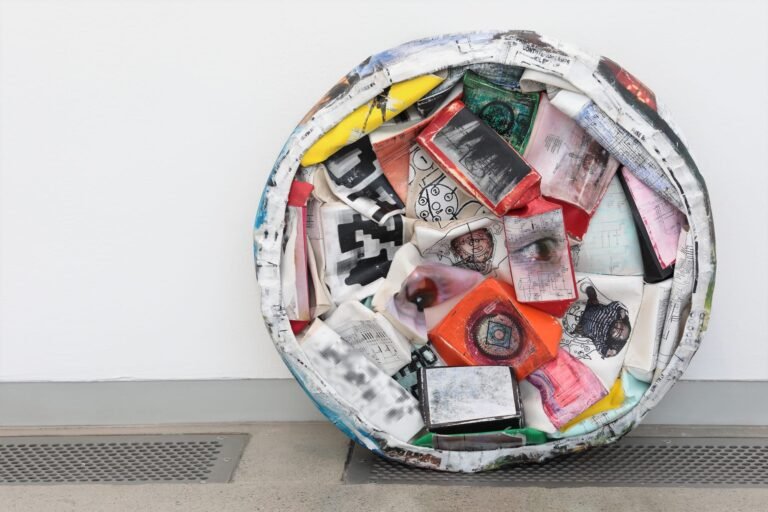

On the top floor of Buffalo AKG Art Museum’s Gundlach Building, a vast body of work from 58 artists comes together for Let Us Gather In a Flourishing Way. The impressive ensemble is both a survey of contemporary Latinx painting and a lively dialogue between a spectrum of artists with diverse backgrounds, experiences, identities, languages, and creative mediums.
Let Us Gather In a Flourishing Way is a major exhibition that has slowly unfolded over the course of several years. Curator Andrea Alvarez—the architect and driving force behind the project—has spent much of this time immersed in research and collaborating closely with each artist throughout the process, refining every detail of the show.

The exhibition’s title alludes to former U.S. poet laureate Juan Felipe Herrera’s titular poem. Oscillating between English and Spanish while employing lush imagery of flora and fauna, the poem itself—like the survey—is an exuberant celebration of community and cultural convergence. He writes:
cielo de calor and wisdom to meet us
where we toil siempre
in the garden of our struggle and joy
let us offer our hearts a saludar our águila rising
freedom
The show traces this poetic rhythm in its spatial design. Herrera’s stanzas greet visitors at each entrance and throughout its galleries, establishing tone and providing context for what lies ahead.
Although the exhibition is organized into seven themes, Alvarez highlights its intrinsically flowing nature, noting that even if the collection were rearranged, the show would still hold together. In a walkthrough, it became clear that space was central to the viewing experience, leaving room for visitors to engage with the works on their own terms, much like the exhibition’s overarching focus on gathering and bolstering free-flowing conversation.

In Moises Salazar Tlatenchi’s “Cruising Queens,” a boat of five faceless figures and an American flag sail icy waters. Reminiscent of 18th-century America, the figures wear powdered wigs and tricorne hats. Finished with a dense layer of glitter and a daintily crocheted lavender frame, the artist’s glamorous materials—and the existence of brown figures in this context—subvert American history. “Cruising Queens” is placed within the exhibition’s New Histories section, which focuses on retelling personal, cultural, and global histories.
Colossal readers might also recognize Eamon Ore-Giron’s tessellated abstractions in “Talking Shit with Ilapa (variation I),” Guadalupe Maravilla’s mixed-media techniques in “Pipusa Retablo,” and Firelei Báez’s vibrant portraits bursting with floral motifs in “Mawu-Lisa (I build my language out of rocks).” Known for deconstructing colonial structures within her work, Báez turns toward the transatlantic slave trade, invoking deity Mawu-Lisa, a critical figure in the culture and religion of the Fon people in West Africa, who were brought to the Caribbean by force.
Bodies & Figures denotes another section of the show, highlighting “representations of and by marginalized people, considering the importance of the body, and who is or isn’t seen in an image,” the catalog says. One such work is Salomón Huerta’s triptych of untitled canvases. Through the absence of figurative human subjects within the paintings, visitors experience an intimate representation of the artist’s father.
“Huerta’s father protected the family in their home in Ramona Gardens, a violent housing project in East Los Angeles,” the museum label reads. “At night, he would set his .38-caliber revolver on the bedside table and ask Huerta to bring him a snack—often a concha or a glass of milk.” Disrupting expectations of traditional portraiture, the artist evokes something that feels deeply tender and human-centered—without the presence of a body.

At the same time, Let Us Gather In a Flourishing Way begs the question: how do identity and place shape each other? Los Angeles-based artist Alfonso Gonzalez Jr. turns to the rich visual language of signage. A meticulous technique passed down from his father’s professional career in commercial sign painting, Gonzalez has developed an enduring relationship with East Los Angeles’ emblematic advertisements and billboards, often reflecting Chicano culture. In “Abogados Tierra Caliente (Billboard),” the artist underscores the inherent connection between local landscapes and one’s selfhood, and an interesting relationship emerges between public commercial objects, personal portraits, and the museum itself.
Chicago-based Yvette Mayorga’s strikingly pink composition, “The Brunette Latinx Self Portrait After Francois Boucher’s “The Brunette Odalisque” c. 1745,” is affixed to a wall in the show’s cluster of Pinturx works, which are described as “contemporary Latinx approaches to traditional painting genres like still life and portraiture.” The artist’s distinctive technique of piping acrylic paint embodies themes of labor, femininity, and memory. Mayorga’s unconventional methods are an example of newer approaches to portraiture and complement the artist’s nods to Baroque and Rococo art.
Included in this grouping of nontraditional painting methods are other artists previously featured on Colossal, such as Sarah Zapata’s textile columns, made from handwoven cloth and various fibers. Installed leaning against a wall or protruding downward from the ceiling, her structures convey instability—a reflection of the current climate we find ourselves in. Narsiso Martinez also makes an appearance with “Checker Leading the Crowd,” made with charcoal on his distinctive cardboard produce box background, calling attention to labor.
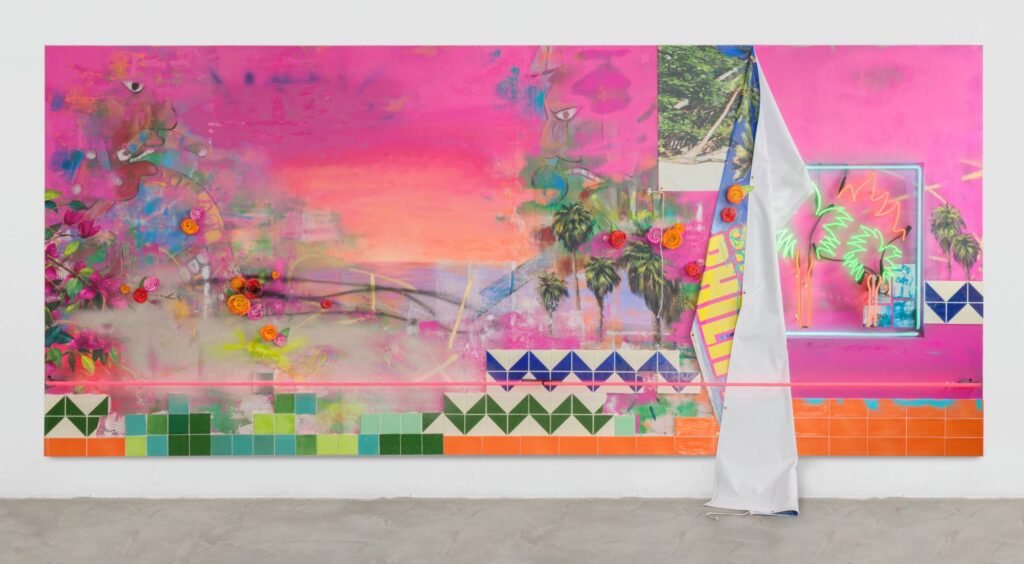
In an anchoring room of the exhibition, “Promised Land” by Patrick Martinez spans 16 feet wide, redolent of a landscape’s sweeping view. Acrylic, neon, stucco, spray paint, and ceramic tile are just some of the layers that sit atop each other in the mixed-media work. Martinez ruminates on his native Los Angeles and the facade of “paradise” amid an ever-changing cultural landscape marked by gentrification and financial marginalization. Abstracted and washed-out structures, spray-paint marks inspired by graffiti, and an archival family photo collage represent the passage of time and the act of constantly rebuilding. “Promised Land” is part of the exhibition’s Land/tierra section, which highlights “Latinx approaches to landscape and the built environment, thinking about land and tierra and their rapid change.”

As a whole, the boundary-pushing exhibition comes together in a chorus of dialogues, mediums, backgrounds, and experiences. The Caribbean and Latin American diaspora is complex, and each artist remains distinct—resisting an external flattening into a monolithic identity. Let Us Gather In a Flourishing Way is a celebration of contrasts and connections and a necessary counterbalance in the glaring face of division.
The exhibition is on view through September 6, when it will travel to the Des Moines Art Center, the Phoenix Art Museum, and the Frye Art Museum in Seattle. Public programming—workshops, artist talks, tours with poet Juan Felipe Herrera, and more—is slated to accompany the show’s run, so keep an eye out for events on the museum’s website.


Do stories and artists like this matter to you? Become a Colossal Member today and support independent arts publishing for as little as $7 per month. The article ‘Let Us Gather In a Flourishing Way’ Convenes 58 Artists to Survey Contemporary Latinx Painting appeared first on Colossal.