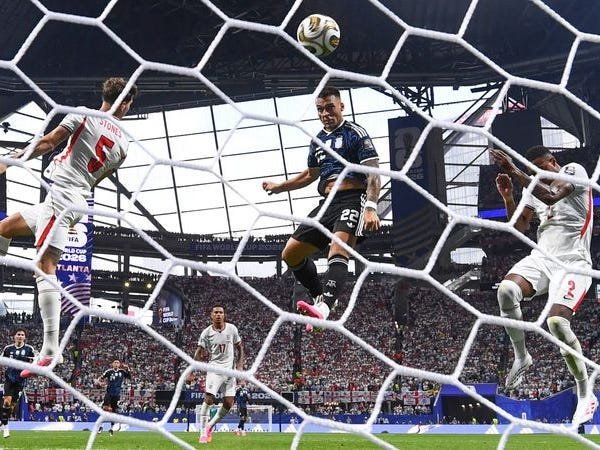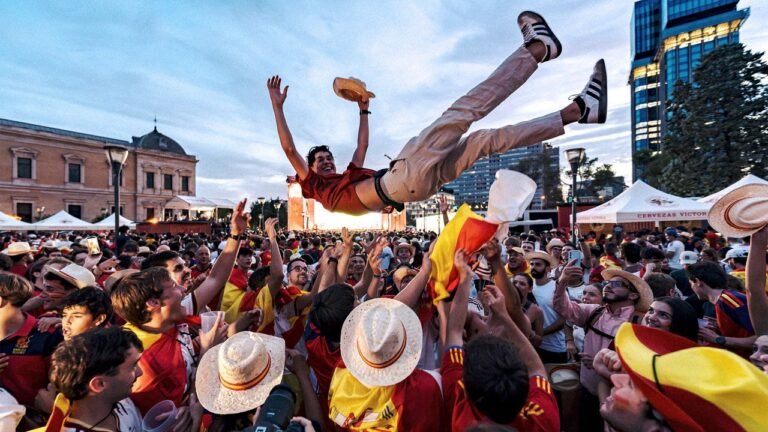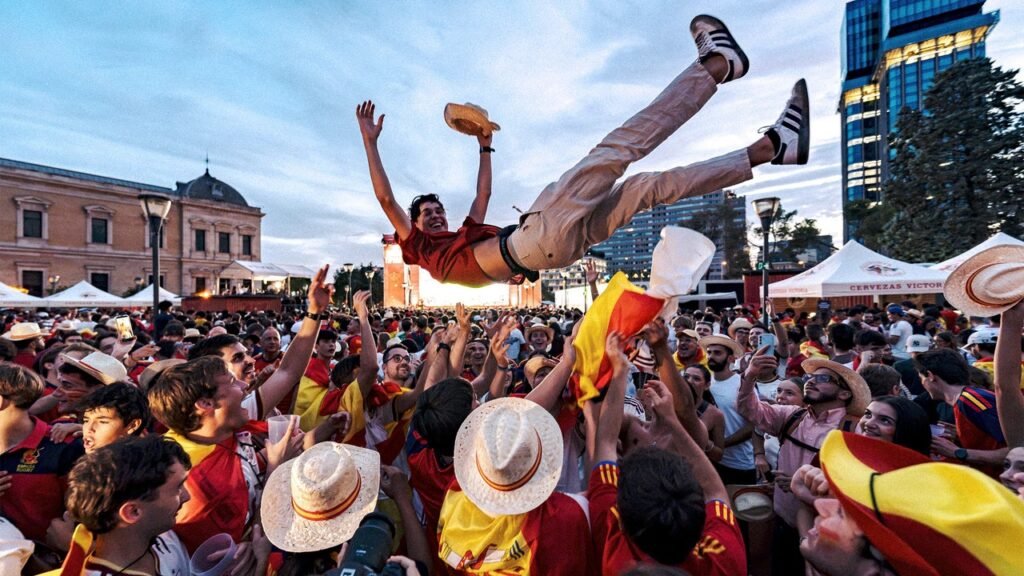
Madrid, the other city that never sleeps, is more awake than ever for the 2026 World Cup final between Spain and Argentina, which will be broadcast from New Jersey today.
Even in the middle of July, with the town feeling almost empty because everyone’s either on vacation or escaping the scorching summer temperatures, there’s an electricity in the air.
The streets may seem deserted, but people are filling terraces, bars, cafés, markets, plazas, and parks, excitedly talking about the second time in history that Spain has reached the final of the biggest sports event on the planet.
And yes, some will argue that it doesn’t matter whether the city is taken over by hordes of Pope Leo, Bad Bunny, or Taylor Swift fans, there will always be Madrileños gathering together to enjoy tapas and cañas. I admit that my people will go out and buzz even if it’s the beginning of the end of the world. It’s a city that lives out.

This is especially true with football. Or fútbol. Futebol. You know, soccer. Whatever you want to call it. It’s woven into the corazón of the inhabitants of this metropolis. It is, after all, the home of the greatest team in soccer (I’m biased). What do you expect? Whenever there’s a big game, people congregate in bars and cafés like matter around a black hole.
But this time is very different. This isn’t just a big game. This is The Game. It’s a feeling that unites everyone, even in a moment of political division. On Friday, as I walked toward the Plaza de Colón, I spoke to random passersby.
“Yeah, we will go to Colón,” two Gen Zers—Javier and his girlfriend, Rosa—told me in Paseo de la Castellana, the main avenue that connects the city north to south. “I will go, too, with my friends,” chimed in twenty-something Nuria, who, like us, was waiting for the bus.

They’re too young to remember the 2010 World Cup final in South Africa, they told me. But I remember exactly where I was when Spain won its first estrella. Sadly it wasn’t here, but in New York.
I was in good company, with my friends Omar and Gema, at their home, watching along with other Spaniards, when a brilliant player called Andrés Iniesta scored what we collectively refer to as el gol de nuestras vidas (the goal of our lives). I remember screaming with pure, overwhelming joy.
I also remember the wave of red that took to the streets of New York that day: Thousands of Spaniards wearing La Roja jerseys seemingly came out of nowhere and ran toward Union Square and the nearby La Nacional, the historic Spanish Association of New York on 14th Street between 7th and 8th avenues.
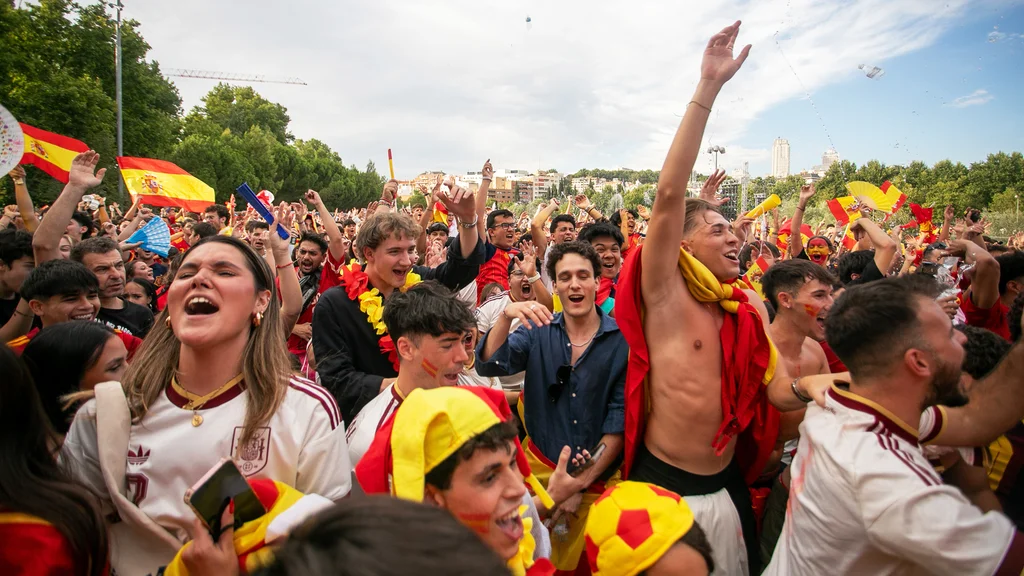
And I remember how I called my dad, who fortunately lived to see the event of a lifetime. I cried like a baby then, like I cried later watching my fellow Madrileños screaming on the streets, watching the game on giant screens in a collective climax.
City of fútbol
This time I’m getting ready to watch the game with my own son in the food court of the Santiago Bernabéu stadium, one of the hundreds of public venues that will hold free parties.
All the bars and cafés in the city are hosting, too, thousands of which have installed screens just for the World Cup final. The Bernabéu has huge wall-to-wall 4K LED screens, with people congregating around the different spaces while enjoying the offerings of some 20 food stands.
There will also be about 15,000 people by the Manzanares, the river that crosses Madrid, the site of a major restructuring and restoration that has made the riverbank one of the best spots to watch the game. The city has installed two large LED displays near the historical Puente del Rey (Bridge of the King).
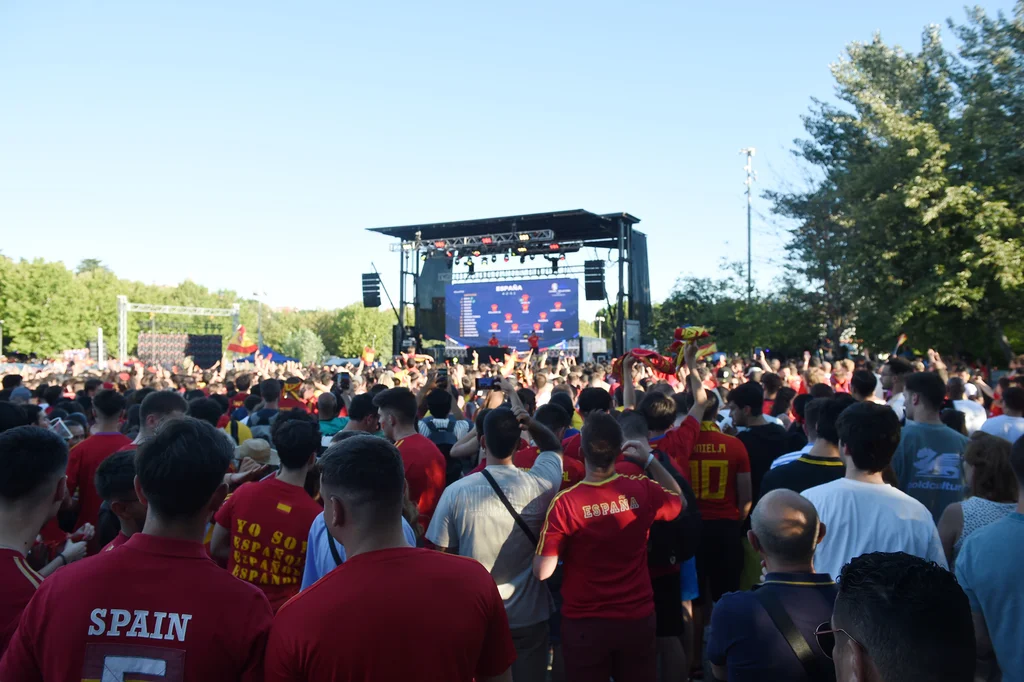
Another stadium, the Movistar Arena, has been readied to accommodate some 15,000 fans, featuring a massive central screen measuring approximately 52.5 by 29.5 feet.
There are many other venues and plazas that will host people, both in Madrid and in the nearby cities, but Plaza de Colón, home of the largest Spanish flag in the country (measuring more than 3,000 square feet) and now featuring a multiscreen setup, will be the main destination.
At the start of the tournament, the plaza accommodated about 6,000 spectators. But as Spain advanced, the area expanded to fit roughly 20,000 people by closing adjacent sections of Castellana. A newly added secondary screen pointing toward Calle Génova will serve the overflow crowd who can’t get into the square.
What can go wrong
There are only two things that can ruin the party at Plaza de Colón. The first is the temperature. If it triggers an official “orange alert” (near or exceeding 102.2 degrees Fahrenheit), authorities will suspend the viewing and urge fans to seek air-conditioned indoor alternatives, a protocol already enforced earlier in the tournament when Spain played Saudi Arabia. The last time I looked, the daytime temperature was expected to be about 100 degrees.
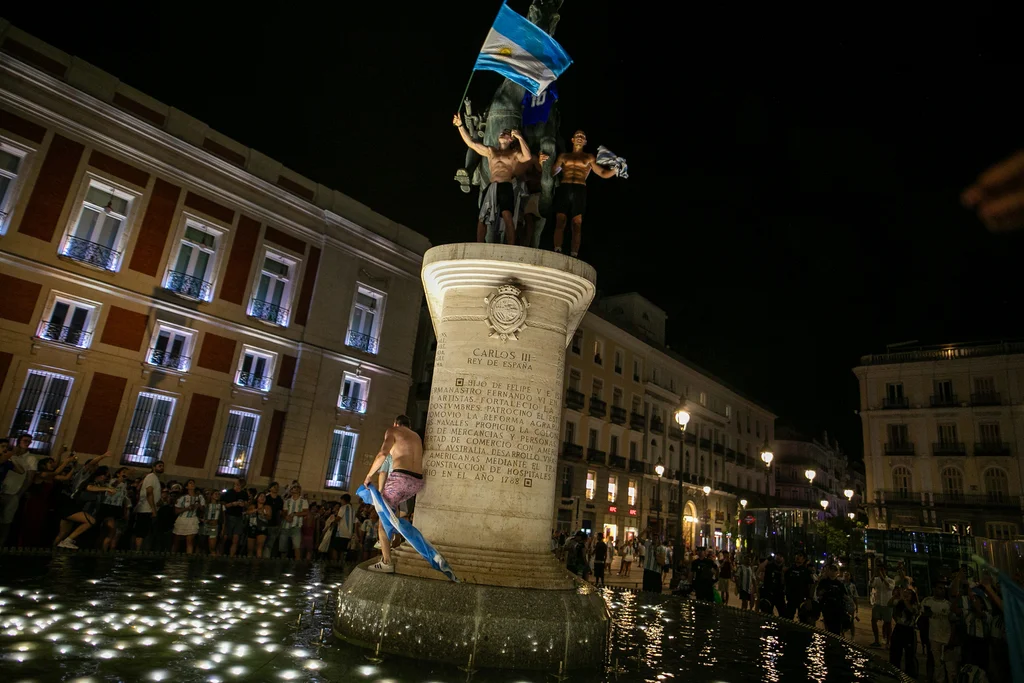
And speaking as a Spaniard, the other thing that can ruin this party is a throng of Argentineans. There are about 60,000 nationals in Madrid. And they’ll be cheering for their team not only against Spaniards but seemingly against the entire world.
Madrid is as welcoming to strangers as New York City, so much so that people say nobody who lives in Madrid is actually from Madrid. But I suspect the Argentineans will not be watching at the Plaza de Colón or any other public venue. My friend Cristina, who owns a bar called Meseta in the southern Madrid district of Usera, said: “I told my Argentinean clients that they should find themselves another place to watch. They went pale!”
It doesn’t matter. Whatever happens, it will be memorable. For me, at least, because I’ll be with son celebrating his country’s first World Cup final like I couldn’t do with my dad 16 years ago. That’d be enough. And if they win, well . . . I don’t know what I’m going to do with myself after bawling my eyes out.