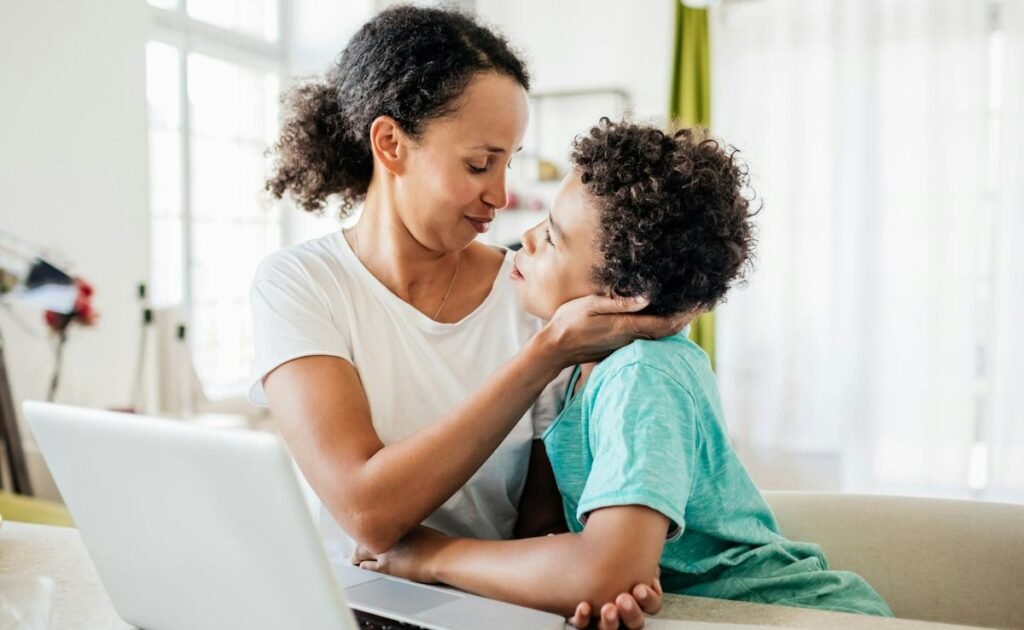
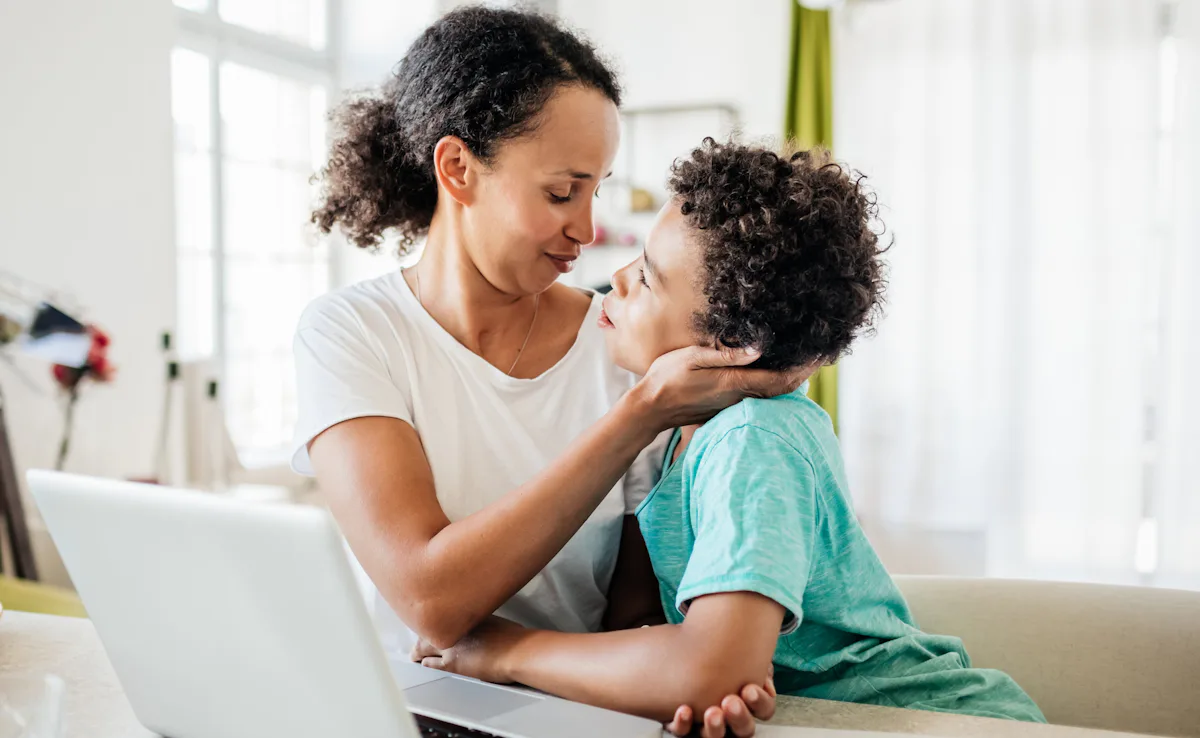
As a little kid, I remember whining to my mother that I was bored and asking her to play. Her answer was always simple: “I don’t play, but if you want to snuggle and read or do a craft, we can.” Recently, I asked my mom about this, and she laughed. “Playing Barbies was like torture to me.”
I never took her boundary as a lack of love or attention, especially because she was always willing to engage in her own form of play, which included crafting, baking, snuggling, and reading. I knew if I wanted someone to play with, I had to ask a sibling, figure out how to entertain myself, or talk my dad into playing a thrilling round of our family game, “Monster.” (Don’t ask.)
While I love my mom’s firm boundary, lately I’ve been feeling guilty when my youngest, who is 3, asks me to play with him. His older siblings are at school, and I work a lot during the day, so giving him my full focus to do what he wants — whether that is playing catch, building a marble run, or constructing a Magna-Tiles fort — feels like an important way to connect.
So I turned to some experts to answer the question: Do we really need to play with our kids? If so, for how long and how often?
Yes, play matters… but that doesn’t mean you need to play hours of Barbies or Hot Wheels
The answer is nuanced.
Play is essential to a child’s development. They learn to communicate, problem-solve, emotionally regulate, and develop creativity, says Dr. Sasha Hall, a senior educational and child psychologist.
When a parent joins in, kids can benefit from the communication practice and the experience of having their parent’s full attention. But that doesn’t mean a parent needs to get on their creaky knees and push cars around the living room.
Instead, Hall recommends making sure you’re noticing your child. Are you responsive to their needs? Do you offer them your attention? Are you interested and emotionally available? Secure parent-child relationships, she says, happen when a parent is the magnificent three: responsive, predictable, and safe.
This rings true of my experience. Because my mom was good at offering me attention, I could get over the fact that she wasn’t interested in taking Barbie and Ken to the ball.
But sometimes, entering their world matters
I recently read this book called Ambitious Mother: From Surviving to Thriving in Your Career and At Home by Dr. Anne Welsh, a clinical psychologist and mom of four, who recommends spending around 15 minutes a day doing a child-led activity with your kid. The idea is loosely based on Parent-Child Interaction Therapy (PCIT), an evidence-based treatment that teaches parents to set aside a small chunk of focused time with their kids.
But what happens when you have multiple kids? Or your days are wickedly busy? How are you supposed to squeeze that in on top of all your other plethora of responsibilities?
Because I didn’t want to turn this into another guilt trip on my motherly conscience, I reached out to Welsh to ask how she manages this with four kids as a busy working mom. She explained that she doesn’t always do it one-on-one, but might engage with two kids at a time. If one of her children is struggling, this kind of connection time is the first thing she returns to.
Don’t beat yourself up trying to eke out 15 minutes a day if you don’t have it. In formal PCIT, parents actually practice just five minutes a day of child-directed “special time,” while other parenting approaches use anywhere from five to 15 minutes. The point isn’t the number, Welsh says. It’s creating a pocket of time when you’re completely present.
“I would much rather parents practice clear unavailability followed by real presence than spend the whole day offering half-attention while feeling guilty that they should be doing more,” Welsh says.
I’ll admit, that stings. Because I’m good at half-heartedly engaging with my kids when my mind is elsewhere, or worse, I’ll try to hide the fact that I’m sending an email. The awful thing is that my kids know it and call me out on it: “Mom, you’re not listening to me!”
So, what’s a parent to do?
Connection can happen through simple tasks
Hall and Welsh also agree that it’s less about what you’re playing and more about making time to connect, distraction-free, with your kids. And this doesn’t have to involve “play.” Cooking and baking, gardening, taking a walk, chatting in the car, swimming, and even doing chores together are all good ways to bond.
“Sometimes we overcomplicate connection,” Hall says. “A child does not need to think, ‘My parent played with me every day’ to feel loved. They need to experience repeatedly, ‘My parent knows me, notices me, responds to me, and I matter to them.’”
Welsh says this is a big part of her parenting too. She frames it as the chance to spend distraction-free time entering her children’s world with them. “One of the biggest things a child is getting is the experience of mattering,” Welsh says. This signals to them: “Your ideas are interesting to me. Your preferences matter. You have something worth showing me. I delight in knowing you.”
Your kids actually need to play without you, too
Making kids play by themselves is good for them, too. Independent play gives children opportunities to entertain themselves, solve problems, and stay with an activity without an adult constantly providing the ideas, says Hall.
If you do join in, she says it’s important to let kids remain the leader. “Young children still need supervision appropriate to their age and circumstances, and they need to know that an adult is available. But being available is not the same as being involved in everything.” (Aka, we aren’t their playtime directors.)
Sometimes we confuse good parenting with good entertaining
We are inundated with parenting advice these days, with an exhausting list of things we believe we need to do to be “good parents.” But we don’t need to be full-time entertainers, and children need to experience boredom and learn how to entertain themselves.
There’s being present and being entertaining, says Hall, and that distinction matters.
So, let us build our Frank Lloyd Wright-inspired Magna-Tiles houses or take our Barbies to the grand ball. Or not. Because it’s less about whether we play, or for how long, and more about making time for connection.