One of NASA’s strangest, most daunting missions just wrapped up – and its crew didn’t even leave Earth’s atmosphere.
Four crew members emerged over the weekend after spending a full year cooped up inside a 1,700-square-foot habitat designed to perfectly simulate life on Mars. The mission, stationed at Johnson Space Center in Houston, is the next best thing to a real mission to Mars, giving scientists an opportunity for a lower stakes run-through without the extreme risks posed by the red planet.
The CHAPEA (Crew Health and Performance Exploration Analog) mission kicked off on October 19, 2025 and was the second of its kind, following a previous isolation mission that ended in 2024. This time around, four crew members spent a total of 378 days in a facility extruded by an enormous 3D printer that was crafted to resemble a real-life Martian habitat, complete with living areas, work spaces, and even the capability for simulated spacewalks.
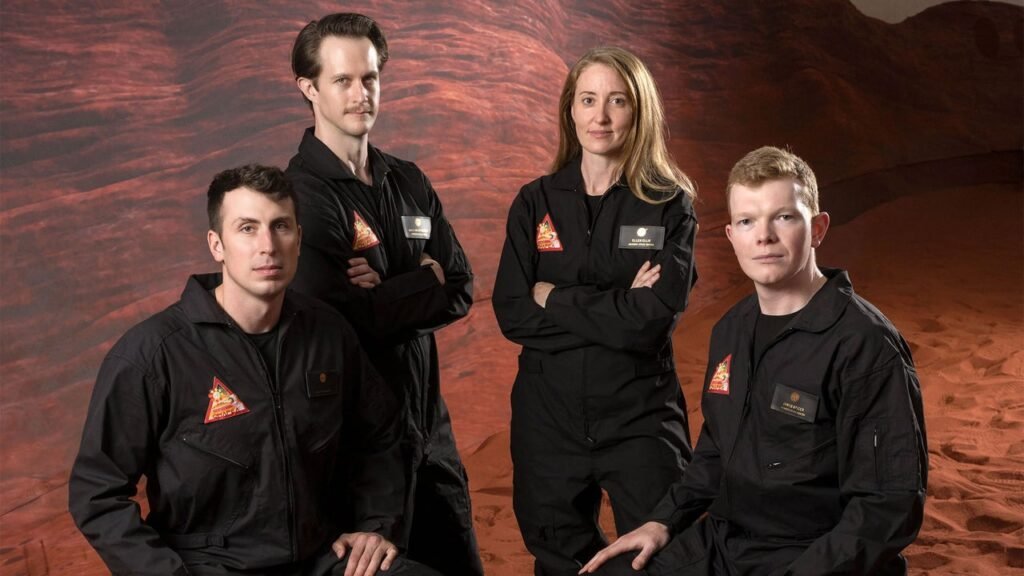
The brave souls willing to boldly go into confinement in the name of science included medical officer Ellen Ellis, mission commander Ross Elder, science officer Matthew Montgomery, and flight engineer James Spicer.
“To my crewmates, it’s been a hell of a year – analog astronauts living in captivity of our own free will,” Ellis said in a press conference after emerging from the habitat. And their work isn’t done yet, with the crew members scheduled to spend two weeks debriefing and undergoing evaluations after the unusual experience.
Staying busy on Mars
Spending a year stuck inside a Mars simulation isn’t everyone’s idea of a good time, but the crew members had plenty of tasks to complete and were studied every step of the way. While the CHAPEA mission lacked the array of life-threatening complications astronauts would encounter on a real trip to Mars, the team at NASA simulated those too.
At various points during the yearlong staycation, the crew faced “environmental stressors such as resource limitations, isolation, equipment failure, and significant workloads” – plenty to keep a crew of four busy for a year in a faux Martian habitat. “We are extremely proud of the crew for their commitment and achievements over the last year on such a fast-paced, highly demanding mission,” CHAPEA principal investigator Grace Douglas said in a press release prior to the “egress ceremony” on October 31.
The isolation might have been the most daunting task of all. During their time in the habitat, the crew members were only able to speak with family members over email, and even that process came with a built-in delay meant to simulate real communication times between the Earth and Mars.
Beyond the 140 million miles of distance from Earth, future astronauts sent to Mars will also grapple with the planet’s toxic carbon dioxide-rich atmosphere and its freezing surface conditions, among the myriad other logistical challenges and deadly resource puzzles inherent to sustaining human life beyond our pale blue dot.
“This mission has been incredibly valuable in starting to teach us how to understand requirements for year-long missions, including medical and psychological care, via communication delays,” NASA Human Research Program Chief Scientist Michael Stenger said as the mission neared its end.
“When combining this Mars-realistic mission analog with a suite of physiological, psychological, and performance measures in a rigorously controlled environment, we’ll be able to translate the knowledge from these experiences to Moon Base and beyond.”