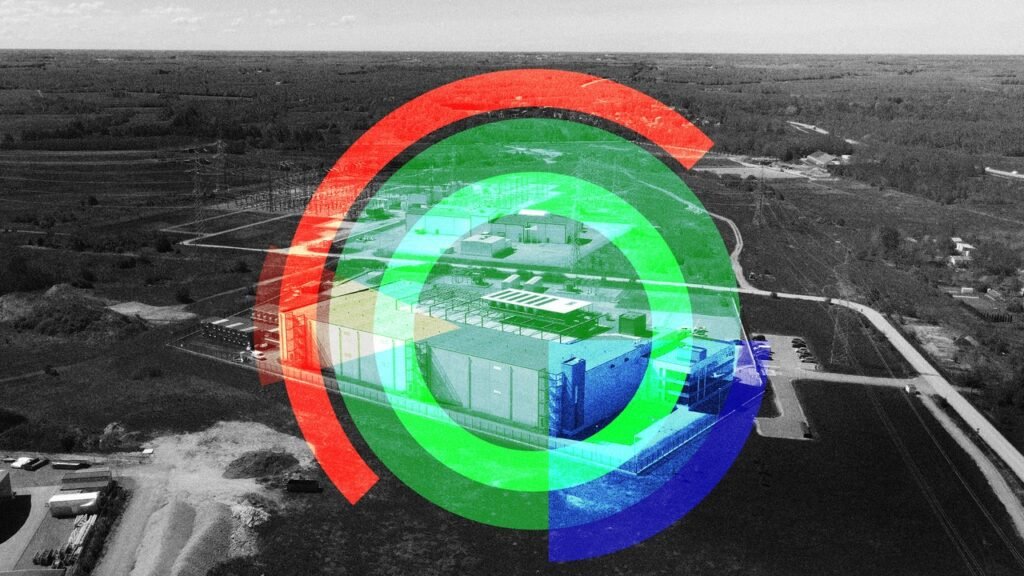
Arnco-Sargent Elementary School sits in a wooded area on a two-lane road about 50 miles south of Atlanta. Across the street is a child care center. A Baptist church is less than a mile away.
But if developers get their way, the school’s newest neighbor could be a sprawling data center campus housing the networking infrastructure needed to help power Americans’ reliance on the internet and, increasingly, artificial intelligence.
Families, some who have lived in the area for generations, are opposed, concerned about traffic, noise, water quality and other adverse effects. In April, the Coweta County commission rezoned 832 rural acres to accommodate the industrial development. Project Sail, as it’s called, could be under construction for the next 10 years.
“I have a first grader. He’ll be in high school by the time it’s even finished,” said Laura Beth, whose tree-lined property backs up to the proposed site. “This will be his whole childhood.”
She chairs Citizens for Rural Coweta, which is suing the county to stop the project, while also leading a petition drive to get a referendum against it on the ballot. The battle is one of several nationwide in which the rapid expansion of these hyperscale centers is colliding with the daily lives of public school families and staff. Americans depend on data centers to work, shop, and learn. Despite the recent backlash to edtech, one research firm estimates that the global market for AI in education will grow to more than $136 billion by 2035.
As demand surges, tech companies look for land that is relatively close to customers and existing electricity and water sources.
“The closer data is stored to the people and systems relying on it, the faster it loads—a benefit that touches everything from healthcare to the classroom technology students and teachers use every day,” said Dan Diorio, executive vice president of state policy and government affairs at the Data Center Coalition, a membership organization.
But with concerns about energy use and environmental impacts, local governments—and New York state—have placed moratoriums on new data centers, and opponents say officials should restrict building near schools and residential neighborhoods.
“I would like to say our situation’s unique,” Beth said. “It hurts me that it’s not.”
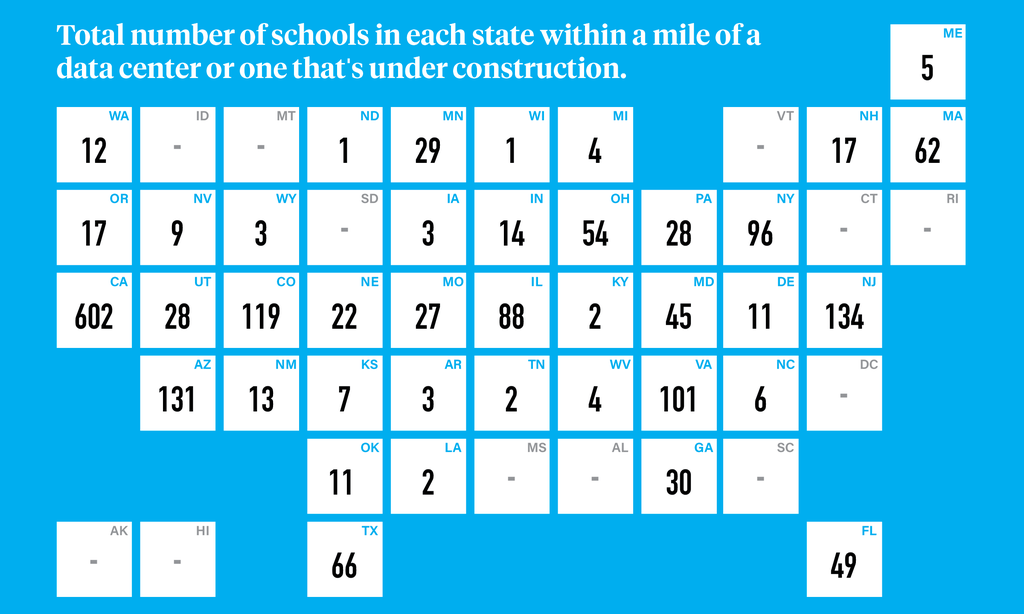
Nationally, 1,878 public schools sit within a mile of at least one data center or a future facility that is approved for construction, according to researchers at Brown University. Shared exclusively with The 74, the analysis of data from Business Insider and the National Center for Education Statistics shows that California has by far the largest number of schools close to data centers or buildings in progress: 602, representing 32% of the nation’s total.
Ahmed Saeed, an assistant professor in computer science at Georgia Tech, said the infrastructure that data centers rely on is more widely available near population centers. But because dense urban areas don’t have enough affordable land, developers often gravitate to suburban and exurban areas.
“As the number of data centers continues to grow, it becomes increasingly likely that some will be located near schools and residential neighborhoods,” he said.
The latest construction boom, fueled by advancements in AI, is fairly recent, so researchers know little about the long-term effects of attending school near a facility. The Brown team, however, will soon release research showing that math scores are lower among students whose schools are closer to a data center. Companies say they take measures to minimize disruption, like planting trees to absorb sound, and some argue the downsides are minimal.
‘This buzzing noise’
School district leaders are among those who say data centers pose too many risks to ignore.
“AI is not going anywhere,” said Marcia Andrews, a school board member in Palm Beach, Florida. “My biggest concern is that these data centers should be far enough away that it doesn’t harm the community, it doesn’t harm the schools.”
The Palm Beach County commission agreed. In July, members rejected Project Tango, a 202-acre development near the Arden subdivision that would have been “just a football field away,” from Saddle View Elementary School, Andrews said. The vote, however, leaves the door open for the developers to revise and resubmit their plans in the future. Andrews, whose district includes Saddle View, grew curious about the site when she saw crews widening the roads and planting palm trees.
“People across the country are waking up now saying, ‘My gosh, we never dreamed that we would hear this buzzing noise 24/7,’ ” she said.
One frequent complaint against data centers is the sound coming from cooling systems, fans, and generators. In Michigan, a resident likened it to a jet engine. Another in northern Virginia, known for having the heaviest concentration of data centers in the world, said the inescapable humming makes him “want to curse.”
A 2022 study from a former NASA safety manager and planning commissioner in Prince William County, Virginia, predicted that classroom noise from data centers near schools would likely exceed recommended levels. A separate legislative study in the state found that the sound is “generally quieter than a lawn mower or nearby conversation,” said Diorio with the Data Center Coalition. But opponents there often share a quote from a mother at Chris Yung Elementary who said her child wouldn’t go outside for recess because of the sound.
Many data centers use diesel back-up generators, which would be like “a bunch of semitrucks idling right next to the school,” said Jessica Owens, director of data at Science for Georgia, a nonprofit. “Would you want your child in a facility next to a place that’s emitting pollutants, especially in the South when we have heat waves that exacerbate those pollutants?”
Noise, she added, would impact a school within a mile, but research shows they also create “heat islands” that can extend up to six miles.
The closest Project Sail building would be about 1,000 feet, less than a fifth of a mile, from Arnco-Sargent Elementary “with setbacks, tree buffers, berms, and other screening incorporated into the design,” said Mattie Sorrentino, a spokeswoman for Prologis, the company behind the Coweta County project. The site is well suited for the data center, she said, because of its proximity to Plant Yates, a Georgia Power facility.
The company “will meet or exceed every requirement,” she said. “Our goal is to keep the project out of sight as much as possible.”
‘Impact on achievement’
Even if students can’t see a data center from the playground, their learning may be at risk.
In their forthcoming paper, the Brown University researchers will show that students who attend school within a mile of a data center have lower math scores than those who are farther away.
“You can rule out all other factors,” said Samantha Kane, a research associate who is part of the university’s Sustainable Education Research Initiative. “It’s actually the proximity to the data center and the potential pollution coming from the data center that is having the impact on achievement, and not other things about the region.”
Critics often point to water use as one way data centers put a strain on local resources. Early estimates said Project Sail would use 6 million to 9 million gallons per day. Now Prologis says it would draw up to roughly 300,000 gallons a day from the Chattahoochee River, and some comparisons from 2023 show data centers use far less water than other industries, like golf courses.
To reduce dependence on the local water supply, Project Sail would use what’s called a closed-loop cooling system. But there are still tradeoffs. To keep the hardware inside from overheating, those mechanisms are “blowing hot air into the area and increasing the temperature” as much as 16 degrees, said Owens at Science for Georgia. If there’s already a heat wave, kids might get less recess time outside. The soaring temperatures also increase pressure on the power grid as residents, businesses, and schools crank up the air conditioning to stay comfortable.
In Virginia this summer, officials in Henrico County, home to 37 data centers, asked the school system to help cut energy costs that are expected to increase by $5 million. A district spokeswoman, Eileen Cox, said the system, with 81 schools and more than 50,000 students, already takes a “proactive approach” to conserve electricity, like setting thermostats higher and operating a four-day workweek during the summer.
The state, however, just enacted an electricity consumption tax on data centers to offset some of the decline in revenue from tax breaks. Attractive exemptions from state and local taxes also make Georgia a preferred site for the industry. At this point, it’s unclear how many data centers are operating or proposed in Georgia, but Arnco-Sargent isn’t the only school in the state near land eyed by developers.
Closer to Atlanta, residents in Lovejoy are petitioning against a facility that would potentially sit between Michelle Obama STEM Academy and Eddie White Middle Academy.
The site plan envisions about 3.5 million square feet (equivalent to 60 football fields) and 15 buildings of data center space on at least 400 acres, said Clayton County Commissioner Tashé Allen, who has scheduled a community meeting for this Saturday.
The community, she said, “naturally has serious, legitimate questions about the cumulative, long-term impacts.”
Traffic concerns
Schools in the vicinity of these facilities can feel the effects even before sites start operating. An elementary school in northeast Louisiana shut down its playground last year to protect students from the thousands of cement trucks and 18-wheelers traveling every day to what is expected to be Meta’s largest data center. There were at least three truck crashes last year, and one smashed into the school’s gate.
For Project Sail in Georgia, Prologis agreed to some road improvements as a condition for the rezoning. Sorrentino, the company spokeswoman, said construction trucks would be routed away from the school and when finished, the project would “generate limited traffic.”
But families are still worried. The intersection that parents and school bus drivers navigate for drop-off and pickup every day doesn’t have a traffic light.
The school has a long history in the community. Now 70 years old, Arnco-Sargent consolidated two older schools that used to serve children from local mill villages. But in 1996, the area’s leading textile company went bankrupt, families moved away and the area, Beth said, has never prospered like other parts of Coweta County. Nearly 60% of the school’s students live in poverty.
“These people are just trying to make a living,” she said. Compared with those who protested against the Palm Beach project, Arnco-Sargent parents perhaps have been less outspoken. “They don’t have time to go to a meeting at 6:00 on a Tuesday. They’re working and have young kids.”
But Beth is hopeful. At the first signature-gathering event, cars lined up for miles as residents waited to sign the petition. “The organizers have nearly reached their goal of 14,000 signatures.
“I feel that this is what it took for the county to listen,” she said.
This article was also published at The74Million.org, a nonprofit education news site.