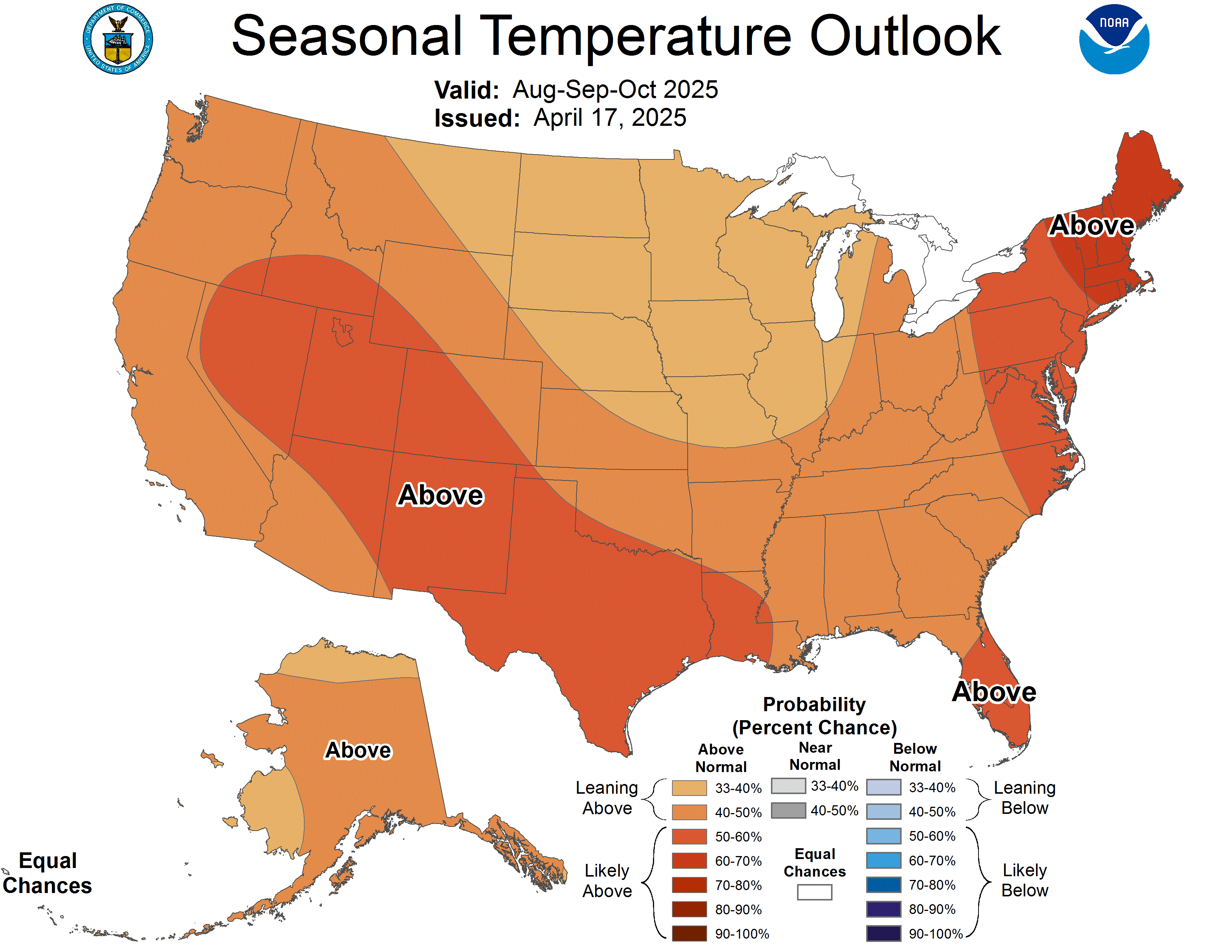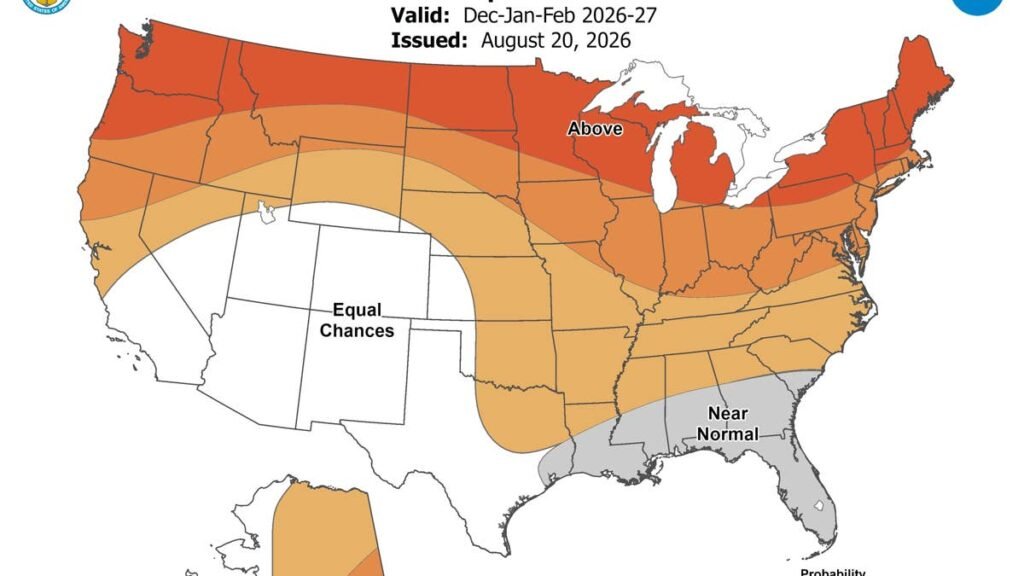
The Climate Prediction Center’s outlook covers December, January and February, the three months that make up meteorological winter, and it lands with El Niño still strengthening in the Pacific.
For drivers that is not the good news it sounds like. A winter that hovers near freezing rather than settling below it produces more ice and worse pavement than a cold one.
What the Map Shows
Most of the country is shaded for above-normal temperatures on the seasonal outlook, and the shading is deepest across the northern tier, from Washington and Montana through the Dakotas, Minnesota, Wisconsin and Michigan into northern New England, where the probability reaches 50 to 60 percent. No part of the Lower 48 is shaded for below-normal temperatures.
Two areas escape the warm lean. Nevada, Utah, Colorado, Arizona and New Mexico are left white, which means equal chances, with no preference between below, near or above normal. The Gulf Coast and Florida are shaded near normal. Those five states are the closest thing on this map to a cold forecast, and nowhere else in the Lower 48 has better odds of finishing the season below its own normal.
One limit is worth stating. The map measures each place against its own normal, not against the rest of the country, so Minnesota in the warm band will still be colder in December than New Mexico in the white one. The current version was issued on August 20.
The Four Corners Is the Region Left in Play
The five states holding equal chances are also home to some of the country’s highest-elevation roads, including long stretches above 7,000 feet, which is why a cold lean there matters more than the same lean would in Kansas. Colorado already runs its Traction Law on the I-70 mountain corridor from September 1 through May 31, and the other four states have plenty of high-elevation road of their own.
The Gulf Coast Has Its Own Winter Risk
The grey band from Louisiana across Mississippi, Alabama and southern Georgia into the Carolina coast is the other place the map declines to call warm.
A strong El Niño typically pushes the storm track south, which can send more moisture across that band through the winter. Cold air does not have to be unusual for that combination to produce ice. It only has to arrive on the wrong night.
That band is also where most drivers run all-season tires year round, and where a single freezing rain event can close interstates that see no snow at all in a normal winter.
What the Freeze Line Does to a Road
Hard cold is not the worst case for pavement. Water that freezes, thaws and freezes again inside cracks is what turns them into potholes, and that cycle runs hardest in a winter sitting near 32 degrees rather than well below it.
Traction works the same way. Deep cold usually means dry snow, while temperatures near freezing mean wet snow, rain on frozen ground and meltwater that refreezes overnight on bridge decks and shaded curves.
All-wheel drive does not help with that. It aids acceleration and does nothing for braking or cornering, which leaves tread depth, tire compound and pressure doing the work. Winter compounds stay pliable as temperatures fall toward 45 degrees where all-season rubber stiffens, and cold air costs a tire roughly 1 psi for every 10 degrees.
The Forecast Behind the Map
The warm signal is tied to a strengthening El Niño, and CPC raised its odds again on September 10, putting a record event at 75 percent for October through December.
The agency’s prognostic discussion calls the warm tilt “supported by calibrated dynamical models and statistical representations of the typical impacts of El Nino,” while noting that impacts become more likely at that magnitude without being guaranteed. The snow signal sits on the precipitation map instead, and it favors the southern half of the country.
What Changes Next
CPC replaces its seasonal temperature and precipitation maps on September 17, and that set will be the first built after the El Niño odds moved. The next ENSO discussion follows on October 8.
Until then the current outlook stands, and it puts the freeze line, rather than deep cold, at the center of this winter’s driving problem.